Tito as an Ottoman agent and how the earth no longer revolves around Serbia

A few days ago, Deutsche Welle ran a short story on my blog entry with funny exam answers I posted a few months ago. I guess the combination of the silliness of some of the quotes and a slow news day meant that the story was picked up by Tanjug, followed by most Serbian media (Vecernje Novosti, Blic, Danas, B92, Kurir, Politika, RT Vojvodina, and Press, including a commentary, and an interview I gave to RTS evening news), some in Bosnia (Radio Sarajevo, Dnevni Avaz, Glas Srpske), Slovenia (Radio Krka, RTV Slovenia), Croatia (Glas Istre, Vecernji List), Kosovo (Gazeta Express), Macedonia (A1, One.net), Montenegro (Vijesti)  and Bulgaria (Vesti). The original article (unsurprisingly) dramatizes the quotes by suggesting that the students are future diplomats. While this might be true (and some, not quoted in my blog post, certainly would be good diplomats), I am rather confident that ones writing about Tito’s wig are less likely to end up in the foreign office. Of course the original post was self-selected by just listing the funniest contributions to over 400 exams over 4 years.

More interesting are the reactions to the articles in the Bosnian and Serbian press (and the comments I have received since). Of course a number suggest that it must have been my teaching which resulted in such skewed exam response. This grossly overestimates my creativity in making up the geography and history of Eastern Europe and the Balkans. Reading through the debates (most comments have been posted on the blic website), I get three different takes on my student quotes.

1. “I would not be surprised if Tony Blair studied at this department…”

The first perspective sees in my student quotes evidence that Western policy towards Yugoslavia, from Tony Blair (above) to another suggesting that the ICJ is as ignorant as the students. Another thinks that “with such students, it is no surprise that they bombed us.” It is of course a creative step from bad student exams to international judges and prime ministers, but this the self-comforting take: We always knew it, the ignorant West mistreated us, if they knew better it would all be different.

2. “For Britain we are like Turkmenistan for us. So I ask you, what we, citizens of Serbia, know about Turkmenistan? … You expect that everything revolves around us.”

A number of comments take a different point of view, as represented by the quote above. They point out that the knowledge of students in Southeastern Europe is not necessarily much better. A comment on Avaz noted that “our students of history  wouldn’t be any better if they were asked about the history of Kyrgystan or Latvia. Nobody studies marginal countries.” Similarly a dear colleague from Serbia wrote to me that some students think the same (maybe less about Algerians in Kosovo, but maybe Tito’s wig?). I think these comments raise the right question. There is strong center-periphery tendency in educational systems. The familiarity of students in Westren Europe about Central and Eastern Europe might be limited (depending of course on where you’re from), but I don’t think an average student from Serbia would know much about Romania or Bulgaria, but know more about France and the UK. I need not to point out that I have also experience rather ignorant views of the West from some students in the Western Balkans.

3.  “The one who mentioned the Ottoman Empire is a pretty clever person. Even in our country people aren’t aware that Islam is slowly colonizing us.”

Finally, a third group see in the quotes evidence of their own conspiracy theories. Thus one person on Blic points out Tito was of course an Ottoman agent by creating the Muslim nation and another concurs as he/she see Islam colonizing the Balkans–I guess confirming the above take on the ability to find confused points of view everywhere–to which a witty reader replied that also gays and aliens are colonizing the Balkans. No further comment needed.

The ICJ Opinion on Kosovo

Reposted from Nationalities Blog.

The ruling has been far more favorable towards Kosovo than most observers have expected. Striking is not only the clear verdict, but also the fact that it was supported by a majority of the judges which give the opinion additional weight. It has been clear since the hearing in late 2009 that supporters of Kosovo’s independence argued on the narrow premise of the legality of the declaration of independence (which is also the scope of the question under consideration), while its opponents sought to widen the opinion to consider the question of secession at large. In its opinion the ICJ has accepted the narrow decision which follows the logic of the court: On one side, it does not want to change international law, especially on the controversial topic of secession, and on the other hand it does not want to offer an opinion out of place with reality, such as declaring the independence illegal when it is clear that it is irreversible. The ruling is far from revolutionary and does not set a precedent in international law: It is clear that declarations of independence are not illegal–their relevance arises from recognition. Whether or not recognition of declarations of independence break international law appears to be a question to be answered another time.

In terms of the implications for Kosovo and Serbia, the opinion strengthens the hand of Kosovo. Probably a number of countries which have been sitting on the fence since the UN General Assembly requested the ICJ opinion just under two years ago are now likely to recognize Kosovo–most importantly they might include one or the other EU member state. However, more significantly neither Russia nor China are likely to recognize Kosovo. As a result Kosovo will be a winner but will have few tangible gains from the decision as UN and EU membership will not be closer. The ICJ opinion does not appear to state that independence of Kosovo is legal thus countries that refrained from recognizing Kosovo due to their own secessionist conflicts are unlikely to change their mind.

Thus, the greatest risk of the ICJ opinion is that as a result there is likely to be little willingness in Kosovo for new talks with Serbia, while hoping that time will play into Kosovo’s hands. And yes, time plays in Kosovo’s hands and Serbia has to clearly define a new policy towards Kosovo, but time without talks with Serbia will not resolve the causes for the deadlock of Kosovo’s state-building project.  However, now there is an opportunity for talks between Kosovo and Serbia: Serbia has exhausted its alternatives and has to come to terms with the reality of Kosovo as an independent country and Kosovo will need to realize that it will not move forward without some kind of settlement with Serbia. Such a settlement would need to include a water-tight promise by Serbia not to impede Kosovo’s UN and EU membership, some face-saving trade-off for Serbia in terms of a role in Northern Kosovo (including border adjustments, although the opinion has weakened Serbia’s argument) and kick-starting Kosovo’s EU integration process. The key challenge will be for Kosovo not to overplay the hand it has been dealt by the ICJ opinion and end up with little more than before.

Dual Citizenship can be a solution, not a problem

I just published a comment with EUDO citizenship blog on dual citizenship for minorities.  Click here for the comment (The full text is below, to see the previous contributions follow link).

Both the Hungarian and the Slovak changes to their respective citizenship laws can hardly be viewed without considerable discomfort: They clearly constitute nationalist and populist moves that seek to re-affirm ethno-national ownership over the state. The idea that citizenship is linked to ethnic identity, irrespective of the place of residence is not only politically troubling, considering the timing before Slovak parliamentary elections, but also in the way Hungary structures itself as a state towards its own minorities. I therefore share the concerns expressed by Rainer Bauböck and Mária Kovács.

At first glance it appears therefore difficult to conceive of potential benefits the amendment to the Hungarian citizenship law might offer. This is even more evident when considering the matter in its broader regional context. As has been mentioned earlier, a large number of European states offer citizenship on the basis of descent or identifying with a particular nation, often with considerable impact on bilateral relations. In addition to Romania and its citizenship offer to citizens of Moldova (based on Moldova having been part of interwar Romania rather than ethnicity, though), all ethnic Macedonians are able to acquire Bulgarian citizenship based a mere declaration (and over 50,000 of them actually have done so), Croats in Bosnia (and according to the numbers also many other Bosnian citizens) have held Croatian citizenship and Serbs outside Serbia (and hypothetically others) can become Serbian citizens by declaring that they consider Serbia as “their state”.

The political and normative problems of these citizenship regimes, some of which Mária Kovács has alluded to, emerge mostly in the country offering access, rather than in the country where minorities with dual citizenship live: Voting rights might bolster populist nationalist political parties and these policies can be understood as defining the countries in question as ethnic democracies with a privileged core ethnic group.

Here, however, our primary concern is with the impact on the country where the minority with kin state citizenship resides.
First, ethnonational citizenship for minorities is often argued to undermine their loyalty towards the state. Compelling as it may seem, this argument does not convince empirically or conceptually. Take the case of Bosnia and Herzegovina. While the vast majority of Croats hold Croatian citizenship, at least until recently only very few Serbs in Bosnia have held Serb citizenship.  Nationalist parties supported by the respective kin states fought for secession during the 1990s. However, support for a common state over secession has been consistently and significantly higher among Bosnian Croats than among Bosnian Serbs. Citizenship of a kin state may be a symbol of limited identification with the country of residence, but it certainly is not the cause for it. As Andrei Stavila has argued, the citizenship offered by a kin state is only partial, even if it includes voting rights. Health care, education and many services, as well as taxation, which define social relations, remain linked to the country of residence – the only exceptions exist in countries with contested sovereignty and parallel systems of service provisions, as in Kosovo.

Second, it is also argued that dual citizenship gives a kin state a free hand to intervene in other countries’ policies towards minorities. One example might appear to be the Russian-Georgian war in 2008 over Abkhazia and South Ossetia. Russia sought to justify its intervention by claiming to protect Russian citizens. Yet, as Peter Spiro has argued elsewhere,  this argument did not gain much credence outside of Russia and there is little reason to believe that Russia would not have invaded had it not generously granted citizenship to inhabitants of South Ossetia and Abkhazia. Problems stemming from dual citizenship can emerge if the kin state and the country where the minority resides do not possess a channel of communication to supplement the citizenship link between the minority and its kin state. However, this only suggests that dual citizenship cannot be the only component for arranging the complex relations between minority, kin state and country of residence.

This leaves the political disputes that might arise between states and minorities over dual citizenship, as is the case in Hungary-Slovakia, as a final point of critique. However, ethnically based citizenship is less the source of contention than a trigger or marker thereof, pointing to other unresolved issues. It is telling that the changes to the Hungarian citizenship law did not trigger similar strong responses in other countries with large Hungarian minorities, such as Romania and Serbia. As a result, the offer of citizenship to ethnic Hungarians by the Orban government was certainly ill-timed and intended to provoke rather than to improve relations with Slovakia, but it does not lie at the heart of tensions.

The critique of nationalist politics should therefore not distract from considering possible benefits of dual citizenship for minorities. I would argue that holding also the citizenship of the kin state can actually help to diffuse conflicts.  It lowers by implication the importance of the citizenship of the country of residence. In reducing its significance, it can diminish contestation over this citizenship and lessen the sense of having to rely on the good will of the majority (as the Slovak response appears to confirm). Diffusing and reducing sources of contestation can generally improve interethnic relations in divided societies. Not in the case of Slovakia and Hungary, but in post-conflict countries, the extra citizenship is also a sort of insurance policy, combined with an exit ticket. While one can lament the decline of certain minorities as a result (most prominently of course Germans in Central and Eastern Europe), the ‘exit option’ can provide a sense of security which might otherwise be absent.

In conclusion, one needs to note that the reasons for countries to offer citizenship to their ethnic kin are not always the same reasons motivating those who accept this offer. Many Macedonians who declared themselves to be Bulgarian to receive a passport certainly do not consider themselves Bulgarian but rather saw the passport as a useful way to travel. Similarly, many of 800,000 Bosnian citizens who also hold Croatian passports might just find it easier to leave Bosnia or to know that in case their country might suffer renewed conflict, they will be able to exit. Thus, ethnonationalist policies of countries are quickly subverted and citizenship becomes a practical tool for citizens who have experienced the transience of states and citizenship during their own lifetime.

Moderation in Mitrovica

This post is re-posted from Nationalities Blog

Amidst the anticipation of the opinion of the International Court of Justice on whether the declaration of independence of Kosovo was illegal or not, other developments are easily overlooked. One little reported election was the local election in Northern Mitrovica on 30 May 2010, organized by Serbia for the parallel municipal structure.

2010 2008
Party Votes Seats Percents Votes Seats Percent
SNS 1,104 7 17.55%
DSS 1,085 7 17.25% 1,735 9 27.68%
DS 1,065 6 16.93% 1,122 6 17.90%
SPS/PUPS/JS 664 3 10.55% 534 2 8.49%
S-D-P, Oliver Ivanovic 461 3 7.33%
G17 442 2 7.03% 223 0 3.56%
SDPS, Rasim Ljajic 319 2 5.07%
Serb National Council, Ivanovic 264 0 4.20%
New Hope, Nebojsa Covic 238 0 3.78%
SRS 214 0 3.40% 2,068 11 33%
For a better future of Mitrovica 157 0 2.50%
Movement for K.M. 133 0 2.11% 383 2 6.11%
NS 123 0 1.96%
Turnout 6,291 6,268
Eligible Voters 20,372 20,652

Source:  Republican Election Commission

Although the elections by themselves re-affirm the parallel structures supported by Serbia, the results suggest a more intriguing picture.
Mitrovica is at the front-line of the dispute over Kosovo’s independence and has long been the site for radical politics. Results of the previous elections, held in May 2008, just a few months after Kosovo’s declaration of independence, confirmed this: The Democratic Party of Serbia (DSS) of Prime Minister Kostunica and the Serbian Radical Party (SRS) together gained 60.68 percent of the vote.
During earlier votes in Mitrovica for general Serbian parliamentary or presidential elections, usually the Radical Party gained most votes.

Fast forward to 2010: at the recent elections, the parties of the current government gained nearly 47 percent of their vote. The much reduced
SRS did not enter the municipal assembly and the support for the DSS dropped by 10 percent. Even the Serbian Progressive Party, the more moderate wing of the Radicals under the leadership of Tomislav Nikolic, gained only marginally more than than the government Democrats. In addition, both G17 and the new Socialdemocratic Party of Rasim Ljajic managed to gain seats.


While the position of the governing coalition regarding Kosovo do not fundamentally differ from the more radical parties, the government has
not supported the radical confrontation strategy in pursuing this policy as DSS or SRS did and reduced the financial incentives for obstructionism. The double moderation through the split of the SRS and the voters’ shift towards the governing coalition is thus highly significant for both Serbia and for Kosovo:

The significance for Serbia lies in the fact that nationalist policies and an intransigent position does not win a majority even in a ‘frontline’ city such as Mitrovica. It thus seems to underpin a larger shift toward more moderate politics in Serbia. The

importance for Kosovo arises from the bad performance of political elites that derived legitimacy for their radical agenda in the North, such as Milan Ivanovic whose group did not even enter the municipal assembly. Thus, the deputy minister for Kosovo in the Serbian government and head of the list “Serbia, Democracy and Justice” Oliver Ivanovic noted that the results would lead to a reduction of tensions in Mitrovica. This does is unlikely to immediately  allow for shift towards dialogue between Kosovo’s institution and the parallel structures. After the significant participation of Kosovo Serbs in Southern enclaves in Kosovo’s local elections in 2009,  this move towards moderation signals that new opportunities for more constructive relations between Serbs and the Kosovo institutions than just a few months ago.

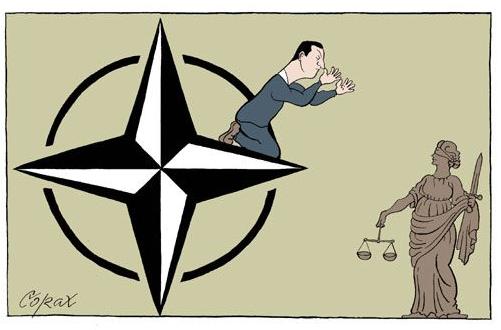
Milo’s Dilemma: Shall I stay or shall I NATO?

Rumors have been reported that Milo Djukanovic might be taking up a job at NATO. The story is fed by his announcement already late 2009 that he would resign from his job as prime minister.Whether such a story is true remains to be seen. However, it is clear that it highlights Milo’s dilemma: He is clearly determined to leave his job, he can only go down from here. Furthermore, he has repeatedly noted that his is exhausted from his long-time job. However, it is hard to imagine him as a 48-year retiree in Montenegro. The country is too small. Being just an ‘elder’ statesman is hardly a plausible role. Thus, leaving for an international job would make sense. However, the role of officials from the Western Balkans in international organizations has been limited and usually based on their professional qualifications.

(from Danas, 8.6.2010)

For his critics, the prime concern of such an ‘escape’ would be his escape from any trial over alleged involvement in any crimes. However, there is another concern. How will win the power-struggle within the DPS? The struggle over the succession of the party will determine the future of reforms in Montenegro and whether the governing party will disintegrate and open the space for new governing coalitions.

Whatever the outcome, the latest rumor suggest that 2009 might be a key year for the future of the governing party and the trajectory of democracy in Montenegro.

Building an older, more beautiful Skopje… or the city of broken urban dreams

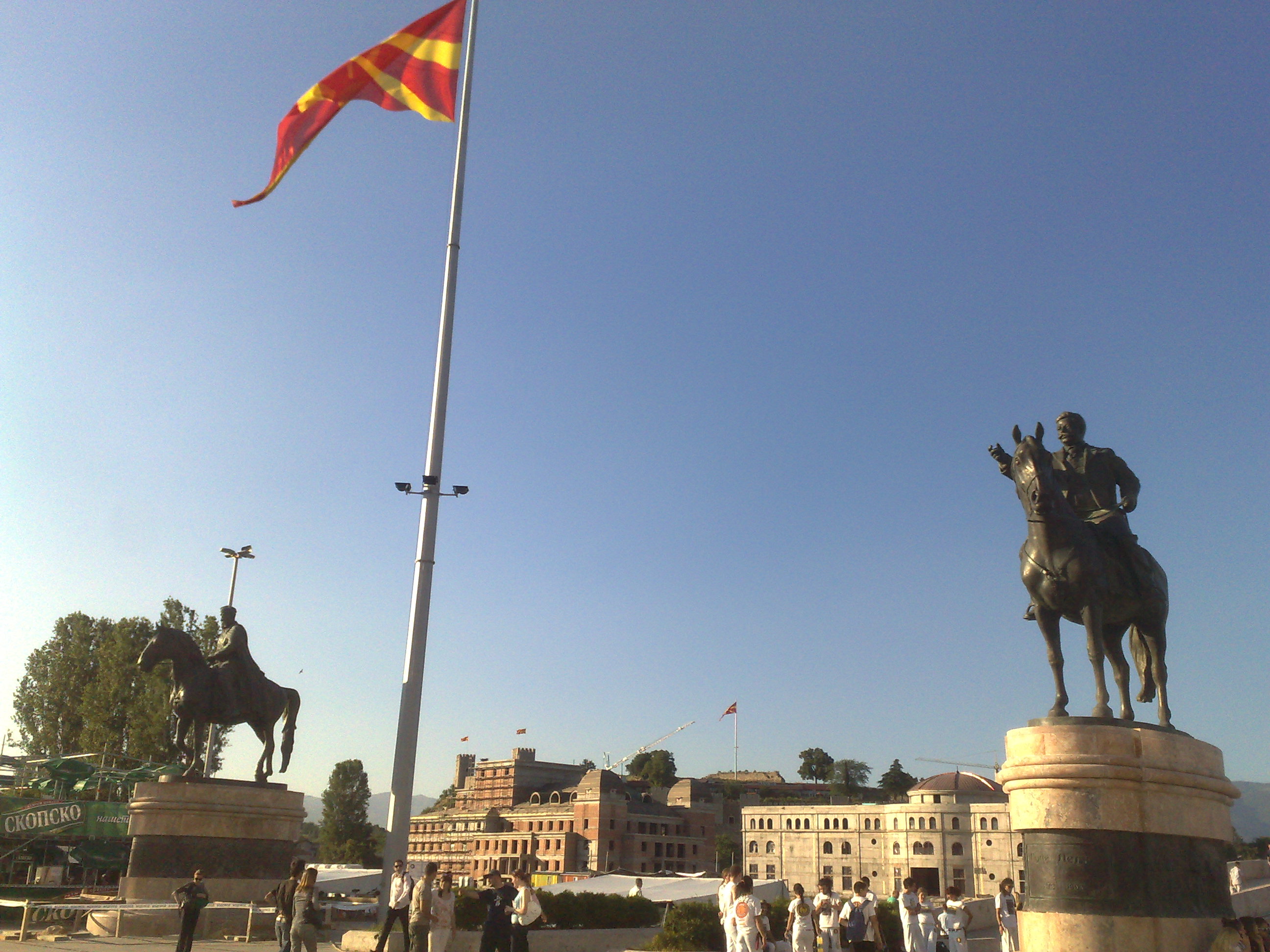
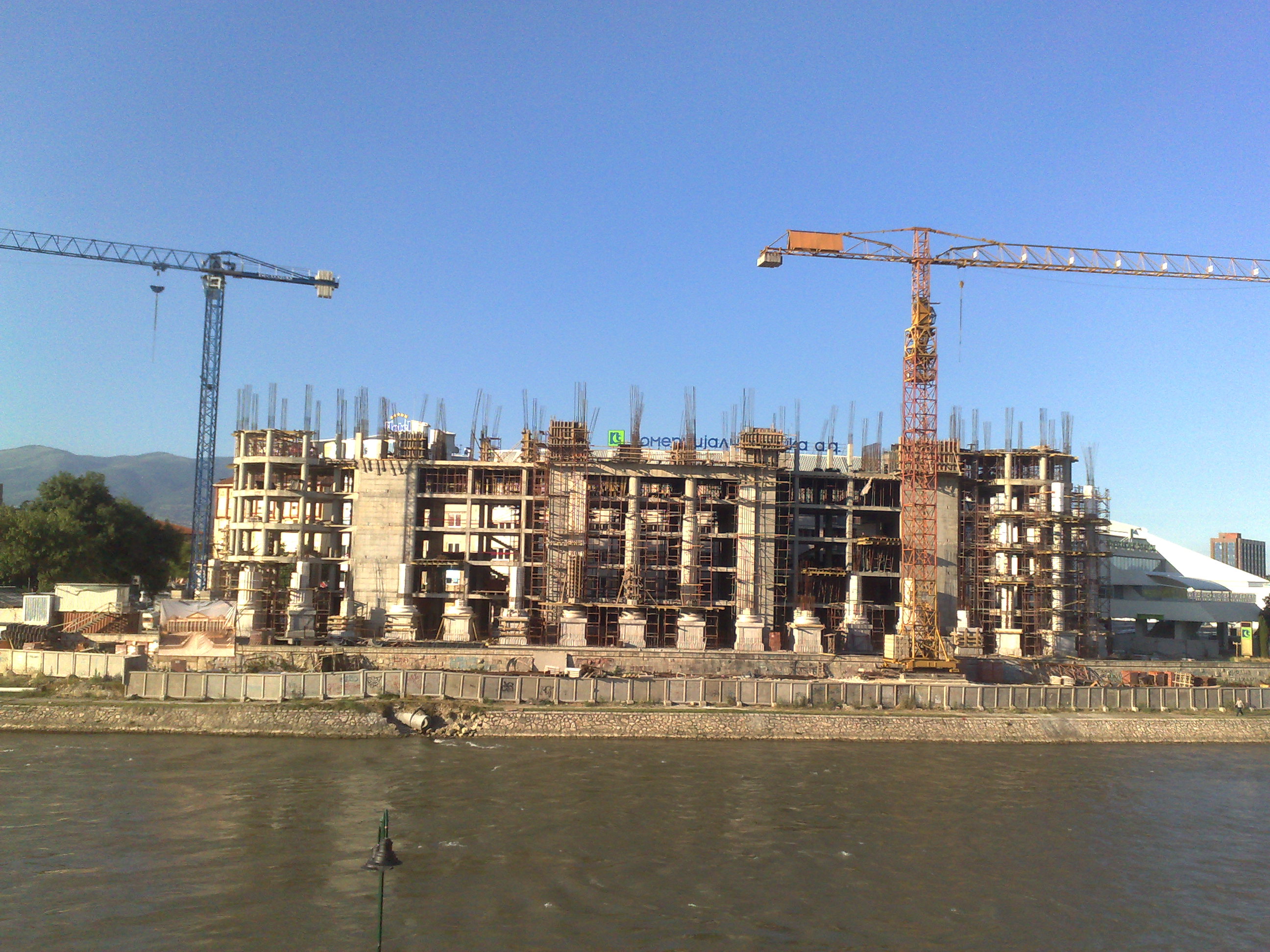
When the project Skopje 2014 became public earlier this year, it lead to protests over high costs, bad taste and the absence of public consultation. The plan foresees a large number of new buildings and statues in the center of Skopje.  Just having returned from Skopje, the ‘plan’ has already transformed the center of Skopje. Originally, it like the plan was too ambitious and outlandish to actually be realized. However, with big gaping holes on the main square, buildings sprouting up on the other side of the Vardar river, and statues already proliferating like Macedonia wants to catch up on two centuries of national monuments in two years, this plan turning into reality.

Goce Delchev

Admittedly, the plan ‘Skopje 2014’ was actually a clever branding trick of the current VMRO government to bring together a number of projects agreed by the previous city administration and interspersing them with a generous dosage of statues.  So what’s wrong with Skopje 2014. There is no doubt that the center of Skopje was in dire need of a make over. It is at least the third master plan for the center of Skopje, the first two foresaw a modernist Skopje in the decades after the 1963 earthquake. However, only parts were realized, leading to unconnected modernist buildings scattered throughout the center, including the magnificent national opera. This third effort to give the city a coherent aesthetic  is a post-modern hodgepodge of styles, including some pseudo-antique palaces and kitsch in no short supply. It is essentially anti-modern in its outlook. Ironically, by scattering the center with an odd mixture of styles, the project seems to affirm the emptiness of national identity rather than re-affirming the nation building project of the government.

Greek columns in Skopje

Besides being a costly enterprise in a country with limited resources, the project is also divisive and, as an Albanian friend told me, ‘provocative.’ The many monuments (three are already in place–one was put up as I visited Skopje) only celebrate the history of Macedonians (not to mention the ridiculous such as seeing Goce Delchev on a horse when he probably never rode a horse all his life). It is clearly an effort to engage in nation building for the majority, not to build bridges with the minority. The planned construction of a church on part of the main square symbolically asserts ownership of a civic site by one religious community. Ideas of also building a mosque is no remedy: it just suggests that identity is about choosing between one or the other, not a civic public space which atheists, Christians, Muslims and others can use jointly. Of course not only will minorities and civic minded Macedonians be alienated from the center. The planned statue of Alexander the Great is certainly not going to help in moving towards a solution in the name dispute (as have other provocative steps over recent years, such as the renaming of the highway and airport).

Considering the speed of the construction, it suggest that the government is able to move quickly when it really wants, one can only hope that might translate to more constructive aspects of governing.

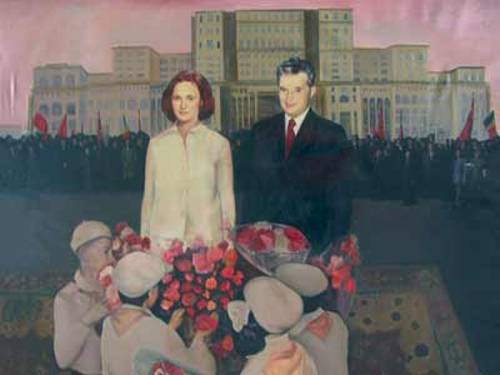
Meanwhile the urban landscape of Skopje is changing quickly.  As a friend in Skopje told me, at least it might lead to some new tourist crowds–just like the those going to Bucharest to admire the Centrul Civic.

Ceaucesu with Masterpiece

The unbearable lightness of being in power: 20 years multi-party democracy in former Yugoslavia

1990s is not only the last year before the beginning of the wars in former Yugoslavia, it is also the year in which multi-party elections were held in all republics of Yugoslavia. So twenty years later, where do things stand?

What is striking across the region is the endurance of a few parties in power. If we rank the countries by number of years out of 20 a party has been in power, we end up with the following:

1. Montenegro (DPS 20 of 20, 100%)

Montenegro’s DPS clearly wins the competition with not losing power once since 1990. It has only seen genuine threats to its power come from within.Prospects for continued rule of the DPS are good, once more change might only come from within.

2. Kosovo (LDK, 8 of 8, 100%)

Rugova’s LDK has been a member of a coalition government ever since the establishment of elected Kosovo institutions in 2002. However, as a coalition partner, it was never dominant during that period and it’s fortunes have declined steadily, being no longer the largest party. If we add the 1990s, when the LDK dominated until 1997 absolutely among Albanian voters, dominance of the LDK fits the larger regional pattern.

3. Bosnia and Herzegovina (HDZ & SDA, 18 of 20, 90%)

Bosnia is tricky with a political system shaped by three distinct electorates with little cross-ethnic voting. HDZ and SDA have managed to be in power for 18 of the past 20 years, only being out of power less than two years in 2001/2 when the short lived Alliance for Change governed. Among Croat voters, the only real challengers to HDZ came from within, in particular since 2006 with the creation of HDZ1990. The persistence of SDA in power is less due to its unchallenged dominance, but due the coalition building dynamics in Bosnia. It has now a number of challenges, some older (SDP, SBiH), others more recent such as the SBB BiH, the party of the owner of Avaz, Randoncic. The third in the original triumvirate of nationalists, SDS, has been in power considerably less time (13 of 20 years).

4. Croatia (HDZ 17 of 20, 85%)

The dominance of HDZ is a striking feature of Croatian politics, held in check by a strong opposition, at least over the past decade. The brief SDP interlude 2000-2003 was also transformative in helping to shift Croatian political discourse towards EU integration. The popularity of President Josipovic suggests that HDZ’s days in power might be numbered.

5. Serbia (SPS 12/15 of 20, 60-75%)

SPS is the survivor among the long-lasting parties in power. Having had complete control for a decade, it came back to support the DSS led minority government 2004-2007 and as a junior partner in 2008. It also transformed itself so that now its president Ivica Dacic sometimes seems like one of the most progressive members of government. It’s also the only dominant party which has been in power both as a junior and as a senior partner.

6. Slovenia (LDS 12 of 20, 60%)

After having dominated governments continuously for 12 years, it is now a small party, eclipsed by others. Thus, this dominant party does not look like making a come back.

7. Macedonia (SDSM 10 of 20 and VMRO 8 of 20, 50%)

Macedonia has had the least clear pattern of a dominant party in the region, with the Social Democrats only governing for half the time. VMRO governed for nearly as long and the sometimes authoritarian reflexes of VMRO under Gruevski suggest that they are on their way to eclipse SDSM for the total duration in power.

Looking at the countries of former Yugoslavia, it is remarkable to which degree a few parties have dominated for most of the period since the first multi-party elections. This dominance has overall declined since the 1990s, but is still not broken in parts of the region. Thus, unlike in Central and Eastern Europe, governments were often booted out for either corruption or due painful reforms, parties in former Yugoslavia have overall been more successful in clinging to power, often with not so good results for the country.  What is encouraging is that with a few exceptions, no single party is so firmly in control that it could not lose power at the next elections.

The disaster of Sarajevo?

Today’s summit of the EU and the Western Balkans in Sarajevo was supposed to re-energize the accession process of the region to the EU and help deal with some of the regional problems in particular the political deadlock in Bosnia. Instead it appears to have accomplished the opposite. According to a report by the Swiss Neue Zürcher Zeitung, the conference ended after just three hours, lacked an agenda, a clear purpose and was generally chaotic.  It had already been clear for a while that it would lack high-caliber EU member states participants to genuinely signal renewed EU commitment and interest in the region. The fact that few prime ministers or heads of state showed up and that most EU countries did not even send their foreign ministers conveys the signal that the region has dropped on the list of EU priorities.

The meeting was not concluded with a “Sarajevo Declaration,” as the Spanish presidency had hoped, leaving in essence the commitment to further enlargement with the representatives of the EU, while the member states have sent a much more ambivalent signal by their modest turn out. It is unclear how the meeting signals a ‘new deal’ for the Balkans as the Spanish Minister of Foreign Affairs, Miguel Ángel Moratinos, called it, as the EU does not appear to have offered anything to the region which had not been on the agenda since 2000.

Particularly striking was the absence of any proposal to overcome the three key stumbling blocks for EU integration in the region: the Greek opposition to accession negotiations with Macedonia, relations between Serbia and Kosovo and the political crisis in Bosnia and Herzegovina.

Despite talk of an EU special representative for the region, none was named. Such a special representative would have been a good idea:  A special representative can help put the region back on the map for the EU. Furthermore, a special representative would help link the enlargement strategy of the EU with its efforts at dealing with its post-conflict engagement in Bosnia and Herzegovina, Kosovo and Macedonia. Linking these two policies would greatly improve the effectiveness of the EU. Finally, the EU often looks at the region country by country, not recognizing the links. Somebody who is able to take a regional perspective would very helpful. Of course it matters who would be the special representative–it would need to be somebody with political clout in the EU and respect in the region.

The name floated in a recent Guardian article was Paddy Ashdown, not exactly an inspired choice. While he has the political weight to be effective, as one could see in Bosnia, his instrumentalization of EU accession in Bosnia has had long-term negative consequences and his image would not give him the necessary respect in the region. Instead, it would be good to see a fresh face in region.

For now, the conference appears to have confirmed the streak of rather disastrous initiatives over the last years in Bosnia, from the Butmir process to the visit in April to Sarajevo by EU and US representatives which both yielded few results and instead compounded the impression that the EU is trying to solve the regions’ problems ad hoc and without a clear commitment. This latest effort  seems to have re-affirmed this message–not one the EU or the Spanish presidency intended.

A history of Yugoslavia and Eastern Europe according to some of my students

Click here on a post on the recent press coverage of the text below.

A history of Eastern Europe and Yugoslavia as you might not know it. From exams 2006-2010 at the University of Kent:

The History of Yugoslavia

There have been many different countries/empires which have been huge and have had a range of different cultures but have managed to stay as one country. A very important example in term of Yugoslavia is the Ottoman Empire which oversaw some of that region. It was a huge empire with millions of servants who were of different race, religion, customs and beliefs. The empire managed to stay together regardless of this issue.

Furthermore, this can be debated as Yugoslavia never really had any enemy in ancient times…

The Creation of Yugoslavia

The formation of Yugoslavia was ‘man made’ rather than inherent and formed through the same values and cultures.

Yugoslavia ….was forced together by the Ottomens and meinteined by leaders such as Tito.

After Yugoslavia was formed three dominant groups fought for power on the left the fascist Usteche who used aggressive ethnic cleansing techniques to drive non-Serbians from the land.

Yugoslavia was formed in 1929 out of the Kingdom of Serbs, Croats and Cheks

Communist Yugoslavia

When the Ottoman Empire collapsed, Communist leaders took and expanded the idea of a united Yugoslavia.

It is true to say that Yugoslavia was a young state, before the second WW the area consisted of several kingdoms…. After Tito removed Yugoslavia from the Soviet Union & pioneered the non-aligned movements during WW2, Yugoslavia entered relative calm.

Communist rule in Yugoslavia defind the nation until 1948 and when the region detached itself from Commuism it scrambled to find an identity.

Tito was already emerging as the glue that binds this group of autonomous provinces.

Tito was almost the puppeter of Yugoslavia pulling its strings.

In the years before Tito’s death, when he was forgetful and sported a terrible wig…

In 1980, President Tito of Yugoslavia died, having ruled the state for over 10 years…

When Tito died the emperror died with him.

There were two bodies that led Yugoslavia right before it disintegrated, Tito Braz and Slobodan Milosevic.

Tito had maintained a Yugoslavia with a federal government system: again, not a typical feature of countries…if Milosevic had succeded would have made Yugoslavia a less artificial country.

The provinces of Yugoslavia include Serbia, Croatia, Slovenia, , Yugoveada and others…

It consisted of eight republics and of the eight two were provinces: Kosovo and Vojvonec.

Kosovo was 95% Algerian.

Yugoslavia had been in a terrible economic climate–following the 1930 global depression and the 1973 Yugoslavian oil crisis…

…Slovenia housed a large amount of institutions that Serbia used.

The Rise of Milosevic

When right wing Serbs were making their voices heard in Kosovo Ivan Stambolic sent Milosevic to sort out the situation. Tito would have never considered this. He would have sent an armed force and destroyed them.

Yugoslavia was powerful before Slobodan Milosevic, because it wasn’t just about Serbs but it was about other places as well such as Bosnea, Macedonia, Kosovo, Croatia, Slovenia, etc.

Milosevic attempted to mobilize the people by lighting a fire under their growing concerns for nationalism.

Milosevic attempted to keep the state as cohesived as possible by introducing the masses into politics.Unfortunately, all the masses had very strong views which was one of the factores led to its demise.

Milosevic was a gruel rotten apple.

His ambitions would not stop him from attempting to take the capital of Croatia Dubronik which as 90% Croat in which he failed.

Although Kosovo had been an independent nation for over 600 years, Serbia…had pulled the nation under Serbian rule

As both Croatia and Serbia were Orthodox believers that were majority.

While Serbia is Orthodox, Croatia and Bosnia are Muslim

War and International Intervention

The international community had viewed the situation in the Balkans as a bit of a ‘so what?’ scenario.

[In 1991] NATO was a relatively new organization and was busy with the USSR… and the UN was happy to observe the looming conflict yet unwilling to act.

The EC also felt under pressure to act because of ethnic ties that they had to ‘Yugoslavians’

The Baltic States are built on blood stains, and for the UN to go in, assuming it could achieve what it set out to was naive and demonstrated it’s lack of cultural understanding.

The declaration of independence infuriated Serbia. That is why today Serbia has rejected the acknowledgement of Serbia as a nation-state, it fears for the Serbians inside Kosovo.

With Germany independently supporting Serbia and the rest of Europe condemning its actions.

Bosnians soon rose up against the Muslims …forcing them to flee.

The Baltic States have always been at least troublesome…It’s a conflict hotspot teaming with ethnic tension and racial prejudice that has built up over centuries and passed down over generations

During the 1990s Yugoslvia and most of the Baltic region witnessed some of the worst atrocities and widespread genocide the area had ever seen.

The Kosovo Rambouillet plan succeeded in invading the conflict in former Yugoslavia, but failed in the short term with the loss of lives in the war.

Communism in Eastern Europe

More than 4 centuries of Communist rule has aggravated the economic situation and the competitiveness to the West.

Eastern Europe has been under the influence of five religions, three of which are branches of Catholicism.

A case example can be seen between Afghanistan and Armenia between 1918 and 1926. Between and much throughout the interwar period, the CPSU had problems with Afghanistan.

The cold war ended in 1950 when the US and the USSR signed a treaty of peace in Yalta

The appeal of Communism was that people would no longer work for the rich, but for each other.

The richest elite in a communist society tends to be the leader. As according to Karl Marx the buorgeoisie and the ruling class in a society tend to rule and keep the state in good order.

They created what was called Goulash communism–goulash being a Hungarian dish compiled with unlikely ingredients.

Gorbachev and 1989

Gorbachev not only talked the talk but walked the walk

Gorbachev made discussions and relations to the Western states about the plan to collapse the Communist regime…The United States president then Regan also accepted his plan…

Gorbachev was the ‘golden eye’ and the hero of east Europe helping to collapse communism and began his plan since the earlier 1990s.

It seems that the madness that took hold of the people of East and Central Europe in that momentous year of 1989, was one that had been inevitable forming like a thunderous cloud on the horizon, bringing with it the winds of change.

The claim that short term …factors are key to explain Communism’s collapse in 1989 is rather reactionary and ill-judged….Long term factors are key to explaining communism collapse in 1989 as one can assess the fall of communism or its demise started from a while ago.

there was a multi-party election carried out in Romania, Czechoslovakia, East Germany and Bosnia for a more decentralized east Europe.

Countries with a single party system run the risk of slipping back into a type of authoritarian regime.

…there is still the block mentality in Eastern Europe, showing it hasn’t integrated that greatly, this is made most apparent in the Eurovision Song Contest where the East European Countries will all vote for each other. This was seen this year when the Serbian entry won, despite how crap it was, because the Eastern Europe will vote for it’s own.

What is all means for Britain

Britain now is a coalition government, the icon of the West now using democratic practices most commonly fund (found?) in Eastern Europe…

Britain looked at the whole idea [EU] of the scheme as a waste of time…under Margeret Thatcher…but [she] was eventually removed and Britain joined… after Britain had been in a huge recession and were the 3rd poorest country in Europe.

The copyright to these statements lies exclusively with the students who wrote this.

Why the failure of the opposition is bad for democracy in Montenegro

Montenegro held local elections in most municipalities yesterday (14 out of 21). Unlike in previous local elections which were observed by international organizations and commented on by ICG and other international think tanks, these got very little attention. This is, I guess, good news for Montenegro. Local elections are not a test of two conflicting political projects at a time of crisis.

However, the resounding victory of DPS and its partners in most (12) municipalities is a negative development. It is less that the opposition is a beacon of democracy and neither has DPS rule been disastrous. For the first time, the opposition was able to unify and run on a joint platform–a lot easier at the local level then at national elections. This new-found unity among the notoriously divided and dividing opposition was seen as a real opportunity to take control of a number of cities, including Podgorica. The results do give DPS a greater lead than it gained four years ago–not long after the referendum. In Podgorica, the opposition came close and the ruling Socialists cannot form a coalition with its long-time side kick SDP which ran separately from DPS in Podgorica.  The DPS candidate for Podgorica, Miomir Mugoša recently made headlines for beating up a journalist.

The real problem arising from the election is the continued dominance of the DPS, having governed since 1990 (and to be more precise since 1945), Montenegro continues to be a dominant party system with little opportunity for a change of government through elections. Needless to say, this is not good for any democracy, irrespective of the behavior of the dominant party. In Montenegro, were the dominant party and the state are particularly closely interwoven, a normal change of government would do the country some good. In addition, bringing the opposition together and into power would also help to heal the divide in the country and be an encouragement for opposition to work within the status quo and not play the Serb card (which in fact seems to be more frequently evoked by DPS to scare voters). At the moment it would seem that change to the government in Montenegro is once more most likely to come from within the DPS through a split as in 1997 rather than through a loss of power in elections.