No shortcuts to Europe

Here is a small letter I recently sent to NIN, regarding a comment in December, but I am not sure it will be published. It comments an idea Boris Begovic launched namely that Serbia should no join the EU, but instead join the European Economic Area. The original article is behind the NIN paywall, but this idea is also discussed in B92, Vecernjie Novosti and elsewhere.

Cartoon from Novosti, 29.12.2012

In his comment “U Evropu bez unije” on 13 December 2012 Boris Begović makes a tempting suggestion: Serbia should abandon the difficult accession process to the EU with its supposedly changing criteria for membership and instead join the European Economic Area (EEA), Europe’s large zone of economic integration that includes all EU members, Norway, Island, and Liechtenstein.

His idea might sound tempting, but is nothing but an illusion.

It is true that the EEA creates freedom of movement, free trade, free movement of capital and services among its members and thus offer a key component of EU integration to non-members. The idea that Serbia could join this agreement without EU membership is, however, rather absurd.

Countries cannot join the European Economic Area directly. The economic area was established in 1994 between the EU and the European Free Trade Agreement (EFTA) and most their members. There is no possibility foreseen for a country to join that is not either a member of the EU or EFTA. So let’s consider the only option Serbia would have to enter the EEA without joining the EU.

First, it would have to join EFTA. EFTA has only four members, Switzerland, Norway, Iceland and Liechtenstein. Of the four members, only three are part of the EEA, Switzerland rejected membership in 1992 in a referendum. Serbia would be an odd partner for some of the richest countries in Europe. Furthermore, no country has joined EFTA since 1991 when Liechtenstein joined. The previous accession was that of Iceland in 1970, all others were founding members in 1960s. Countries left EFTA rather than joined it in recent decades to become EU members (UK, Denmark, Sweden, Austria and Portugal were original members). Thus, EFTA is composed of a rather odd and small number of countries. Since no country has joined for such a long period there is no clear accession process, but membership would require agreement among all four member states. At the moment, there is little reason why Switzerland, Norway, Iceland or Liechtenstein would be interested in free trade with Serbia. Now for the second obstacle: A country joining EFTA is not automatically member of the EEA.  The EEA agreement states clearly in Art. 128 that “… any European State becoming a member of EFTA may, apply to become a party to this Agreement. .. The terms and conditions for such participation shall be the subject of an agreement between the Contracting Parties and the applicant state. That agreement shall be submitted for ratification or approval by all Contracting Parties in accordance with their own procedures. “

What this means is that a member of EFTA can apply to join the EEA, but there has to be an agreement between that country and the European Union and all its members and needs to be ratified by all of them.

If Serbia abandons EU accession and then would join EFTA in the unlikely case that Switzerland, Liechtenstein, Norway and Iceland find Serbia an attractive partner, the EU and its members would have to agree to join the EEA. It does not take a lot of imagination to see that the EU and its members are not going to eager to see Serbia access key EU benefits (such as freedom of movement of workers) by skipping the accession process and the conditions. The only scenario under which it would be imaginable for the EU to accept Serbia as a member would be if it had abandoned offering a membership perspective for the Western Balkans and saw this as a viable alternative. Still, Serbia would not be accepted without fulfilling numerous conditions, in particular in terms of adhering to the acquis communitaire, the EU legislation, that is relevant for the free movement of goods, people, services and capital before the EU and its members would be willing to accept Serbia. In brief, if Serbia decides not to opt for full EU membership and go for the EEA, it will still end up negotiating with the EU.

I am not going to comment in any detail the suggestion that an independent Kosovo is a problem of the EU, as if it had nothing to do with Serbia or the argument that the conditions of EU membership keep changing, or the suggestion that the financial contributions of the EU are “very, very small”. Croatia for example has 687.5 Million Euros set aside for the second half of 2013 alone, which is around 1.45% of the GDP of Croatia or some 4.2% of the Croatian state budget planned for 2013, hardly negligible amounts.

It is true that enthusiasm for enlargement among its member state is decreasing and that individuals members might make sometimes unreasonable demands. However, this is largely linked to the current economic crisis inside the EU. By the time Serbia is close to joining, it is realistic to expect that crisis to have passed and member state taking a more positive view towards enlargement. If Serbia pursues EU membership, it will be have an easier time to join then. Of course, Serbia can decide not to join, but it is a dangerous illusion to believe that the EEA is a viable alternative or easy way to get some of the benefits of free trade and movement without joining the EU.

Republika Srpska for Kosovo?

A few days ago the platform of the Serbian government for talks with leaked in the Belgrade press and Daniel Serwer made the non-paper of the Serbian government available on his blog. Serwer called the proposal Fantasyland and Hashim Thaci rejected it as a 19th century plan. Of course in negotations there is no reason for the other side to respond positively to a proposal that presumably outlines the starting position for talks. So what does the platform actually propose?

Press in RS is drawing maps of the “new RS in Kosovo” according to the government plan

Observers have likend the structures that would be set up in it to Republika Srpska in Bosnia (mostly positive in Serbia and negatively outside). The platform itself explictly only refers to Katalonia as a model rather then to the RS, but some feature seem to evoke the RS.

In brief ,the platform proposes establishing an “Autonomous Community of Serbian Municipalities in Kosovo and Metohija,” with the nice-sounding abbrevision ZSO KiM  This would constitute a territorial autonomy of Serb majority municipalities in the North and in the South (including Štrpce, Gračanica) and would have competences in education, health care, sports, culture, public Information, environmental protection, urban planning, agriculture, as well as their own police and judiciary under formal authority of Kosovo and the ability to maintain direct ties to Serbia including funding and finally the use of own symbols.

In terms of institutions, this autonomous unit would have an assembly and government, liking it to an autonomous region. Although the plan calls this autonomous region “community” the plan does not contain any non-territorial forms of autonomy or feature of cultural autonomy (except for some semi-autonomous status of sub-municipal Serb settlements, but even they are understood territorially).

When looking back at the Ahtisaari plan, the differences between the decentralisation proposed therin and the competences requested by the Serbian government do not differ fundamentally. The plan forsees that municipal competences include “education at the pre-primary, primary and secondary levels; public primary health care; local economic development; urban and rural planning; public housing; naming of roads, streets and other public places; and the provision of public services and utilities, among others.” In addition some Serb municipalities received the right to organise higher education, hospital and secondary health care, cultural and religions affairs and an “enhanced role in the appointment of police station comanders. Furthermore, the plan does forsee the formation of “associations and partnerships with other municipalities in Kosovo to carry out functions of mutual interest” and the possiblity of “to cooperate with municipalities and institutions in Serbia, including the right to receive financial and technical assistance from Serbia, within certain clear parameters set by the Settlement.”

The main differences between the competences outlined in the Serbian government non-paper and the Ahtisaari Plan are the control over the police and judiciary and the establishment of seperate institutions, both of course substantial.

More significant are the differences in terms of the overall proposed structures of Kosovo in the non-paper. It suggests a bi-cameral parliament with an upper house called the “House of Regions and Religious Communities” and a lower house with guaranteed seats for Serbs. The idea of a “House of Regions and Religious Communities” does seem rather odd for a number of reasons: First, religion is a not a relevant category in the politicial divisions of Kosovo, ethnicity is. Thus, such a house, if at all, should represent national communities, not religions. The term might be a way to bring the Serbian Orthodox Church into the institutions, which in itself would be very problematic. Second, it might be a term to avoid the obvious parallels with the House of Peoples in Bosnia.

When it comes to voting the platform suggests that Serbs should not be outvoted “in matters that directly impact the competencies of the autonomous region and the rights of Serbs and other minorities. This is considerably less than voting rights of the RS in Bosnia where MPs from either entity can block any decision by a 2/3 majority, a power the RS has made extensive use of.

It would thus be misleading to equate the autonomy for Serb municipalities with the RS in Bosnia. First, the competences are large but less than those of the RS, secondly and more importantly, the ability of the Serb municipalities to block decision-making in Kosovo would be extremely limited in comparsion to the blockages the RS can and has been causing in Bosnia. This difference is of course not surprising considering that Serbs make up less than 10% of Kosovos population and the municipalities make up not much more of the territory of Kosovo.

The proposal could thus be considered to ask for an autonomy between a full entity-like structure in Bosnia and the propose Ahtisaari plan. This is not to say that there are some problems with the platform. First, the idea of a tw0-chamber parliament and the representation of religious communities seems unreasonble considering the size of minorities and the limited competences such an upper chamber would have. Considering cases like South Tyrol or the Aaland islands, both enjoy territorial autonomy, but no specific parliamentary representation in Italy or Finland respecitvely. Instead there are other mechanisms in the relationship between the autonomous region and the central government to protect the autonomy of the region.

The second problem which Dan Serwer in his comment mostly focused on is the idea in the platform that the entirety of Kosovo would remain part of Serbia and the constant references to the “Autonomous Province of Kosovo and Metohija” seems rather anachronistic and is definetly detached from reality. The platform does not outline what Serbia would be willing to offer Kosovo in exchange for agreeing to establishment of the autonomy arrangement. The platform suggests that the Kosovo authorities could receive the official authorisation by the Serbian government, but within the framework of the Serbian constitution, i.e. without recognition of independence. There are two ways of looking at this. If this reflects the substance of the Serbian position, this platform offers little for Kosovo to agree to any of it: The proposal largely formalised the status-quo and thus Kosovo would have no incentive to accept any part of the propsal without a clear Serbian accepetance of Kosovo’s independence, if not outright recognition. However, if the platform is also made for domestic consumption and about the symbolic assertation of sovereignty over Kosovo, then it has better prospects.

The suggestion that the Serbian government could formally transfer the competences of the autonomous province to the institutions of Kosovo might sound absurd, but they would constitute a way for the Serbian government to argue that the current Kosovo institutions are authorised by the Serbian constitution  and thus provide for a manner to official and formally cooperate with Kosovo institutions while maintaining the legal fiction that Kosovo is part of Serbia. Although it would be preferable for the Serbian government to fully acknowledge the reality of Kosovo’s independence, this opening might provide for the tool to live with Kosovo’s independence. A second positive feature of the agreement is the apparant abandonment of partition as a goal. By linking the municipalities in the North and in the South into one unit, partition would be less likely and presumably the more numerous Serbs in the South would dominate such an institution.

The platform of the Serbian government is, as I have argued above, far from ideal and as any negotiating position per definition not a compromise, but the goal of one party. Still, I would take it is a reflection of the more pragmatic line of the Serbian government, rather than as just an effort to create a new Republika Srpska in Kosovo.

Don’t let the Roma represent themselves, they can’t be trusted

Some interviews are best without any comment. Here is an interview with Bela Kurina, who represents the Roma Democratic Party in the Novi Sad assembly. The party caught some attention in May already for not having a SINGLE Roma representative among the six candidates it received after winning 6.4 % of the vote in local elections. Kurin, a former official of JUL and DSS, noted that there are Herzegovinians, Slavonians and Montenegrins on the list, but Roma could be too easily bought to be put on the list.  It isn’t clear who the president of the party is as Blic notes that the president is Tomislav Bokan, who also used to be a DSS official and for the SRS and put three family members on the party list [comment by Kurin: if there were 78 Bokans, they would all be on the list of the party].  There have been some suggestions in Danas, that its electoral success might have been helped by, how shall we call it, some financial assistance to voters.

Now Kurin gave an interview a la njuz.net for the Vojvodina show politbiro that was re-broadcast on RTS in the talk show “Da mozda ne” on 13 December 2012.

Here are some highlights in English:

“Imagine that we would have Roma on the list of candidates for councilors. This is something I could not allow. You know what happens, not just here, but also in general in Serbia in parliament that the seat [of an MP of councilor] belongs to the person and not the party and that he can decide with whom to be. We simply did not want to have people in the party who will sell themselves… The only party that until the end of the four year mandate [he has a bit of hard time getting that straight], the Roma Democratic Party cannot be manipulated with and not one councilor can be bought because these are people with a material basis and serious, and I think that there is no price for buying councilors of party.”

“We asked from them for the city cleaning considering, as you know, this is Roma business, or rather Roma mostly work there… we were promised this by [the DS] and when we asked for this after the formation of local government, this [option] was for a reason I don’t know eliminated.”

“We also asked for half of the gardening services…in the end we ourselfs said, don’t give us the gardening services, just give us the cleaning services. If we manage this, we can see what we can do, but they did not give it out, they want to control everything.”

And thus the incorruptable Roma Democratic Party broke with the Democratic Party and joined the Progressive Party in their new city government. Now they got their control over the cleaning services, as well as Urbanism (including tourism). And thus the benevolent non-Roma can unselfishly employ some more Roma in Novi Sad.

[thanks to Dušan Pavlović for drawing my attention to this interview]

My role in the Austrian colonial conspiracy against Croats

Since I posted my brief response to the faked interview yesterday (republished on radiosarajevo.ba), there have been some new twists in the story. Dnevnik.ba which apparently unknowingly took over the fake interview appologised and published a clarification. Somewhat different has been the response of poskok.info.

They acknowledged in email correspondence the mistake (attributing it to a colleague from Croatia), but after I did not respond to their questions about the Croat rights to self-determination, etc. (it seems like answer to their questions was a bit like tell a thief how the clock works which he just stoke from you), they published a, shall I say, rather tendentious comment. The bottom line is that they added the stuff to the interview because I should have said it and only because of the whole Austrian colonial influence didn’t (I especially like the description of VL as the neocolonial voice of Austrian postcolonialising capital).

In contrast to what the portal thinks, I am not an expert in international law and there are probably others better qualified to answer the question whether or not the Croats of BiH (aka the Austroottoman Kurds in the heart of Europe) have the right to autonomy or self-determination. My sense is that the answer would disappoint the portal, but then again, this might all be part of a global conspiracy.

A few imaginary lines or some news snake oil on Croat entities

In today’s brave new media world, stories, articles and interviews are quickly posted, reposted and shared. While it is making life difficult for many media outlets to get the reader to come their site or buy the newspaper or magazine, stories get a round quickly. Sometimes it seems that the reposting portals might do just a bit more than circulating an existing text.

The original interview

The original interview

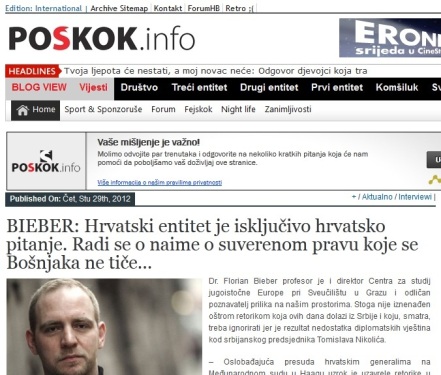
It took me thus by surprise when some friends and acquaintances asked me a few days ago whether I really supported the creation of a Croat entity in Bosnia and Herzegovina. Not having suffered amnesia recently this news surprised me as much as my friends. The source for these claims was the “re-print” of an interview I gave a few days ago to the Croatian daily Večernji List on the webportal poskok.info (meaning viper in Croatian).

The title of the „interview“ was “Hrvatski entitet je isključivo hrvatsko pitanje. Radi se o naime o suverenom pravu koje se Bošnjaka ne tiče…”  a line one would not be able to find in the original interview. Following many questions which the portal correctly copied from the interview (without ever mentioning the original source), there comes the surprise:

The Fake

The question “Do Croats have the right to ask for their entity in Bosnia and Herzegovina?” which Večernji List never asked me followed by an answer I never gave:

“Of course they do, this is as if you’d ask me does the buyer of a car get the steering wheel for this car? Croats in Bosnia and Herzegovina are a constituent people and accordingly to all [sic!]UN convention sovereign people have the right even to self-determination and to declare independence. In this sense, the demand for territorial autonomy inside the state that is not questioned is a normal and legitimate process. The problem of Croats in Bosnia and Herzegovina is more the problem of the right expression of what that people anyhow have the right to considering that their political elite does a bad job and is inarticulate, whereas a part of the Croat political forces many years openly serves the Bosniak national project.

Broadly seen, Croats in BiH already have some ‘entities’ considering that cantons per definition are entities for themselves are entities [sic]. Entities in international law are nothing else but territorial units with specific institutions and competences.The international community constantly commits legal violence against Croats in BiH. The questions is when this body will radicalize and then the question will arise whether they will stay in BiH. Namely, Croats in BiH are above all a small nation who hold the balance, if you turn them against BiH I think that BiH is finished as a political idea.”

The fictional answer contains bad metaphors and the absurd idea that UN conventions have anything to say about constituent people, their right to self-determination or entities.

Following the next question the creative interviewer returned to an original question by VL, but took the liberty to embellish the answer (the added sections marked in bold) :

I think that the odds for this in current circumstances, are very slim, but politics is changeable and the question is what will be tomorrow. Remember Kosovo. Who foresaw the independence of this province? And Kosovo is not inhabited by a constituent people, but an ethnic minority in Serbia.

The failed constitutional reforms in BiH in 2006 and 2009 demonstrated that even minimal change to the Dayton Constitution is nearly impossible. Creating a Croat entity would be a major change to the Dayton Constitution and is opposed by Bosniak [the text in VL mistakenly writes Bosnian] politicians if it affects only the Federation.

Certainly the RS would oppose the changes if it would also affect the RS. As a result, I cannot see this coming about, unless this is part of a grand bargain between the political elites. However, the record has been poor. Finally, the census of next year is likely to show two things. First that Croats are much smaller in number than Bosniaks and Serbs and that many Croats do not live in areas with whom the Bosniak elite manipulates as ‘nominally Croat’ regions.  In this manner the theory of multiethnic Bosniaks is failing considering that ethnically mixed regions of BiH generally exist in regions that used to be part of Herceg Bosna.

These two points strength the arguments for creating a Croat entity but the question of its realization depends only on Croats. Frequently the wrong question is asked in public—will Bosniaks allow Croats this and to this one constantly returns. There is nothing Bosniaks have to allow Croats and neither Croats Bosniaks. The sovereign right of people are defined for themselves and concern only the nation to which it relates.

Also here the changes use terms like “Herceg Bosna“ which are not really widely used outside of, well “Herceg Bosna” and the additions constitute the opposite of my original statement which I concluded with the observation that “Both of these undermine arguments to create a Croatian entity.”

So why should I or anybody else care what some marginal portal called “Viper. Portal for Social Decontamination” makes up? With the quick spread of stories via social media such as twitter and facebook, few media are truly marginal. Thus, word spreads even from unserious portals such as poskok.info as it attested by the numerous friends and acquaintances who found out that I was a clumsy defender of the supposed Croat right to a third entity. Secondly, news spread to another, more serious news portal, dnevnik.ba which circulated the fake interview, getting hundreds of hits (currently the portal is down). Thus quickly a few made up questions from a marginal portal become “real.”

“Mixed Meat” or a lesson in national purity in Republika Srpska

One comes across a lot of bad, hateful and nationalist texts when reading newspapers in former Yugoslavia, but a recent column in the Daily Glas Srpske (Voice of Srpska) called “Mixed Meat” (Miješano meso) stands out as a highlight to which lows of hate speech the public discourse in the RS has sunk.  The columnist Nikola Pejaković describes in great detail his opposition to mixed marriages, marriages between individuals of different national or religious background, and suggests that they are essentially a expression of communism, to be precise: “a Yugo-melting pot with the goal or creating a Yugoslav nation, atheist and based on the teachings of Marx, Engels, Stalin and local šalabajzer” (an untranslatable term standing for something like a simpleton).

He accuses particularly Serbs for having given up their god and been to willing to enter mixed marriages and points out “the experience of the past war has demonstrated that mixed marriages have resulted in many problems for these people and their families. Thus we should no longer beat around the bush. Ok, love happens, but when it happens… But where to marry? In whose church? Or again in the municipality, like the marriage is a municipal matter, a building permit.”

In the end the columnist concludes that “in my humble opinion marriages that remain mixed (sic!), where one doesn’t know who is the man and who the woman, neither to which god the children should pray, where for the sake of peace at home they celebrate neither Easter or Bajram—are just a misfortune for the lover and for their children.”

Of course such a language is nothing new to Glas Srpske, which was owned by the Republika Srpska government until a few years ago when it was sold to Željko Kopanja who used to be considered a critical and daring journalist in the RS.

While the hate speech of the war and immediate post-war period has declined it remained loyal to nationalist rhetoric of SNSD. Amidst glorifying the RS and the war, downplaying war crimes committed, the suggestion that “mixed marriages” stands out as particular offensive. The fake care for children from mixed marriages cannot hide the fascist (and I do not like to use this word) assumption: nations should marry among themselves, some kind of national purity would thus be maintained expressed through religiousness and worship of the imagined ancestors of the nation.

Not only does the author clearly oppose mixed marriages to be concluded, but also against the ones that already exist. Ironically, the authors claims that “Excuse all those who are in mixed marriages or from mixed marriages. This is not against them, but against the communists and their pro-Nazi plans, playing with people-nations and genetics, against their experiments which cost us 60 year standing in place ….” (of course there were mixed marriages before Communism and after)

Of course, it is the author who is promoting ideas of national purity which is a lot closer to the terms he accuses the communists of. The fact that such ideas which present the legal relationship between two individuals of different national or religious backgrounds communist and undesirable in 2012 in a European daily is hard to fathom, especially for a newspaper published in Banja Luka where Radoslav Brdjanin said 20 years ago about children from mixed marriages “We shall throw them into the Vrbas and those who swim out are certainly Serbs.”

Is Integration the new Catchword for Minority Politics?

Yesterday, I had the pleasure to attend the launch of a new set of guidelines on integration of the High Commissioner on National Minorities in Ljubljana (or rather in Brdo). These new guidelines strike me as a very important shift in the international approach towards minority-majority relations. While so far, the emphasis has been on minority rights, these guidelines take the debate in a different (and so far neglected) direction. They emphasise the need to integrate minorities into society and also outline the responsiblity of the overall society and minority communities.

During the launch I had the opportunity to reflect on the importance of integration based on a conflict management perspective on the Balkans. Here, this shift seems long overdue due to two key factors. First, the minority rights standards in the region as often exemplary, very sophisticated and complex, yet implementation is often lagging behind and it is unclear whether these minority rights standards would really suffice to improve minority-majority relations and help marginalised minorities. Second, segregation is a problem in SEE. There is the continued segregation of Roma in special schools and other aspects of everyday life and there is the segregation in parts of Croatia, Bosnia, Macedonia and Kosovo where minorities and majorities have little contact and often kept appart in schools. Here, minority and group rights have been an excuse to advance segregation and there is a need to reverse this trend. Integration, if not understood as assimilation, thus forces the state to not just create a little niche for minorities to replicate majority nationalism in minature, but rather requires a change to manner in which the society is constituted.

In essence, integration requires less laws and more policies by the states to actively support the development of cross-ethnic links. This will be tricky as most governments in SEE have been happy to promote minority rights as much as international organisations insisted while building up nation states for the majorities.

The second challenge is about the role of the state. While minority rights are primarily about safeguarding minorities from the state and the state providing particular services to minorities, integration cannot be only pursued by the state. Even minority rights have been hard to implement without social support for it, it becomes impossible for integration. As a consquence, integration is a considerably more long term agenda and cannot come top down from international actors only. This does not mean that international organisations, such as the Council of Europe, the OSCE or the EU such not pursue integration or encourage countries to pursue this policy, but it will be harder than with minority rights to measure success. In my mind, based on the discussion, I think the emphasis on integration should have four dimensions:

1. leading by example. If political leaders from EU members like Germany, UK or France declare multi-culturalism to be dead or pursue repressive policies towards EU citizens who are Roma, this damages the credibility of integration in all of Europe. Strategies of integration are as much needed in ‘old’ EU member states as anywhere else.

2. policies not laws. Integration requires state policies and strategies. Laws can reflect that (i.e. in terms of multilingualism, education), but the initial impetus has to be with the state approach towards diversity.

3. societal change. There is a need to realise that without having a supportive public that endorses the idea of integration (rather than assimiliation, segregation or expulsion), no policy or law can work.

4. decoupleing minority rights from seperation. While some aspects of minority rights require seperation (i.e. teaching in mother tongue), there is a need to balance this with integration and minority rights should not be serving as an excuse to reduce social ties and segregate communities (esp. in schools).

An unexpected count: Results from the Bosnian sample census

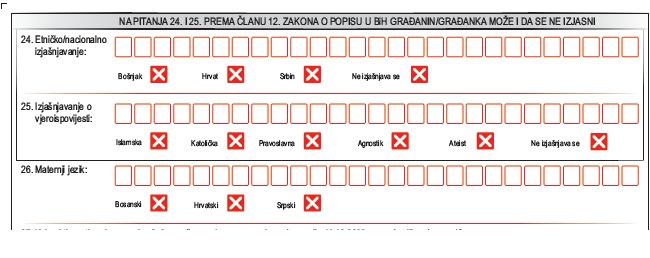
Over the past two weeks, Bosnia held a small scale sample census to prepare for the much expected 2013 census. The census has been postponed several times and is highly controversial, mostly because the issue of ethnonational identity. Not only are quotas in the civil service and elected offices allocated according to the census (so far formally according to the 1991 census, but down the road it might be hard to uphold this if a new census is available), it is also an important tool for all parties to bolster respective claims (i.e. about the Serb predominance in the RS, about the number of  Bosniaks in Bosnia overall). Today, nobody knows the number of inhabitants, not to mention their self-identification. It is thus no surprise that the census results will be hotly contested. Already the run up to the census has been controversial: the identity questions about ethnic/national identity and religion have created heated debate once the first draft questionnaire was published. While offering write-in options, it did offer the categories Bosniak, Croat, Serb, undeclared and other (write in) and below, neatly replicating the identity categories, Muslim, catholic, orthodox, undeclared and other.

The critique focused on the fact that non-religious citizens had no clear category available, nor did people with multiple identities. Again, all these categories were similar to censuses conducted in other countries of the region in 2011. In addition to domestic criticism international observers lobbied for less rigid and more open questions. The NGOs lobbying against the proposed survey were successful and the questions on identity were reformulated.

The new questions first gave a write-in option with the national identities only listed below, allowing for  respondents to choose more than one identity. For religious affiliation the questionnaire now offers the choice to be an agnostic and atheist, a significant change from the previous form and regional practices.

Image

The sample census hast just been completed and no results have been officially announced, but today Dnevni List published results of the census. The results have to be taken with great care, as we do not know if they are based on all sample municipalities, nor can we be sure that the results are reliable (the article includes some dubious claims, such as the suggestion that any nation that amounts to more than 50% of the population has the right to a nation state according to international standards). There is an important additional caveat. The sample census is not aimed at being representative. However, it was conducted in different regions of Bosnia, including the Federation, the RS and Brcko, in villages and in cities (or rather city municipalities, including parts of Banja Luka, Sarajevo, Mostar). Thus, it is not representative, but it can certainly considered to be indicative of country-wide trends.

If the results are even anywhere close to being indicative, it would be quiet an earthquake for Bosnia’s identity politics. According to the article, 35% declared themselves to be Bosnians and/or Herzegovinans, especially younger citizens. This would make this group presumably larger than any of the three nations and certainly more so than Croats and presumably Serbs. In addition, many older citizens appear to have identified as Muslims rather than as Bosniaks. Others identified as Catholics and Orthodox rather than as Croats or Serbs. This would suggest that state and religious affiliation matters more than national identity to many.

While the article does not publish the results in percentages, the data presented would suggest that against most common expectations ethno-national identity categories have largely failed. State identity might be stronger than expected and the uniform ethno-religious categories have been challenged.

Even if there are no immediate implications for the political system, in case these results are replicated country-wide, it would have considerable consequences. It would be hard uphold institutions such as the three member Presidency and the House of Peoples which currently exclude all non-Serbs, Croats and Bosniaks. The implementation of the ECHR ruling regarding Sejdic and Finci would also receive greater urgency. It might also raise questions why non-ethnic parties fared so poorly if they have such a large pool of potential voters and might reinvigorate electoral campaigning of this population group.  Either way in Bosnia, censuses are elections and vice-versa. It will be important to look out for the census/election results next year.

Who won the Montenegrin elections?

I participated in a workshop on the state of the Western Balkans last week in Munich organized by the Hanns-Seidel Foundation, the party foundation of the Bavarian Christian Democrats. As a speaker noted that in Montenegro there has not been a change of government through elections since 1945 (a point I have made as well), an unnamed gentleman sitting next to me whispered in my ear “This is just like in Bavaria!” The location, the “Franz Joseph Strauss Saal” made the comment even more appropriate. There are some differences between Bavaria and Montenegro, however. A political system with a single party dominance can be more easily compatible with a consolidated democracy when a region of a larger state is in question. At least national politics brings about changes of government. It could thus be argued that the lack of change of government (at least not through elections), indeed a feature of Montenegro, has become a more serious deficiency of the political system once Montenegro become independent. However, looking a the result of the most recent parliamentary elections suggests that this is not about to change.

As the election results came in, both the government and opposition celebrated their victory. The opposition of course did not win the largest share of the votes, but it celebrated for depriving the governing coalition of their absolute majority. So who really won?

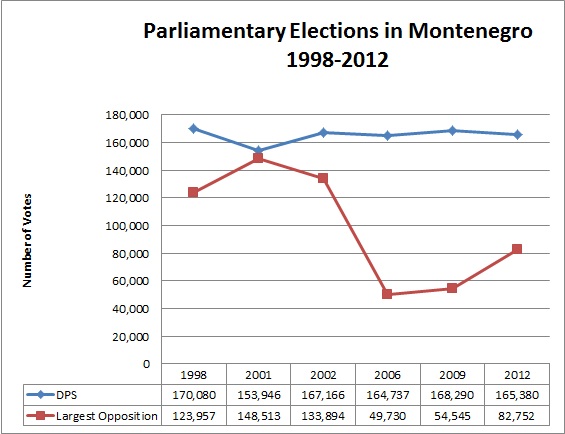
It is true that the governing DPS and its partners (SDP and the Liberal Party) lost their absolute majority in these elections, but considering them as losers would be getting the numbers wrong. First, having won 46.3% of the vote and 39 of 41 seats necessary to form a government means that the current governing parties are still doing extremely well. A comparison with previous elections also shows that the loss of the governing coalition is insubstantial. Since 2002, i.e. for ten years, the ruling parties have gained nearly identical numbers of votes (between 164,000 and 168,000). This variation of less than 2.5% of the vote over a ten year period is a striking sign of stability and the ability of the DPS and its allies to mobilize a very stable and large segment of the electorate. From this point of view, the elections in 2012 were worse than in 2009, but better than 2006. Thus, there is clearly no defeat visible here. If we look now at the largest opposition party, we find considerably more variation over time. The lowest point is reached in 2006 when the opposition is divided between pro-Yugoslav (whatever that meant at the time), Serb national and technocratic-economic camps. The opposition has left this low point now firmly behind, but it remains weaker than the SNP was as the main opposition party in 2001 and 2002. While the Democratic Front might signal the increasing ability of the opposition to form a joint platform and focus on issues other than identity politics, the odds of winning elections without a change in DPS seems difficult to imagine considering its very steady electoral base.


Normal Name, Strange University: The Global Network of the European University

After writing about private universities in the Balkans last year and the “Oxford” award that a number of universities in the region have received (here, and here), there is another institution that caught my attention. It did not make it into my top ten list, because its name is less interesting and nothing immediately caught my eye, but eventually it did. There is a university in Belgrade, called European University.

Not only by name, it appears to be a very European institution:

So the founder and rector Milija Zečević, who features prominently on the main website (and most other pages here, and here , it is the university’s version of where is waldo?), has a long list of honors, which give the impression that he is in the elite of European Academia, he is a president, an academician, doctor hc, Grand Doctor of Western Philosophy and a Commander of the World Order Science. Wow. That all sounds very impressive. So let’s look at these honors and achievements:

He has an honorary doctorate from the Albert Schweitzer University in Switzerland. Never heard of it? You should, it’s a truly international institution. Its website is in English and Spanish and its president is in Madrid, its rector in Argentina and other functionaries in Warsaw, Spain and Alabama. Very international, but its seems that neither rector or president or any other leading official is based in Switzerland. As the university points out, “ASIU does not grant academic degrees,” but it does seem eager to grant honorary degrees.

And courses does it teach? Well, it seems to offer no courses of its own (“Traditional academic classes will in fact be but a small part of our activities”), but it does refer to a number of institutions, including the London Diplomatic Academy (which among its publications offers the Royal Book of Diplomacy and Science which “gives biographical data on our members and lists the most important addresses of the diplomatic missions accredited before United Nations. It is a publication of quality and distinction” and some important documents that are hard to obtain elsewhere such as the Universal Declaration of Human Rights (New in the 2004 edition) and can be purchased for 100 Euros or in the luxury edition for 170 Euros)…. and the European University in Belgrade.

The rector also has a “Grand Doctor of Western Philosophy” and is Commander of the World Order Science from the European Academy of informatization. Now I have never heard of a “grand” doctor, but presumably it is bigger than a regular Doctor. The European Academy of Informatization does not have its own website. There are, however, some sites and online fora  suggest that this might not be an entirely serious institution. According to an article in La Libre, a Belgian publication, this Academy also granted a title to the late dictator of Turkmenistan Saparmurad Niazov for his achievements.

Now, the rector is also President of the European Academy of Science. The European Academy of Science is not to be confused with the European Academy of Sciences, or the European Academy of Sciences and Arts. The European Academy seems at least to have the same webdesigner as the European University and is an NGO based in Vienna. It is an exclusive club of just 16 members, according to the website. As one member helpfully points out, being an academician is a great honor as, “one Academician per million people”. This gentleman also happens to be or have been the Director of the London Diplomatic Academy; President of the Albert Schweitzer International University, Geneva and Vice-President, International Center of Informatization in Brussels which might just have something to do with the European Academy of Informatization. Four other members are from Belgrade. Another member is Eduard Evreinov, who is also responsible for the European Academy of informatization and something called the World Distributed University (aka World Information Distributed University), and has been associated with a number of universities and institutions  that are suspected on internet fora to be diploma mills (see here , here , here).

Now, if you are impressed with this dense network of academicians and scholars, here is something else. According to the Serbian accreditation of the European University, this university has the following “members” abroad (Чланице Европског универзитета из иностранства):

European Academy of Science, Vienna

European Academy of Informatization, Brussels

MIM – The Center for European Master and Doctoral Studies, Budapest

Institut Franco-Americain de Management, Paris

Sales Manager Akademie, Vienna

London Diplomatic Academy – London

Albert Schweitzer International University, Geneva.

It would seem that the European University in Belgrade thus a prestigious network of “members” abroad that have been honoring the rector of the university they are part of with all these outstanding honors.

And now I think I have earned a Grand Doctorate.