Glorious Kosovo-Agriculture Cooperation between the Glorious Nations of Serbia and China

“Serbia, China agree to boost agricultural cooperation”

This is todays headline of the Chinese XINHUA news agency. Not exactly saving Kosovo…
Here’s a reconstruction of the conversation:
Kostunica: You have to veto the Artisaari plan, it will forcibly remove 15 % (actually, we re-calculated, it is 15.3%) of our territory. This will be a precedent…etc etc
Hui Liangyu: (looking distracted through the window)… I see you have nice corn fields, do you want to sign an agreement?
Kostunica: Yes, especially for the cornfields in Kosovo, so that we trade on the basis of all 100% of Serbian corn fields, not just 84.7% of them. etc. etc.
Hui Liangyu (yawning) Okok

and thus the glorious agreement on boosting agricultural cooperation was signed

Finally the “I” word has been mentioned officially for Kosovo. Today Ahtisaari unveiled his plan for Kosovo and after avoiding now, as expected, mentions that Kosovo should be given independence. The hesitancy over the past seven years to name future status of Kosovo this explicitly has been understandable, but also gave unrealistic hope to the Serbian elite that anything else was an option. At this point, unfortunately, it still looks like Serbian authorities will be busier preventing the decision in the Sec. Council and any implementation, rather than making the best of the offer and the extensive minority rights protections offered in the package.

Gloomy Balkans?

When discussing the Western Balkans with analysts and policy makers, one can notice distinct mood shifts over the years. In some cases is might be just because you are at a gathering of optimists or pessimists, in other cases it has little to do with the situation in the countries, as it might be the case of dissapointed internatioanl (false) expections or what is bad in one country does not necessarily bode ill for another.
Be this as it may, it was striking to note the worried atmosphere at a meeting last week in Paris of EU policy makers and analysts. After 2006 seemed like a year where transition from post-conflict to European integration would be more tangible, little was decided. Now 2007 might be overwhelmed by the legacy of 2006. Both the status decision for Kosovo and the shutting down of the OHR in Bosnia appears already to be too much in one go. So, local ‘ownership’, the buzzword of a few years back has fallen in popularity. It appears that the future EU mission in Kosovo will be similar to the OHR including the Bonn-powers (to dimiss officials and pass legislation) and since the current High Rep. Schwarz Schilling is leaving early and even he noted the continued need for the OHR, full souvereignty to Bosnia also seem to be not forthcoming any time soon. To a large degree, the talk of an independence referendum of the Serb Republic by Milorad Dodik is to blame. Ironically, one of the politicians the most critical of the international community and of the OHR in particular has thrown it another life-line.
Whether the OHR will remain effective and it’s decision legitimate remains to be seen. It is an emperor without clothes and if it is called on its weakness, there might be difficulties ahead. A few years back, a good part of Bosnian citizens supported an increase in the power of the OHR, in 2006 the UND early warning report notes that supporters of reducing the OHR’s competences are larger than those who would like to increase it among all three national communities. Similarly in Kosovo, there is a question whether such a type of mission will be legitimate and accepted, especially as the status solution is unlikely to satisfy anybody fully.
Finally, as there is a sense that EU enlargement might be slowed down and not because of the countries in the region, but because of the EU’s current internal crisis, the key carrot might be loosing some of its pull.
Altogether, the meeting left me thinking that despite some key decisions being taken in 2007, stability remains at risk and we might have to wait for 2008 for more courageous steps towards EU Integration of the region.

Last Monday, I participated in a discussion on the status of Kosovo and its implications at LSE. What was striking beside the apparently large interest in the topic was the diaspora mobilization. As a result, it was more controversial and difficult to talk calmly about some issues, such as conditional independence, than in Belgrade (or Prishtina). I guess abroad there are more people who see their role as “professionally” defending what they think their nations’ interest is.

University Cafeterias as breeding ground of revolutions from Kosovo to Lebanon

Beware of university cafeterias. More than once in recent history have they been the source of protest and unrest. The mention that the confrontation between supporters of Hizbollah and other opposition groups and government followers began in the cafeteria of the Beirut Arab University. This reminds me of the 1981 demonstrations and riots in Kosovo which also began in the university cafeteria over bad food and later demanded the status of republic for Kosovo.
Solution: Close down university cafeteria in troubled times… or maybe serve such good food that nobody can complain.

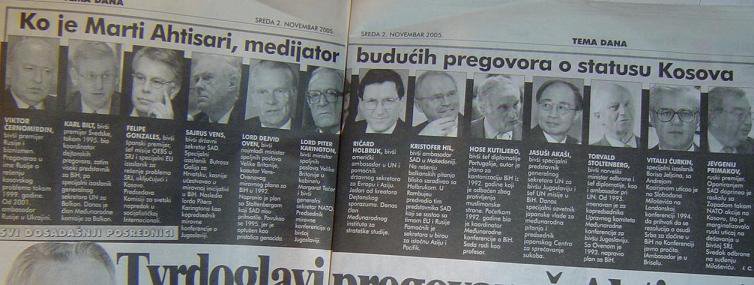
Many international mediators of Kosovo


Blic published today a nice little list of all the international negotiators Serbia and ex-Yu has seen come and go (and in some cases come back again). Some forgotten (does anyone remember Vitalji Churkin’s efforts) others more prominent.
Any further additions to the list welcome.

No. 1: Jacques Poos, the foreign minister of Luxembourg who uttered those famous words about the hour of Europe dawning.

Substance or Status: published comment for NIN (I wonder why?)

Here’s a short comment on the beginning of the status talks on Kosovo. I wrote it for NIN, the Serbian weekly, but they decided against publishing it in the end.

Substance or Status?

The beginning of final status talks is an acknowledgement that democratization, minority rights and economic and social development in Kosovo cannot be advanced without resolving the status and local authorities taking more responsibility. While timing matters, there was never much doubt outside of Serbia itself since June 1999 that Kosovo would not return under Serbian rule. At the same time, the failure of both the international presence and the political elite (Kosovo Albanian and Serb alike) to promote a democratic society, a vibrant economy and a functional political system, suggest that ‘independence’ (with or without qualifiers) is not going to resolve the problems of Kosovo, but without a resolution of the status question, non eof the real issue will be tackled.
So where to go from there? The formula of the Serbian authorities “Less than independence, more than autonomy” does not help much and is in fact as little of a compromise (why would one side propose a compromise?), as complete independence from the Kosovo Albanians side. Even in the worst repression under Milošević, Kosovo was conditionally independent in the sense that Serbia did not control the social, political, cultural and economic life of the Albanian majority other than by repression. It is hard to offer less independence to a population and government who will act as if they have that independence (consider Montenegro).
What is lacking, both on the Albanian and on the Serbian side, however, is a discussion on the substance, not the form of the final status. What should be the substance of Serbia’s interests in Kosovo? Here are some suggestions: a) the rights of Kosovo Serbs should be secured and displaced Serbs and Roma should be able to return in Kosovo (or receive support if they want to stay in Serbia); b) the border should be open and there should be a free flow of goods and persons between Kosovo and Serbia, c) the cultural heritage in Kosovo, including the Serb heritage should be protected (argubly the cultural heritage is European, not only Serb). d) Kosovo should be stabile, with strong institutions and a vibrant economy. Such practical goals, rather than symbolically clinging to formal status, are much more likely to yield results and provide both security for Serbia and a future for Serbs in Kosovo.