The surprising-unsurprising “Yes” for the EU in Croatia

The referendum on EU accession of Croatia gave a resounding “Yes” in favor of joining the EU. According to the final results, 66.27% of citizens who turned out voted in favor. The No vote got only  a third of the vote. Striking is that every county of Croatia voted in favor of joining the EU, even the most Eurosceptic region of Dubrovnik-Neretva stilled voted 56.93% in favor. The regional variation is thus not very great and there is no clear regional pattern except for the two southern regions of Split and Dubrovnik being more skeptical. Support was great in towns close to the EU, such as Varazdin and Cakovec, but also in poorer towns and regions like Slavonski Brod or Gospic. This suggests that the reasons for support were multiple. Opponents of the EU did not do well, even in strong-holds of more nationalist parties, such as in Slavonia where the HDSSB did well in parliamentary elections. Ironically, it would seem that the Euroskeptics did best on the Dalmatian islands of Brac and Hvar. For example in the two municipalities of Jelsa and Stari Grad on the Island of Hvar, support for EU accession was just above 50% (51.16% and 51.79% respectively). This would also suggest that rejection of the EU is less based on the nationalist arguments heard in the referendum campaign, but possibly on the sense of some tourist destinations that membership will not bring an tangible benefits. The few Bosnian Croats that voted (just over 6000, or 2.3% of eligible voters) endorsed EU membership with 87.85%.

The turn out in the diaspora was low, but so was it in Croatia itself. This somewhat puts a dent into the referendum results. Only 43.68% of eligible citizens voted. The low turn out is not unique to Croatia: elsewhere similar referenda often had an equally low turn out. Now it could be argued that the result is no surprise. No significant parliamentary party campaign against joining and even Ante Gotovina in custody at the ICTY endorsed the vote, undermining nationalist argument against accession. So no surprise? Well, there might not have been no surprise now, but only a year ago, Euroskepticism was high. Protests last year in Zagreb burnt the EU flag, even if protestors agreed on little else. For years prior, Croatia had become by far the most Euroskeptic country in the region. In 2009, according to the Gallup Balkan Monitor, only 26.2% of Croats thought the EU was a good thing, nearly half of the runner-up Serbia, in 2010 the number dropped to 24.8%. So were the numbers wrong? The referendum suggests two things about support for EU accession in the Western Balkans: First, citizens might be growing weary of the EU as negotiations drag on, once they are concluded, it is easier to warm up to the EU. Second, many citizens might not “love” the EU, but they consider it the least bad option. Thus among many “Yes” voters in Croatia today are surely also those who rather not take any chances, especially as the alternative remained unclear and potentially risky. Thus, even if support for accession is likely drop in the other countries of the region–as it so often dues in the accession process–this does not suggest that citizens will vote against membership at the end.

A semi-surprising outcome of elections in Slovenia and Croatia

Ballot Paper for the Croatian elections: evil and lesser evil

A few days a ago, I had the chance to discuss the outcome of the parliamentary elections in Slovenia and Croatia (see here for the podcast). The fact that the incumbents lost the elections was no surprise. Not only is the current economic climate across Europe such that incoming governments have little chance of winning elections, no matter whether they are from the left or right, but also opinion polls in Croatia and Slovenia had predicated a resounding loss of the governing coalitions and parties. The main surprise was the victory of Positive Slovenia led by Ljubljana’s mayor Zoran Jankovic and founded only six weeks ago.

A striking feature of both elections in Slovenia and Croatia is the decline of the extreme right. Even though both elections were fought under the impression of a severe economic crisis and popular dissatisfaction, the extreme right could not benefit. For the first time since 1992, the Slovene National Party did not win a seat in parliament. In Croatia, the extreme right was represented by a confusing number of incarnations of the Croatian Party of Right, winning an all time low of one seat (the Croatian Party of Right running alone and winning no seat, the Croatian Party of Right-Ante Starcevic running with the Croatian Party of Pure Rights winning one seat and another autochtonous Croatian Party of Right). For full results see the final report of the election commission.

Of course, this does not mean that there were no populists winning elections. The ruling HDZ campaign on nationalist themes (unsuccessfully), denying national legitimacy to the opposition. It also formed a regional coalition with the populist mayor of Split Zeljko Kerum. The winner of Slovene elections is a populist, although more of the center left and the second party, the Slovene Democratic Party of Janez Jansa is heavily drawing on populist themes and seeks confrontation on classic national-populist themes.

The new centre-left governments in both countries have daunting tasks ahead of them. They have to engage in painful economic reforms and not just make few changes, but alter the very structure of the economic system. Even if Slovenia has been government mostly by centre-left governments since independence and Croatia by conservatives, there is a broad shared social support in the countries for a state that provides extensive services, be it in regard to health and social benefits or for employment. Such a state seems in both countries currently no longer sustainable. Thus “slimming down” the state will be inherently unpopular and left-wing coalitions will be forced to pursue neo-liberal reforms. This will make it likely that both new governments—if Jankovic is able to form a coalition—will quickly become deeply unpopular. Unless they are able to turn a corner in terms of economic growth quickly, they both seem likely to be replaced at the next elections, or even earlier. There is in fact a sense of deja vue in both countries. In Slovenia, the coalition seems like to be sabotaged by the abuse of referenda—the strategy employed by Jansa’s SDS in the past. In Croatia, the uncompromising position of Jadranka Kosor on election night suggests that HDZ might try to sabotage the government from the streets, a successfully strategy of Ivo Sanader’s HDZ ten years ago. Now, it might not be over war crimes, but economic cuts. While it does seem likely that the new governments will become unpopular, it remains still unclear on what the alternatives will be. Jansa’s SDS seems to be struggling to be electable to a majority of Slovenes and HDZ will have to decide between just reinventing itself or finally reforming itself, if it can.

Water and plums with Ante Markovic

Ante Markovic (Source: Nacional)

When I went into his office in early September in Sarajevo, there was no doubt in recognizing the person opening the door. Ante Marković had aged since being the last Prime Minister of Yugoslavia and being a witness at the Milošević trial eight years ago, but was full of energy, dressed relaxed and confident. He offered me some plums and water. I had come to invite him to a conference on the end of Yugoslavia I organised in Graz. We had been discussing his visit for months, but he remained hesitant whether to come. However, when I called him he was enthusiastic about meeting Sarajevo and discuss the conference. It was a tough sell. Marković was curious about the conference and genuinely hesitated about whether to come or not. He made me give him the best sales pitch I could offer, why he should come to Graz, the place he spent a decade after he resigned as prime minister. It was close to home, somewhere in Yugoslavia, when home was not really an option. He was a persona non grata for governments in Slovenia, Croatia and Serbia, for different and yet similar reasons. Only Macedonia kept an open door. However, returning to Graz after all these years did not convince him. He had fond memories of Graz, he told me, but this was the past. He had returned to Sarajevo after a decade outside of Yugoslavia. He told me about the offer to advise the Bosnian government, an offer he turned down in order to focus on his business. He originally intended to build water power stations in Bosnia, a plan which failed, leading him to focus building apartments and houses in and around Sarajevo.

When he first tentatively agreed to come to Graz, he did so with the caveat that urgent business meetings could always get in the way. At an age when many might look back, he was firmly looking forward. This was also the reason he decided not to share his memories of the dissolution of the country at the conference. He did not want to look back. He said this without any bitterness or sadness about the past. He had little good to say about todays politicians or the politics in the post-Yugoslav space, but he seemed to have little nostalgia. Maybe this is not surprising, considering that his brief time (just over 2 years from March 1989 to December 1991) as prime minister of Yugoslavia (officially the president of the Federal Executive Council of the Socialist Federative Republic of Yugoslavia) was decline despite his efforts to save the country and economy.There was no time to celebrate his successes at curbing inflation, filling the shops and giving some renewed confidence in the political system.

Even though he withdrew from public life after his resignation, he was very much aware of how popular he was throughout Yugoslavia. But he would remind me in our conversation, how this popularity stems from two years of his life, but his work and passion was not politics, but working in companies, something he did for decades, both before holding his first political offices in Croatia in the early 1980s, and after moving to Graz to start a new company.

Looking back at the economic reforms he initiated, Ante Marković did not think of them as opening the door towards a liberal market economies. While liberalising the Dinar and enabling privatisation and greater private engagement in the Yugoslav economy was the first step towards a market economy for all the seven states now on the territory of Yugoslavia, he rather saw his reforms as an effort to bring about a new type of economic system that would preserve the best feature of socialist self-management and combine them with some aspects of market economy. The global economic crisis reminded him of the failings of capitalism and the abandonment of the socialist system without the effort to preserve some features appeared a mistake in his mind. While he was persuasive and the economic difficulties especially in the Yugoslav successor states seem to prove him right, I was not entirely sure that the economic system he was beginning to build really could have become an alternative. But, as so many of his successes, they are incomplete and thus remain a path not completed.

His memories were a curious mixture of pride and awareness of his significance at a historical crossroads, but also a lack of interest to be celebrated for this. This might also help answer the puzzle of why his efforts to challenge the rising nationalist elites in Serbia, Bosnia and Croatia failed. His reformist party gained some votes, especially in Bosnia, but was not able to challenge the new nationalists (he founded them in July 1990, too late for elections in Slovenia and Croatia). He might have lacked the drive and will to impose himself and his ideas were popular, but not sufficiently populist for the time.

I left the office with a strong handshake by Ante Marković and an invitation to return anytime if I were in Sarajevo. Unfortunately now an offer I will not be able to take him up on. As I emerged on the streets of Sarajevo, not far from the new EU offices, I was wondering if the people I passed on the street knew how close Ante Marković was working in normal office building, building houses, as had he not been, briefly, the best hope in the worst of times.

Stagnation or the consolidation of not-quite democracy in the Balkans

A few days ago, I attended an interesting discussion on democracy in Serbia. The panel presented a recent survey conducted by the Institute for Social Sciences in Belgrade. The results were not overall surprising, but highlight some interesting trends. In particular, most striking was the fact that while most citizens support a democratic system of government, they have a very skeptical view of democracy and a majority does not consider Serbia to be a full democracy, but some kind of hybrid between democracy and authoritarianism. This is  a considerably more gloomy view of democracy than rankings such as Nations in Transit or the Bertelsmann Index. It might be time for these to also take popular assessments of democracy in the respective country into account. Beyond that, there seems to be some a trend of democratic stagnation in the region. None of the regimes in the Western Balkans are dictatorships, but neither are they consolidated democracies. The problem already lies in the terminology: The term unconsolidated democracy, as used by Nations in Transit and many scholars implicitly suggests that it is “natural” to move to a consolidated democracy. In recent years, hybrid regimes have been taken more seriously and we had recently a good discussion on this regime type by Ivan Vukovic, a visiting fellow at the Center for Southeast European Studies, however the terminology is still often confused and confusing. Both the semi-authoritarian regimes of the 1990s (Milosevic, Tudjman) were hybrid regimes, as are the governments of Macedonia, Montenegro, Serbia, Bosnia etc. today. Of course, they differ substantially, the former leaned more towards authoritarianism and the latter more towards democracy. The question arising from the discussion, especially with Irena Ristic and Vedran Dzihic, was whether or not these types of regimes should be considered not just a temporary glitch, but rather as a discreet and stable type of regime.

Decreasing support for EU integration and elsewhere in the region, as well as democratic backsliding in countries like Hungary suggest that there might be a permanent “democracy gap” in the making, i.e. the current democracies in Southeastern Europe might be stable and have a number of features that set them apart from liberal democracies. However, rather than seeing it as a deviation towards the inevitable goal of a consolidated liberal democracy inside the EU, it might be helpful to consider them as there to stay, EU membership or not. Of course, this is not to argue that there a liberal democracy is intrinsically impossible in the Balkans, a point that would smack of essentialism, but rapid change and catching up seems unlikely. If one takes this perspective, understanding how these regimes work is not just tell the story of how they deviate from liberal democracy, but rather how they empower particular elites and are strikingly resilient and adaptable. It also means that our tools to analyse these kinds of democracy are entirely inadequate. For example, Irena was noting that while party membership might indicate popular engagement with politics in a consolidated democracy, in hybrid regimes in Southeastern Europe, party membership means access to jobs, and not political engagement.

A friendly letter from the International University of Struga

In June I wrote a post on private universities in the Balkans with strange names or websites. For some reason, the blog was picked up a few days ago and become quiet popular. In addition to a short article in Vijesti which noted that UDG (or as a reader calls is JuDiDži) is on number 3 of the top 10, I also received the letter below from the International University of Struga.

Dear Mr. Florian Bieber,

Well, Mr. Bieber let us teach You that when a researcher comes out with such accusations should make serious research because any other allegation without facts is cause for a criminal offense.

Even relying on data from our website, we responsibly claim that you have not handled it well because what you say African-American students, is information that we have a good academic collaboration with the University of California precisely with American Heritage University.

In the future when you undertake to write articles of this type be well informed and do not play with the dignity of institutions and employees. From where do you know the academic staff and their quality? You stay in your office, click on the web pages of universities and make decisions, well, Sir in order to come up with such facts at least you are supposed to stand up from the chair in which you are pinned and to visit these universities and explore, if one day you want to become a professor in the true sense of the word.

According to the above and according to the values that should possess a professor turns out that you are in the top list of most miserable professors who play and imagine they are scientists.

Obviously you need attention!

We inform you that for Your accusation the legal department of our university is preparing to submit criminal charge because it is a slander.

Sincerely,

International University of Struga

Now I should clarify a few things: the list of “bizzare” universities was based on the self-presentation of the universities and their name. Some might be trying hard to become respectable institutions, some are degree mills (I just heard that there is a university in the region housed in a former mill).

Now specifically for the International University of Struga. When I wrote that “According to the website, the uni boasts many African-American and Asian-American students, palm trees,” this was not based on field work, but on irony. If one visits the website of the university the pictures look like they were bought from the ACME university photo shop and do not seem to show much of IUST. Thus, if one were to rely on the photos, it would look like the student population of IUST looks more like that of a college in California than on lake Ohird.I am also curious to hear how claiming that a university is having African and Asian-American students and palm trees is slanderous (even if it is not true).

The Risks and Benefits of Ethnic Citizenship

Millions of people in Southeastern Europe are citizens of more than one state. Many acquired this status when they were gastarbajteri [guestworkers] in Germany, Austria and elsewhere in Western Europe; others received a second passport as they fled the wars that accompanied the disintegration of Yugoslavia. For some people, dual citizenship seems due to a quirk of fate: for example, their father may have been born in a different Yugoslav republic than they and held that republican citizenship when Yugoslavia was still a single country and when republican citizenship had no practical significance. Due to some long abandoned vestiges of patriarchal rules, today they have the right to a second citizenship of a republic they never lived in. Among the many ‘multi-citizens’ of Southeastern Europe there are probably a million who have received passports from countries they have never lived in. Hundreds of thousands of citizens of Bosnia and Herzegovina hold Croatian citizenship as a result of their ethnic Croat identity. Over 50,000 Macedonians also became citizens of Bulgaria after declaring themselves to be ethnically Bulgarian. Recently, Serbs from Bosnia (and elsewhere) have been able to become Serbian citizens by declaring their loyalty to Serbia—most prominently, President of the Serb Republic, one of the two Bosnian entities, and Milorad Dodik, who publicly submitted his request for citizenship to the Serbian Foreign Minister Vuk Jeremić in 2007. Nearly a million Moldovan citizens have applied for Romanian passports and over 100,000 have been granted EU citizenship, on the grounds that they are descendents of former Romanian citizens who lost their Romanian citizenship when Bessarabia was annexed by the Soviet Union in 1944.

Read the rest of the comment at: http://www.citsee.eu/op-ed/risks-and-benefits-ethnic-citizenship


Riots of consumerism or a new kind of retail therapy

The riots (called civil unrest by Al-Jazeera) are not “criminality pure and simple” as David Cameron called it. Of course, they are criminal and I have no sympathy for those committing the looting and violence. However, characterizing them just as a crime fails to capture the context.

2011 is the year of social movements, from the Arab spring to mass protests in Southern Europe and lately in Israel and now in the UK. The social movements have their origins in the global economic crisis. They might be triggered by the hopelessness of the poor as in Tunisia, the dim prospects of the shrinking middle classes in Israel, Spain or Greece or the lack of perspective for “youth” in many parts of the UK. Of course, not all types of social movements and types of expression are equally legitimate or understandable, but they have similar origins.

Looting is in many ways the most appropriate expression of a social movement in the UK. British society has struck me as more consumer-oriented than in any country I have lived in (save possibly the US), definitely beating the rest of Europe. Shopping is the fun activity to do on Sundays. If you are feeling down, you go for “retail therapy”. If you are politically active, you do or do not buy some product or from some company. Looting is taking a social trend to the logical conclusion where there are members of a society are less and less citizens and increasingly only consumers.

The second striking feature of British society in contrast to most other European countries is the latent and often open violence and aggressiveness or a particular social group (mostly defined by age and social background), visible on Friday and Saturdays in any given British town or city. The often tense and distinctively unpleasant atmosphere in British high streets as dark falls stands in stark contrast to most European down towns. The violence in recent days of course by far exceed this everyday violence and aggression, but those provide the subtext which made the large-scale violence possible.

The riots and looting have been coupling these two trends, a consumerist violence to express an dissatisfaction of a social group which seems unable to clearly articulate either the exact nature of their disgruntlement or the cause (besides the police, the Conservatives and the state in general), but they are sure angry.

While it is a first step to recognize that an underclass exists in the UK that feels like it has little to loose and is socialized to believe that consumerism (including consumerist violence) is both a means of political expression and outlet for grievances (retail therapy of a different type). What is needed is a broader debate about social cohesion in the UK, how consumerism replaced other forms of social engagement and the manner in which public displays of aggression are more acceptable than elsewhere.

Kosovo: Of Talks and Violence

Just three weeks ago, relations between Serbia and Kosovo seemed to have been the best in many years. A first agreement between the two governments paved the way for increased freedom of movement in regard to travel with ID cards, license plates and other technical issues. The atmosphere between the key negotiators Edita Tahiri and Borko Stefanovic seems professional.

The nationalist opposition in Serbia and Kosovo opposed the agreement, with Vetevendosje suggesting that it further undermines Kosovo’s sovereignty and DSS and the Radicals in Serbia arguing that the agreement leads to Serbia’s recognition of Kosovo. In brief, it was exactly what the EU had hoped to accomplish, a practical first step which paves the way to further negotiations and building confidence between the parties which had mostly talked at each other. This outcome was more encouraging that most observers (including myself) had predicted due to the upcoming Serbian elections early in 2012 and the rather weak Kosovo government. The reason it became possible was combination of the Serbian government banking on the EU candidate status prior to elections and an agreement with Kosovo can only improve the odds. The Kosovo government on the other hand appears to have trying to regain its international legitimacy through serious talks, after Thaci was tainted through the Marty report and the flawed parliamentary elections.

How did this success in talks so quickly descend into the latest round of violence? The talks did not resolve the issue of Kosovo products being able to enter the Serbian market, which has been impossible to date and hurt the fledgeling Kosovo economy. In an apparent move to improve Kosovo’s bargaining position and in response to Serbia apparently stepping away from a deal of customs (talks scheduled for mid-July were postponed for September as parties were unable to come to an agreement), Kosovo banned the import of Serbian goods. As Tim Judah convincingly argues, this was an unpleasant surprise for the Serbian government, as it suddenly and unexpectedly upped Kosovo bargaining power in talks where the pressure on Serbia traditionally came from Brussels (or Washington), not Prishtina. Of course, the implementation of such a ban is impossible as long as the borders as permeable and the government has few options of preventing the import of Serbian goods. If it would stop such goods on the border between north and south Kosovo around Mitrovica, it would only help consolidate the partition. Thus, it dispatched the special police unit ROSU to take over the two main border posts between Kosovo and Serbia in the North. It reached one and was blocked by Serbs barricades at the other. However, it was not to stay for long and was forced to withdraw soon thereafter under international pressure. During operation, a ROSU member was shot and killed by a sniper, presumably linked to local Serb nationalist structures. The barricades erected in the North and the subsequent burning down of the Jarinje border post by hooligans (according to Tadic) or a local smuggler (according to Blic) mobilized the Serbian parallel power structures in the North and further raised the stakes.

Apparently, the Kosovo government sent the police without consent of either the EU or the US government and the operation seem to have been planned by the government rather than being a regular police operation. Altogether this would mean that the operation was effort by the government to create a fait accompli (on a side: Milos Vasic reminds us that seizing customs posts is also how the war in Slovenia began in June 1991).

The incidents have fueled suspicions on both sides and encouraged both extremists  and spoilers. While the Kosovo government and media appear to be convinced that the Serbian government was behind the burning down of the border post in Jarinje, the Serbian media had a hard time imagining that the police operation could take place without international support.

The Kosovo government now threatend that it would arrest the Minister for Kosovo Goran Bogdanovic and the chief negotiator Borko Stefanovic if they entered Kosovo. While this is a symbolic gesture as the ability of the Kosovo authorities to arrest them in the North is limited, it undermines future talks and links the incidents back to the negotiations.

Although the official goal of the police operation failed, Prime Minister Thaci claims that there is no return to the status quo ante. He might be saying this to save face after the failure of the operation. Alternatively, one can consider the operation a success. He gained credibility domestically and for the first time the Kosovo government took the initiative without seeming to be remote controlled by the US embassy or others. The operation certainly put the status of the north on the agenda. The price the government might have been too high, though. First, the operation, which seems clearly reckless (it reminds of Saakashvili ill-fated intervention in S. Ossetia in August 2008) and without much promise to lead to a real rather than symbolic change, suggests that the Kosovo authorities have become more unpredictable and willing to use unilateral force to change the situation in their favor. Second, it would also seem to strengthen hardliners in Serbia who have warned about armed intervention of the Kosovo authorities in the North. Finally, the operation is unlikely to have earned the government international sympathies, even from close allies.

As the violence seems to have ended and Kosovo’s North returns to the “tense, but calm” status, where does this leave talks and the parties? Both sides come out looking more vulnerable: Serbia for the first time felt pressure from the Kosovo government through the boycott and the police action, even if brief and ultimately unsuccessful. Kosovo has noticed that it cannot established its authority in the North without international consent. The international presence is reminded that the situation can escalate very quickly and limited the escalation of violence requires a strong KFOR presence. One good side effect of the violence might be that it shed a light on the continued criminal security structures in the North. No matter how one thinks about the ROSU police operation, the killing by sniper of a police officer and the burning of border post suggest that these networks remain ready to use force quickly to protect their interests. While Tadic has been seeking to reduce the influence of the political representatives of these structures, the incidents might encourage the Serbian authorities to clean up the North of Kosovo more vigorously.

Despite all the posturing at the moment, it seems unlikely that talks will not continue, both governments have too much to gain, yet the violence is a reminder that negotiations are determined not just on the negotiation table, but also on the streets of the North of Kosovo.

P.S. As reader pointed out, the Kosovo government was successful in as far as KFOR upon taking control of border posts at least temporarily blocked all further trucks coming from Serbia.

The first results of the Montenegrin elections, I mean census, are in

Today, Monstat has released the first results of the April 2011 census. It’s census year around world and also in the Balkans, which will mean a new snap-shot of controversial issues such as identity. In a politically charged environment, these are not so much definitive indicators of identities, but subjects of debate and contestation. In Montenegro, there has been an campaign led by different organisations to mobilise citizens to indicate their identity in a particular way. The muftija of Sandzak Zukorlic and the Reis ul Ulema Ceric called on Bosniaks to declare not only their religion as Islam, but also to declare their mothertongue as Bosnian and their identity at Bosniak. Similarly the Croat National Council called on Croat to identify as Croats, being Catholic and speaking Croat.

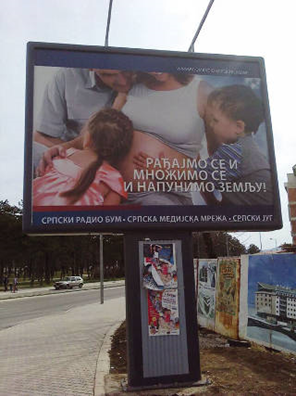
A Serb radio station put up billboards calling on Serbs to have children, to multiply and fill the country.

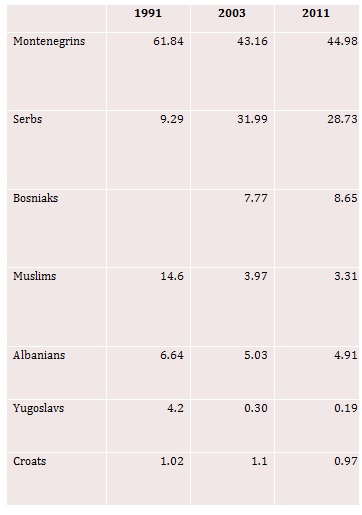
Similarly there were posters calling on citizens to identify as Montenegrins. In brief, there was a proper election campaign of identity. Observers have noted that elections in Bosnia are often a population census. In Montenegro in turn, censuses are elections. So who won? A quick comparison with the result of the last census in 2003 show that the decline of Montenegrin identity since 1981 has been halted and that there is a slight increase. At the same time, number of self-identified Serbs has declined slightly, but again this decline is only by a few percentage points. The number of Bosniaks/Muslims, Croats and Albanians has not really changed significantly.


These results suggest a stabilization of the identity categories since 2003. There were dramatic shifts in the previous decade , especially from Montenegrin to Serb identity, caused by the re-definition of Montenegrin identity as endorsing Montenegrin statehood. Despite the creation of an independent Montenegro in 2006, there does not appear a dramatic shift away from Serb identity.  What is also telling is the continued divide among Bosniaks and Muslims with around 2/3 identifying as Bosniaks and 1/3 as Muslims (8.65% and 3.31% respectively). It is interesting to note that around 0.8 % of the population indicate a composite identity (such as Montenegrin-Bosniak, Montenegrin-Serb), not a negligible group considering that such combinations are not usually encouraged in censuses. Also 0.19% still identify as Yugoslavs.

The fact that identity still does not follow the exact patterns that the nationalist logic dictates is best shown by the mother tongue. Only 36.97% of the population indicate that they speak Montenegrin, 42.88% call their language Serbian, and 5.33% Bosnian. Over 3% call their language Serbo-Croatian, Bosniak, mother tongue or by some other name. These results suggest that a majority of Bosniaks and Muslims don’t consider their mother tongue to be Bosnian, many Montenegrins choose a different language (presumably Serbian) and more than half of Croats don’t speak Croatian. Here, the number of Serb speakers dropped the most, indicating that the campaign of the Montenegrin state to establish Montenegrin as a language has borne fruit.

This picture is further complicated by religion where 72.07 % are orthodox, 19.11% indicate Islam or Muslim and 3.44% Catholicism as their religion. Agnostics and Atheists are just above 1.3% of the population.

This picture suggests that the congruence of religion, language and national identity is less “perfect” than nationalist engineers of identity would like it to be. At the same time, efforts to subvert these categories have not done so well: the campaign for Montengrins to declare as Jedi or Sith only gathered around 100 followers.

One Socialist party less in the Balkans: Dodik and the Socialist International part ways

After five years membership in the Socialist International, the Alliance of Independent Socialdemocrats of Milorad Dodik has been suspended at a meeting of the SI council in Athens. The suspension was for nationalism and extremist positions of the party.  The SNSD was only admitted in January 2006, just as it took over power in the RS. Considering the nationalist rhetoric of the party since the elections in 2006, the suspension is long overdue.The long wait was probable due to the (false) hope that the SNSD might return to more moderate policies. There has been no indication of this and there has long been nothing social democratic in its policies.

In response to the suspension Dodik announced that the SNSD would preempt its own exclusion by leaving the Socialist International. In explaining his move, he noted that there was no use to being part of the SI and that is members were responsible for the global crisis. Instead, he was moving to establish closer ties with United Russia the dominant party in the Russian Federation. This seems indeed like a much more appropriate match for Dodik’s SNSD: a party without any platform which provides for the support of the leader and is happy to dominate with undemocratic practices.

The suspension also puts an end to the curious situation that the key stumbling block to the formation of the Bosnian government has been the difficult relationship between two members of the SI: the SNSD and the SDP of Zlatko Lagumdzija. It also suggest that the SI was unable to make retaining membership sufficiently attractive to moderate Dodik’s policies–in contrast to Serbia where granting the Socialist Party (SPS) observer status in 2008 helped usher in the DS-SPS coalition government. Over recent years, Socialist parties and foundations have maintained low-level contact with the SNSD in the hope to shape the rank and file of the party. The exclusion from the Socialist International would probably mean that also those contacts would decrease (although this is up to the discretion of the individual parties and foundations). Considering the rhetoric and policies of the SNSD there is little indication that this affiliation had a moderating effect on the party.