Why Nikolic won and what it means

The victory of Tomislav Nikolić in the second round of Serbia’s presidential elections last Sunday surprised most observers, including myself, and demonstrated once more how unreliable most opinion polls in Serbia are. Already in March (in fact in January he first wrote it), Dušan Pavlović, a good friend and a level-headed observer of politics, made a key observation: Tadić scheduled presidential and parliamentary elections to take place at the same time to have his popularity “rub off” on the Democratic Party which has been considerably less popular then him personally. The idea was that by combining the two elections, DS would be more likely to win a new majority in parliament. But Dušan Pavlović wondered, rightly as it turns out,  whether the dynamic could not also work the other way around: What is the unpopular party tainted Tadić as candidate?

This is perfectly captured by the cartoon below by Marko Somborac, whose cartoons in Blic are some of the best analysis of Serbian politics. So, just like Slobodan Milošević in 2000, Tadić announces early presidential elections asking the question, “What is the worst that could happen?”

The worst happened, at least for Tadić. The quick deal with SPS after the first round of elections sent the wrong signal, there will not be change: Before Sunday night, it looked like the government will be very much the same, as will  be the president. This was clearly too much of the same for too many voters. What tainted Tadić in the eyes of many liberals has been his dominance of the government and holding onto the presidency of the party while being president, controlling the PM and giving too much space to Ivica Dačić and SPS–a coalition that seemed to have developed into a relationship. It is thus that not only Vesna Pešić, but also others who belong to the liberal end of Serbian politics decided to vote for Nikolić (or at least threaten they would).

For many ordinary citizens, DS and Tadić were also no longer the clear “European” option, as Eric Gordy notes: ” All the harm people had been warned to expect from Tomislav Nikolić had already been inflicted by Boris Tadić.” In addition, the difficult economic situation does not help any incumbent. Finally, the DS committed a strategic mistake in its  electoral campaign: The campaign was largely negative, warning of the dangers a victory of Nikolić and SNS. Once more to quote a cartoon by Marko Somborac, where he depicts a DS election poster stating “We know, unemployment, corruption, bad living standards, but ‘buh! Toma!”.

A campaign based on fear of a Nikolić victory was credible in 2004 and 2008 when he stood for the SRS, but todays SNS is hard to distinguish from the Democratic Party, especially when it comes to the two big themes EU and Kosovo. Thus, the transformation of the political system since the break up of the Radicals has been ignored by Tadić’s campaign, while citizens did note that there has been this important shift.  Thus, observers like Andreas Ernst of the NZZ are right that the outcome is more a punishment of Tadić than a victory for Nikolić (who did not seem to expect to win), yet without Nikolić’s transformation, this outcome would not have been possible. In short, many who either did not vote at all or voted for Nikolić last Sunday are not only punishing Tadić because of Tadić’s policies, but also because it became possible to punish him by voting for Nikolić.

So what does this mean? A long, excellent, interview Michael Martens from the FAZ conducted with Nikolić shortly before the elections demonstrates why there is good reason for any Serbian citizen to be embarrassed that this man became Serbia’s president. Not the fact that his academic credentials are dubious, but the fact that is unwilling to own up to his past and his cynical and hateful statements until a few years ago.  It seems clear that he has made a political turn-around after 2008 and all the first signals after his election victory suggest that he will continue along these lines, but his often twisted and confused responses about past statements suggest that the break was pragmatic, not substantial.

It is easy to be a good European in opposition when the price is low–but whether he is able and willing to make difficult compromises is far from obvious. He thus runs the risk of becoming another fair-weather European politician in the region, who likes the EU because voters do, but not when it comes to giving some pet issues. Of course, he might also be able to turn out to deliver on key issues, such as Kosovo, as he does not need to worry about a strong contender to his right calling him a traitor. Whether he will be come part-time pro-European politician or will be willing to make painful compromises remains far from obvious. Finally, if he is unable to forge a SNS led coalition, he might remain a lame duck president, reduced to the constitutional powers of the president. That in its own right might not be such a bad thing for Serbia’s democracy.

A European Journey from Zagreb to Graz

In Graz, everybody discussing Southeastern Europe, including myself, is eager to point out that Zagreb is closer than Vienna. Of course, this might be true in terms of kilometers, but not necessarily if measured by hours travelling. If you take a car, the journey for the less than 200 kilometers is a quick two hours, but if public transport is your choice (or not) things look different.  If one wants to travel directly between the two cities, there is a bus at 6 am, a train at 7.30 and finally one more bus at 23.00. These take a breathtaking four hours to Graz (average speed 50 kilometers per hour)

Those not lucky to catch these trains or buses will have to take a slightly longer journey, as I did today.

The not-too-friendly at the ticket counter give me a flyer with my connection predicting an sobering 7 hour journey. I got on the intercity “Sava” from Belgrade to Munich. I remember the cars of the Yugoslav railways, when I took them for the first time 20 years ago, back than surprisingly how new they were. How could the Yugoslav railways (the Yugoslavia which was just Serbia and Montenegro) have new cars, when everything around it was collapsing, under sanctions. Now, the cars looks appropriately worn. The Yugosphere is alive and well with exchange of crude graffiti between supporters of Delije and Ustasha in the toilets, where they belong.

At the border, the Slovenian carina official kept shouting at a hapless Bulgarian “nešto za prijaviti” and the other passengers gladly repeated after the customs official in both Serbian and Croatian prijaviti, prijaviti. The customs official got increasingly aggressive amidst his disbelief that this word could not be the same in all world languages (or at least all of the ones spoken in the Balkans). After all this, is a Schengen border, the EU begins here and displaying good old habits marking ones national sovereignty with rudeness are now Europeanised.

A friendly Serbian waiter came shouting through the car “restaurant arbeiten—restauran radi”, but not enough time before Zidani Most, a little hamlet in a valley between Celje and Ljubljana. When I first changed trains here two decades ago, I thought I had arrived in the wild gorges of the Balkans, but it is only a charming train stop at the end of the Alps. A place nicer when driving through than when stopping. Mentally preparing for an hour stay here, a train rolls into the station that my Croatian timetable kept from me. Stopping in every village to Maribor, I might even arrive earlier in Graz. Maribor is only an hour and a half away from the stony bridge and Boris Kidrič continues to welcome new arrivals.

An elderly lady sells a little knitted Slovenia map, another one offers a  little kitchy cityscape drawn (or rather burnt) on wood and as additional incentive to make the purchase, engraved on top “Maribor European Capital of Culture 2012”. A few colorful cubes mark the main squares and a two car rail bus slowly moves towards the border, Spielfeld-Strass. In order to honor Maribor become cultural capital, the train connection between Graz and Maribor, some 50 kilometers apart has been cut down to two direct trains a day (despite “EuroregionMaribor-Graz and nice headlines such as Graz and Maribor are getting closer together in the local newspaper).

At the border, the two trains approached each other like for a cold war prisoner exchange. The Slovenian train and the Austrian train meet head to head, spit out their passengers and took the ones from the other side. Nobody was left behind. So when the local train (called Wiesel or in English Weasel) pulled into Graz, it took only five and a half hours instead of the feared seven.

Thus, one year before Croatia joins the European Union, getting from Zagreb to the European capital of culture 2012 and on to Graz is a journey at an average speed of less than 50 kilometers per hour, taking not much more time than the journey did over 100 years ago. My Baedeker Austria-Hungary from 1905 tells me that it take two hours from Agram to Steinbrück (Zidani Most to Zagreb today, one and half hours ) and around three and a half hours from Steinbrück to Gratz (today anywhere between two and a half and three hours).

After the five and a half hours, four trains, three changes, and two cultural capitals, Croatia’s EU integration felt like a virtual world, far removed from the stuffy, torn up trains that make this a journey at the borders, not the centre of Europe as it should be.

Oxford also in Kosovo, Bossi in Albania

Thanks to a colleague, I just found out that not only the Paneuropean University Apeiron, Slobomir University, Euro College and Megatrend, as I  noted  in my previous post, have been honored with an award from Oxford, i.e. the European Business Assembly, but also the Iliria Royal University in Kosovo received a recognition in “a solemn ceremony organized in the European Summit of Leaders in the Oxford University, nominated by the European Club of Rectors, University Iliria won the European Prize for Quality.” This means that of the ten universities I commented on last year, four received this honor.

Another university of list, Crystal University, got some attention in Italy (and here) recently for granting the son of Umberto Bossi, former head of the Lega Nord,  Renzo Bossi a university degree in just one year.

Oxford in Banja Luka…

Since I wrote a post last year about private universities in the Balkans, I have kept coming across some oddities in the region and beyond associated with private universities. Here is the latest:

I was surprised to see that Paneuropean University Apeiron in Banja Luka won an award from Oxford (“Oxford in Banja Luka”), but this is what its ad proclaimed (see below) on the website of B92. Imagine my surprise that this “Pan-EUropean University for Multidiscipline & Virtual Studies” achieved such recognition.

Of course, it is not quiet so simple. The award was granted by the European Business Assembly (http://www.apeiron-uni.info/). The EBA is “an independent corporation for development and management of economic, social and humanitarian collaboration.” The only connection to the University of Oxford is the location. The organisation seems mostly specialised in organising “high profile” events and handing out awards (the Socrates Awards are given out twice a year). The list of recipients strangely enough requires log in.

The organisation is interestingly linked to the following

ICL (the International Club of Leaders, President – , UK. ICL – is the association of top-managers of the world’s leading enterprises in the middle category).

CRE (The Club of the Rectors of Europe, President – Wil Goodheer, Austria. CRE – is an association of rectors, professors and academics from the major university and academic centres of Europe, Central Asia, the Middle East and Africa).

OGMV (Knight Order of Grand Master La Valette, Grand Master пїЅ Professor John W.A. Netting, UK. OGMV – is a chapter of leaders from different spheres of public life that advocate for the triumph of universal human values, humanism and patronage).

ISC (The International Socrates Committee)

The Club of the Rectors of Europe, is chaired by the rector of the International University of Vienna. This university has no website or rather its domain expired (http://www.iuvienna.edu) and is not listed among the recognized private universities in Austria (http://www.bmwf.gv.at/startseite/hochschulen/privatuniversitaeten/). However, it seems to have now become the Megatrend International University Vienna (MIUV) (http://www.megatrendvienna.at/), as the street address of the old international University and the new Megatrend are identical (http://www.efors.eu/vienna-universities-en/id/1101).  However, as disclaimer on the website states ” Megatrend University owns the operations of former IU including its website only since May 7, 2011. Megatrend is in no way the legal successor of former IU or its owner, the “Verein zur Errichtung und Förderung der “The International University” and is not responsible or liable for any action or omission of them. Should you find any statements or promises of former IU on this website, this is only due to the transition process and will be changed very soon.” Nevertheless, also the Megatrend International University is not listed as a university recognised by the Austrian ministry. The new rector is a different one than the president of the “Club of Rectors of Europe”. The Club of Rectors seems to be also offering its own awards, one recently handed to Slobomir University for Quality in Higher Education (European Quality Award): http://www.spu.ba/eng/european.html

Interestingly, the International Socraties Committee (http://www.ebaoxford.co.uk/International%20Socrates%20Committee/) in charge of”determining the International EBA Award-winning nominations” includes few academics, except of the Afa Bablola University in Nigeria (which also recently got an award in Oxford: http://www.abuad.edu.ng/en), the Euro University in Estonia, a university in Armeina, Nargono-Karabakh and Georgia and Vietnam and Megatrend Universtiy in Serbia.

Of course, we don’t have the list of Socratest Award winners, as the list is not public on the European Business Assembly website. Googeling for the award, we find out that the winners around the globe,  including

Forest Research Institute Malaysia

SHABAVIZ PUBLISHING COMPANY

INTERNATIONAL MARBLE CO. LLC, OMAN (highly recommended viewing: http://www.youtube.com/watch?v=B75CahcNk_o)

Micro Technologies India

Baku State University

Henry Herbert Lartey, Chairman of the Great Consolidated Popular Party (GCPP), Ghana

Euro College, Macedonia (http://www.eurocollege.edu.mk/vienna/index.htm)

and Megatrend University (http://www.megatrend.edu.rs/fps/str.php?bs=Istorijat&language=1)

and many many others

I recommend also viewing this: http://www.youtube.com/watch?v=5eH8JXvNOFo&list=UUe8Tt1HLzgCdCdltjeLrp8g&index=1&feature=plcp

I leave the judgement of what this award means for the Paneuropean University in Banja Luka up to the reader.

…and the winner is Tadić

After I posted my comment that I consider Dačić not the winner of the Serbian elections, Tim Judah was surprised that I consider Tadić the winner of the elections, even before the second round of elections. Consider that his coalition only 22.11% of the vote and he got 25.31% in the presidential elections, this does seem counter-intuitive.

This is why I think that despite the numbers, Tadić is the winner:

First, his party did a lot better than it appears at first glance. While the DS-led coalition “For a European Serbia” gained 102 seats in parliament last time around, this time around the “Choice for a better life” coalition of the DS gained only 67 seats. However, in 2008, DS ran together with more singificant partners, most importantly G17plus which ran as the new United Regions of Serbia independently this time around, gaining 16 seats. Thus, in total of 83 seats, down from 102 by 20, but not a huge loss.The loss of the DS share is even smaller. Only 64 of the 102 MPs were from the DS. While DS will have to leave some seats to its partners from the 67 gained in 2012, it will retain a proportionally larger share as the partners were much smaller this time around.

Second, the loss was also cushioned by the limited success of Nikolić SNS. It has taken over most SRS voters since 2008 and its results in 2012 were sure a success for the party. Nevertheless, the number of seats gained by the SNS in 2012 is 73 or 5 less than the SRS in 2008. As a result, DS no longer is heading the largest coalition as it did in 2008, but the opponents took a beating as well.

Third, in the presidential elections in 2008, Tadić gained around 10% more than this time, but Nikolić gained 15% more last time around and was in first place. Thus, there has been a stronger showing of additional candidates, such as Dačić, but this was hurt Nikolić more and considering the more support for other candidates for Tadić, he is likely to win by a larger margin than last time around.

Altogether, this is a success for Tadić, who has been president for 8 years and it thus likely to become the longest serving president in the region, as he ducked the 2 term limit common throughout the region, including Serbia, through the passing of a new constitution. In addition, the opposition to the DS is likely to weaken as Nikolić seems like the eternal loser, having run for president in 2000 (of Yugoslavia), 2003, 2004, 2008 and 2012.

Finally, in light of the economic crisis that also hit Serbia hard after 2008 and the tendency of incumbents to lose in European elections, including in the region (Croatia, Slovenia), the elections results suggest that the true winner is Tadić.

And the winner is…not Ivica Dačić

After some newspapers misleadingly declared that Serbia was once more “at the crossroads” before the latest elections, the Socialist Party of Serbia and its president Ivica Dačić was declared the “winner” of these elections. However, if Dačić were the winner, he only achieved a Pyrrhic victory. Indeed, his party and its two partners did very well, gaining 14.7 percent of the vote, a larger share than most opinion polls had predicted. This was also a success as for most of the past four years, it was not sure to which degree its electorate would follow the party’s reorientation after 2008 when it formed a coalition with Tadićs Democratic Party. However, the party and its president failed in one key aspect. Its power derives from its ability to be an indispensable partner for Tadić and being the only party that could form a coalition with the Progressive Party (SNS) of Tomislav Nikolić just as easily as with the Democratic Party. This ability to join different governing coalitions would have given it tremendous bargaining power and Dačić made no secret of his desire to become Prime Minister.

However, the election results did not go his way. Despite the party’s own success, the result of the Progressive Party has meant that a coalition between Socialists and Progressives would not suffice to form a government. The SNS and the SPS (and its partners) only hold 118 seats, not enough for the necessary majority of 126 deputies. There are no obvious partners in parliament to grant the two parties the crucial additional 8 MPs. Minority parties would be unlikely to support such a coalition and the Democratic Party of Serbia of former Prime Minister Koštunica has positioned itself so far to the right, openly rejecting EU membership, that they are not a viable partner for the two parties that claim to have become advocates of EU integration.

As a result, the SPS can demand an increased share of ministers due to its greater electoral support from the Democratic Party, but it cannot maximize its influence by threatening to provide a majority for Tomislav Nikolić. Ironically, the Democratic Party has more options. If the SPS tries to extract a too high price from it for joining the government it could form a “grand coalition” with the Progressives. Considering that Tadić wants to win the second round of presidential elections against Nikolić, it is not surprising that Democrats and Socialists came to an agreement about future cooperation just days after the elections. When it comes to negotiating the new government, the hand of Dačić will be tied and the party will certainly get greater influence in the government, any threat to not join the Democrats will sound hollow. Thus, all the signs point to a new governing coalition which does not look very different from the old one.

When Bosnia was Divided in Graz

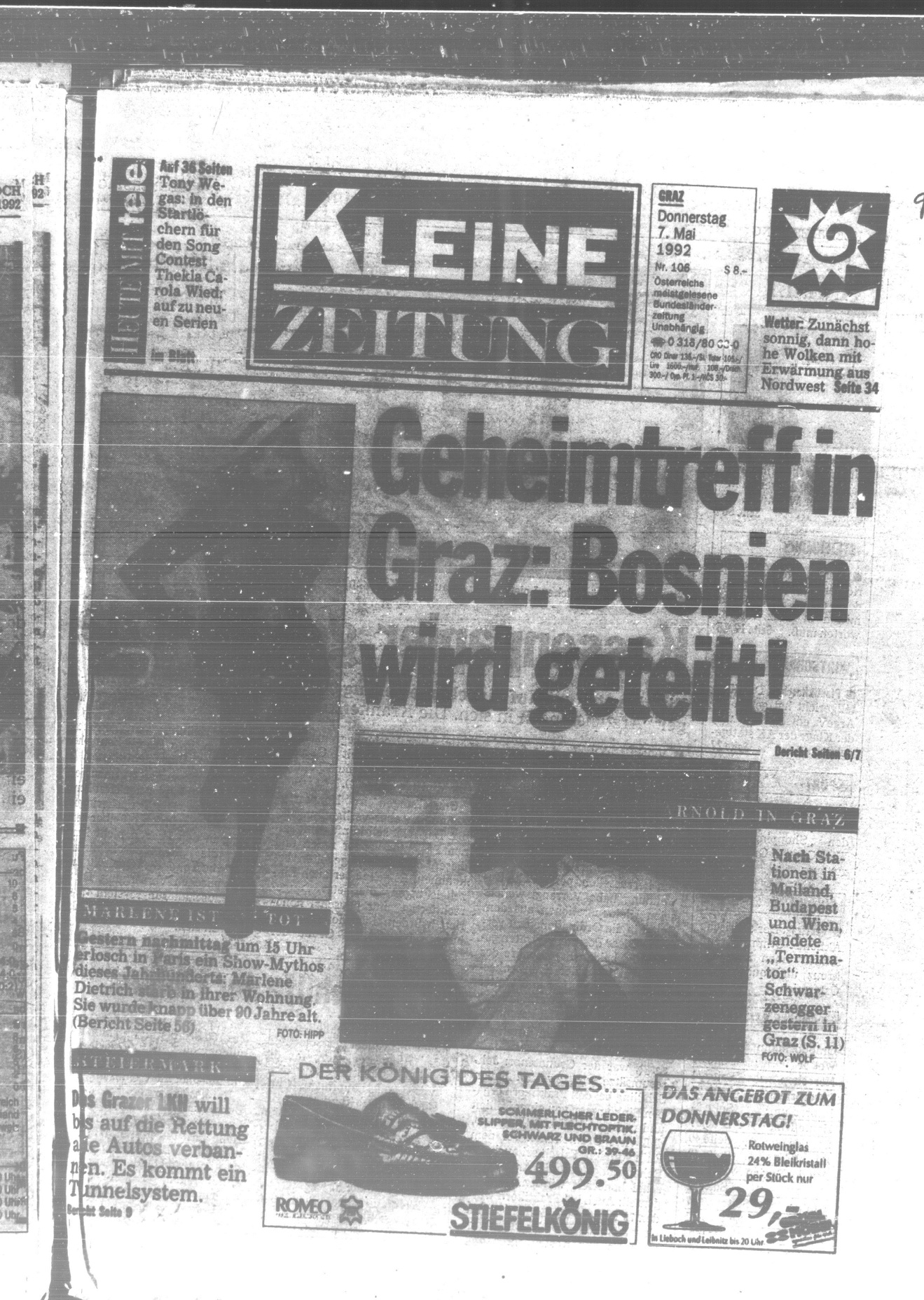
Only a month had passed since the beginning of the war in Bosnia when the Bosnian Serb leader Radovan Karadžić meet with new strong man in the Bosnian Croat HDZ Mate Boban for a secret meeting at the Graz airport on 6 May 1992. At this point, the HDZ was still formally a coalition partner to the Muslim SDA in the Bosnian government, but this alliance was quickly unraveling. It was thus that this meeting was officially “secret”, even though the Austrian media, including the state broadcaster ORF, and later the international press reported extensively from this event. The content of this meeting remained silent, as there was no official announcement and the Croat delegation left the five hour meeting without speaking to journalists. Karadžić however revealed to reporters and, as the Austrian daily “Die Presse“ notes on 7.5.1992,  that the talks focused on the “cantonization of Bosnia”. Already at the time, Austrian tabloids speculated, as it turns out rightly, whether the meeting had as its goal the partition of Bosnia.

Karadzic at the Graz Airport, 6 May 1992

The meeting in Graz between Boban and Karadžić follows an earlier, better known meeting between the Serbian and Croat preisdents, Slobodan Milošević and Franjo Tudjman, in March 1991 in Titos old hunting lodge where both had already agreed on the partition of Bosnia. How much Karadžić and Boban received the backing of the two republics also became obvious as Karadžić arrived with the plan of the Yugoslav government and Boban with a car of the Croatian authorities.

So what did Boban and Karadžić agree on in Graz? Despite speculation about the partition of Bosnia by media and frequent reference to the agreement during trials at the International Criminal Tribunal for the former Yugoslavia, the content remains largely unknown. Neverthless, the Bosnian daily “Oslobodjenje“ proved to be well informed a few days after teh meeting, correctly identifying the content of the agreement. The agreement itself was later published by the Croatian politician Zdravko Tomić. Austrian journalists noticed that the Croat and Serb delegation focused on a large Bosnian map showing the demographic distribution. The Agreement indeed focused on drawing a line of division between Croat and Serb spheres of influence in Bosnia, effectively dividing the country without the third and largest community being represented at the table.

Croat and Serb representatives do not agree on all matters in Graz. While Karadžić considers the river Neretva the border between Serb and Croat territories in Herzegovina, the Croat delegation supports the border of the 1939 Croat banovina instead. In the North of Bosnia the two delegations agree on the division of territory along the strategically important Posavina corridor that connects the region around Banja Luka with Serbia. The Agreement concludes that „as a consequence of what has been agreed there is no reason for further armed conflicts between Serbs and Croats on the territory of Bosnia and Herzegovina “.

Kleine Zeitung, 7 May 1992

The Agreement does not in a single word mention the Muslim population (not to mention anybody else). This is particularly absurd when dividing Mostar, the scene of intense battles between Croat and Bosnian government forces just a year later. The agreement notes that Croats claim all of the city, while Serbs see the Neretva river once more as the line of division.

During his trial at the ICTY Karadžić noted the importance of the agreement as it largely put an end to the Serb-Croat conflict. Similarly the well respected Serbian journalist Miloš Vasić noted in 1993 that the Grazer Agreement constituted „perhaps the single most important document of the Bosnian war“, as it enabled the Bosnian Serb army to focus on Muslim targets and prepared the ground for the two side war against the Bosnian government in 1993.

The maps on which the nationalist leaders drew new borders have been rolled out before Graz: The European Community represented by Portugese diplomat José Cutileiro suggest the creation of ethnically defined cantons already in February 1992 at the insistence of nationalist politicians. The division of Bosnia also had been decided already in 1991. In Graz, however, new borders were drawn for the first time and one conflict, the Croat-Serb one in Bosnia, came to an end so that the overall war would continue much longer. The consequence of the agreement was the Croat-Muslim war within the war which only came to an end in 1994 with the Washington Agreement, a prerequisite for the Dayton Peace Agreement.

What remains of the Graz Agreement? With more than three years of war with and some 100,000 victims, the borders Boban and Karadžić drew in Graz were drawn and redrawn, some changed, others remained the same. The border between the Croat and Serb dominated regions of Herzegovina is similar to the 1939 Croat banovina, as Croat negotiators in Graz had hoped. The Posavina region has remained under control of the Serb Republic, even if it is divided by the District of Brčko. More important than the maps is the idea that Bosnia should be divided along ethnic lines. Despite (or because of) the Dayton Peace Agreement and extensive international support for refugee return, most of Bosnia remains divided into ethnically largely homogenous regions. The Graz agreement is thus a reminder 20 years after its conclusion of the failure of international mediation and ruthlessness of nationalist “leaders” to divided lands without any consideration of the people living there. While Mate Boban died in 1997 and Radovan Karadžić stands trial in The Hague, their ideas, maps and plans remain alive.

(thanks to Nidžara Ahmetašević and Iva Komšić  for researching the background materials).

The non-historical elections in Serbia

For once, elections in Serbia will not be a historical crossroads during next Sundays elections. News reports over the past decade have termed all parliamentary and presidential elections as historical: they were in 2003 over the success of DOS in the aftermath of the overthrow of Milosevic, in 2007 and 2008 the Kosovo issue raised the spectre of a take-over by the radicals. The elections this year are historical for Serbia only for not being historical. For the first time since the introduction of multiparty elections in 1990, it will matter not that much which of the two largest parties wins the elections.

Image

Serbian superheros

There is no doubt that Tomislav Nikolic and many from the “Progressive” Party (SNS) have an unsavory past with the Radicals and their statements and policies during their previous life are hard to accept, but they stated goals differs only marginally from the Democratic Party. Of course, one can doubt their committment the EU integration and liberal policies or, more importantly, their competence, but there is little doubt that the battleground in Serbia has shifted towards the centre. Already in 2003 and 2007 the Radicals became the largest party less for their extreme nationalist positions, but rather for their social populism.Today, the is little appeite among either the electorate or the SNS to challenge the consensus that has emerged in Serbian politics over EU integration, reform and a rhetorical committment to Kosovo.

Latest opinion polls seem to suggest that the SNS might be narrowly defeated by the Democrats. Even if this is not the case, they will have a hard time to form a government, having a much more limited choice of potential coalition partners: both the Radicals and Kostunica would take the SNS away from its desired international rehabilitation and make any progress in terms of EU integration impossible, leaving the SNS only the coalition around the Socialist Party of Ivica Dacic as a significant partner. The DS can count on the popularity of Boris Tadic and three partners tipped to enter parliament, the liberal reformist LDP, the eternal governing party (since 2000) G17 now called United Regions of Serbia (in cooperation with some local strongmen) and the Socialist Party.

Thus, the elections seem to point towards a continuation of the current government with some reconfiguration among the coalition partners–and even if this were not the case, Serbia has moved towards a political system that is far from perfect, but fear that every election is a juncture between EU and abyss is no longer justified.

Serbia’s candidate status delay: Romania, the Vlachs of Serbia and the EU

After everybody expected a smooth confirmation of Serbia’s EU candidate status today, following the agreement between Belgrade and Prishtina last week and the support for status by Germany that had earlier blocked Serbia’s bid, the decision seems to have hit an unexpdected snag. Romania has blocked a final decision over the treatment of the Vlach minority in Serbia. This blockage is both surprising and worrying, even if it ended after just a few hours:

Romania had not indicated earlier any intention to block the EU candidate status for Serbia. It appears to have been a surprise by many observers . Such last minute efforts to push ones own agenda on such an important issue is clearly worse than a little sneaky. It undermines the already weak credibility in the region and leave the impression that accession countries can fulfill conditions, but member states will come up with their own ecclectic agenda. As a result, legitimate conditions are tainted by such requests. There is a further problem with Romania’s blockage: While the status of Vlachs leaves much to be desired, the treatment of the community certainly does not merit such an intervention. The most recent report of the Advistory Committee for the Framework Convention notes a number of problems, but nothing either that substantial or specific for the community that would merit such a drastic kin state intervention (if Romania is a kin state at all, a role not accepted by all Vlachs in Serbia).

Delaying Serbia’s candidate status is also likely to doubly hurt the Vlach, Romanian and other minorities in Serbia. The use of the kin state to block (even if it will turn out for a few hours) progress towards the EU over minority rights is only going to have a negative impact on minority rights. Of course, the EU accession process is a key tool to improve minority rights, but not like this: Giving Serbia candidate status and beginning negotiations is much more likely to improve the status of minorities than letting Serbia wait. As with other aspects of the accession process, the actual negotiations are the most effective tool to secure change rather than punishing a country. As a result, the Vlack minority will be more likely to benefit from the candidate status for Serbia as soon as possible rather than from Romania’s intervention at this point. Of course, once negotiations start, the minority rights agenda will be driven by the Commission, not by member states. This means that kin states like Romania now might be less interested in genuine minority rights and rather in flexing their smallish muscle and present themselves as the protector of national interests. Considering the large number of cross border minorities and kin states in the region, the Romanian delaying tactic is a worrying signal for the EU enlargement process and unfortunately unlikely to do much good for minority rights.


The Significance of the Belgrade-Prishtina Agreement

As most compromises, the agreement between Serbia and Kosovo concluded a few days ago contains its share of absurdity. Kosovo can now participate in regional meetings with a footnote referring to the UN SC resolution 1244 and the ICJ opinion the declaration of independence, but these two references are meaningless. 1244 refers to the interim status of Kosovo that has clearly passed, even within a new UN SC resolution and the ICJ opinion is clear on the declaration of independence, but does not tackle the independence of Kosovo itself. It is similar to attaching a footnote to an apple pie saying that apples can be prepared in many different ways and a second note that an apple pie can call itself what ever it wants.

However, the meaninglessness of these disclaimers aside, the agreement has greater significance: It is the first time that Serbia has accepted the Kosovo government to represent Kosovo at the international level directly, rather than being formally represented by the UN mission or being able to participate, but without a mandate. As a result, this solution could be path-breaking for Kosovo in the future. The solution could outline the direction in which Kosovo could eventually co-exist with Serbia in the international arena. Since the declaration of independence in 2008, the challenge has been to find a way in which Serbia can live with Kosovo without extending full recognition and this agreement outlines the mode through which this could be achieved. Serbia recognizes Kosovo as a separate entity with a government, while stopping short of international recognition. Such a solution could open the door for membership in other international organizations and also eventual EU membership. The step from extending this solution from regional meetings to international organizations is small and has now become conceivable. If the agreement holds and proves to be a acceptable solution for both Kosovo and Serbia, the ball is in the court of the EU to outline a credible EU integration perspective for Kosovo and for the five EU member that have not recognized Kosovo to reconsider their stance. Of course, relations between Serbia and Kosovo will remain on the agenda and the agreement does not resolve the many remaining questions, but it might turn out to be a bigger step than the mediators and the parties have anticipated.