Dayton Lost, Kosovo too

Forgotten in the whole discussion on the independence declaration of Kosovo has been the news that the Dayton Peace Agreement has been lost. Luckily somebody found it
. Currently the Serbian government is trying to find the independence declaration of Kosovo so that it can be ‘lost’ to.

Srebrenica typo

If you thought that the Department of Records in Brazil mistyping “Buttle” instead of “Tuttle” was one of the worst historic bureaucratic blunders, you’re wrong.
In a court case in the Netherlands in which survivors sue the UN and the Netherlands over the genocide in Srebrenica, the UN noted that “its office in Sarajevo refused air support in Srebrenica because the Dutch commander there failed to fill the request form correctly.”

Did they cross in the wrong box (please support us with UN navy maritime support) or did they wrongly identify what happened in the form (calling it mass murder prior to an independent UN confirmation based on an extended fact finding mission) or where some signatures missing (of the victims/perpetrators confirming events) ? I’m curious.

Partisan songs in Croatia and Bosnia

While singing Partisan songs is still a scandal in Croatia, especially on election night, it is quiet ok in Bosnia.

Elections in Bosnia and foreign leaders

If you are in Bosnia these days and are not following what’s going on, you might be mistaken to think that presidential elections are occurring.

Candidate 1: Sarajevo, last weekend

Candidate 2: Banja Luka, last weekend
The good news is that there are no elections looming and neither Sanader nor Putin are running in them.

The bad news is that once more some are looking outside the country for help from other outsiders ruling the country.

In fact, the hysteria in RS and Serbia over Miroslav Ljacak’s imposition is out of proportion when reading the decision and actually remembering that in the past year more often than not, decisions were not taken in the Council of Minister of Bosnia due to the boycott of Bosniak members.

Never before have RS officials and Serbia react so hostile to any OHR decision over the past 12 years, suggesting that it is not really about the decision, but rather something to do with Kosovo.
See more here

New High Rep Lajcak

Miroslav Lajcak has been formally named new High Rep. for Bosnia by the PIC. This confirms what has been long expected. He will replace Schwarz-Schilling in July. Will he be just another ‘last HR’ or really the last one (both Ashdown and Schwarz-Schiling suggested being the last ones). His main accomplishment has been the mediation in Montenegro for the referendum. While the referendum and independence went smoothly, there were a lot of ifs which remained unclear and highly problematic in last year’s intervention (the so-called gray zone in particular, i.e. what to do if less than 55 but more than 50 % voted for independence). Lacking heavy weight backing from a larger EU member state (like Ashdown) and in fact being from a country which has a government currently not viewed as the most, ehem, European might make Lajcak weak. Considering the confrontational climate in Bosnian politics at the moment and the standstill in terms of reforms, this is all not too promising.

Vuchko, the friendly wolf

In Sarajevo last week I noticed that Vucko posters in town to remind of the Winter Olympics. The International Olympic Committee has possibly the best description of this little furry wolf with the howl which seems to call for cough-drops:

“Vuchko”, the tough and courageous wolf. This mascot helped to change the traditionally frightening and bloodthirsty image of the wolf, which is present in the region. This wolf has both a serious and a cheerful side, but is happy rather than serious. It symbolises the desire of human beings to make friends with animals, to make a wolf into a Vuchko.

Paddy Ashdown’s Lecture

Yesterday Paddy Ashdown gave a lecture here in at the University of Kent. He spoke only little on Bosnia, but instead offered both a biting critique of unilateral intervention a la Iraq and an equally staunch defense of intervention in Bosnia and other countries, if done multilaterally.
Most interesting was his lessons learned from intervention, some already generally accepted in the policy community such as rule of law first, elections second, others, although obvious, were more instructive, such as don’t model the country on (an idealized version of) your own country. A number of these lessons seem to be the result of reflecting after his mission as HR in Bosnia. In particular, he favors the abolition of the Bonn powers and movement towards greater self-governance in Bosnia. Considering that he was arguably the most interventionist high rep, the call for less intervention should be instructive for current discussions on extending the mandate of the OHR in Bosnia.

Gloomy Balkans?

When discussing the Western Balkans with analysts and policy makers, one can notice distinct mood shifts over the years. In some cases is might be just because you are at a gathering of optimists or pessimists, in other cases it has little to do with the situation in the countries, as it might be the case of dissapointed internatioanl (false) expections or what is bad in one country does not necessarily bode ill for another.
Be this as it may, it was striking to note the worried atmosphere at a meeting last week in Paris of EU policy makers and analysts. After 2006 seemed like a year where transition from post-conflict to European integration would be more tangible, little was decided. Now 2007 might be overwhelmed by the legacy of 2006. Both the status decision for Kosovo and the shutting down of the OHR in Bosnia appears already to be too much in one go. So, local ‘ownership’, the buzzword of a few years back has fallen in popularity. It appears that the future EU mission in Kosovo will be similar to the OHR including the Bonn-powers (to dimiss officials and pass legislation) and since the current High Rep. Schwarz Schilling is leaving early and even he noted the continued need for the OHR, full souvereignty to Bosnia also seem to be not forthcoming any time soon. To a large degree, the talk of an independence referendum of the Serb Republic by Milorad Dodik is to blame. Ironically, one of the politicians the most critical of the international community and of the OHR in particular has thrown it another life-line.
Whether the OHR will remain effective and it’s decision legitimate remains to be seen. It is an emperor without clothes and if it is called on its weakness, there might be difficulties ahead. A few years back, a good part of Bosnian citizens supported an increase in the power of the OHR, in 2006 the UND early warning report notes that supporters of reducing the OHR’s competences are larger than those who would like to increase it among all three national communities. Similarly in Kosovo, there is a question whether such a type of mission will be legitimate and accepted, especially as the status solution is unlikely to satisfy anybody fully.
Finally, as there is a sense that EU enlargement might be slowed down and not because of the countries in the region, but because of the EU’s current internal crisis, the key carrot might be loosing some of its pull.
Altogether, the meeting left me thinking that despite some key decisions being taken in 2007, stability remains at risk and we might have to wait for 2008 for more courageous steps towards EU Integration of the region.

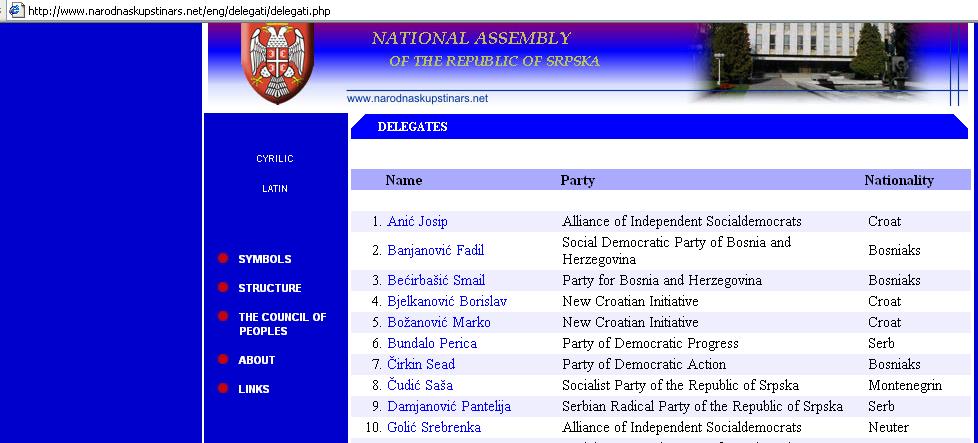
the ‘neuter’ members of the RS parliament

In the brave new world of ethnicity in Bosnia, the House of Peoples in the Serb Republic also has one MP, who is ‘neuter’… in the original it is “neopredjeljena”, I guess undecided. Otherwise, its multiethnic heaven, including Serbs, Montenegrins, Croats, Bosniaks, Slovenes and Jews.

Papal Infallibility and Paddy Ashdown

In a sentimental piece about Ashdown leaving Bosnia soon, the Guardian describes him as having “assumed an authority which has been compared to that of a medieval pope.” It is important to emphasize the word ‘medieval’, as the concept of Papal Infallibility was only introduced in 1870.
Telling is when Ashdown notes that his biggest failure was the fact that “is that although we have created institutions, we have not created a civil society.” He made a similar remarked at a recent conference on the 10 year anniversary of Dayton in Geneva. I guess that as long as outsiders try to ‘create’ a civil society in Bosnia or elsewhere, we’re in trouble.