When Bosnia was Divided in Graz

Only a month had passed since the beginning of the war in Bosnia when the Bosnian Serb leader Radovan Karadžić meet with new strong man in the Bosnian Croat HDZ Mate Boban for a secret meeting at the Graz airport on 6 May 1992. At this point, the HDZ was still formally a coalition partner to the Muslim SDA in the Bosnian government, but this alliance was quickly unraveling. It was thus that this meeting was officially “secret”, even though the Austrian media, including the state broadcaster ORF, and later the international press reported extensively from this event. The content of this meeting remained silent, as there was no official announcement and the Croat delegation left the five hour meeting without speaking to journalists. Karadžić however revealed to reporters and, as the Austrian daily “Die Presse“ notes on 7.5.1992,  that the talks focused on the “cantonization of Bosnia”. Already at the time, Austrian tabloids speculated, as it turns out rightly, whether the meeting had as its goal the partition of Bosnia.

Karadzic at the Graz Airport, 6 May 1992

The meeting in Graz between Boban and Karadžić follows an earlier, better known meeting between the Serbian and Croat preisdents, Slobodan Milošević and Franjo Tudjman, in March 1991 in Titos old hunting lodge where both had already agreed on the partition of Bosnia. How much Karadžić and Boban received the backing of the two republics also became obvious as Karadžić arrived with the plan of the Yugoslav government and Boban with a car of the Croatian authorities.

So what did Boban and Karadžić agree on in Graz? Despite speculation about the partition of Bosnia by media and frequent reference to the agreement during trials at the International Criminal Tribunal for the former Yugoslavia, the content remains largely unknown. Neverthless, the Bosnian daily “Oslobodjenje“ proved to be well informed a few days after teh meeting, correctly identifying the content of the agreement. The agreement itself was later published by the Croatian politician Zdravko Tomić. Austrian journalists noticed that the Croat and Serb delegation focused on a large Bosnian map showing the demographic distribution. The Agreement indeed focused on drawing a line of division between Croat and Serb spheres of influence in Bosnia, effectively dividing the country without the third and largest community being represented at the table.

Croat and Serb representatives do not agree on all matters in Graz. While Karadžić considers the river Neretva the border between Serb and Croat territories in Herzegovina, the Croat delegation supports the border of the 1939 Croat banovina instead. In the North of Bosnia the two delegations agree on the division of territory along the strategically important Posavina corridor that connects the region around Banja Luka with Serbia. The Agreement concludes that „as a consequence of what has been agreed there is no reason for further armed conflicts between Serbs and Croats on the territory of Bosnia and Herzegovina “.
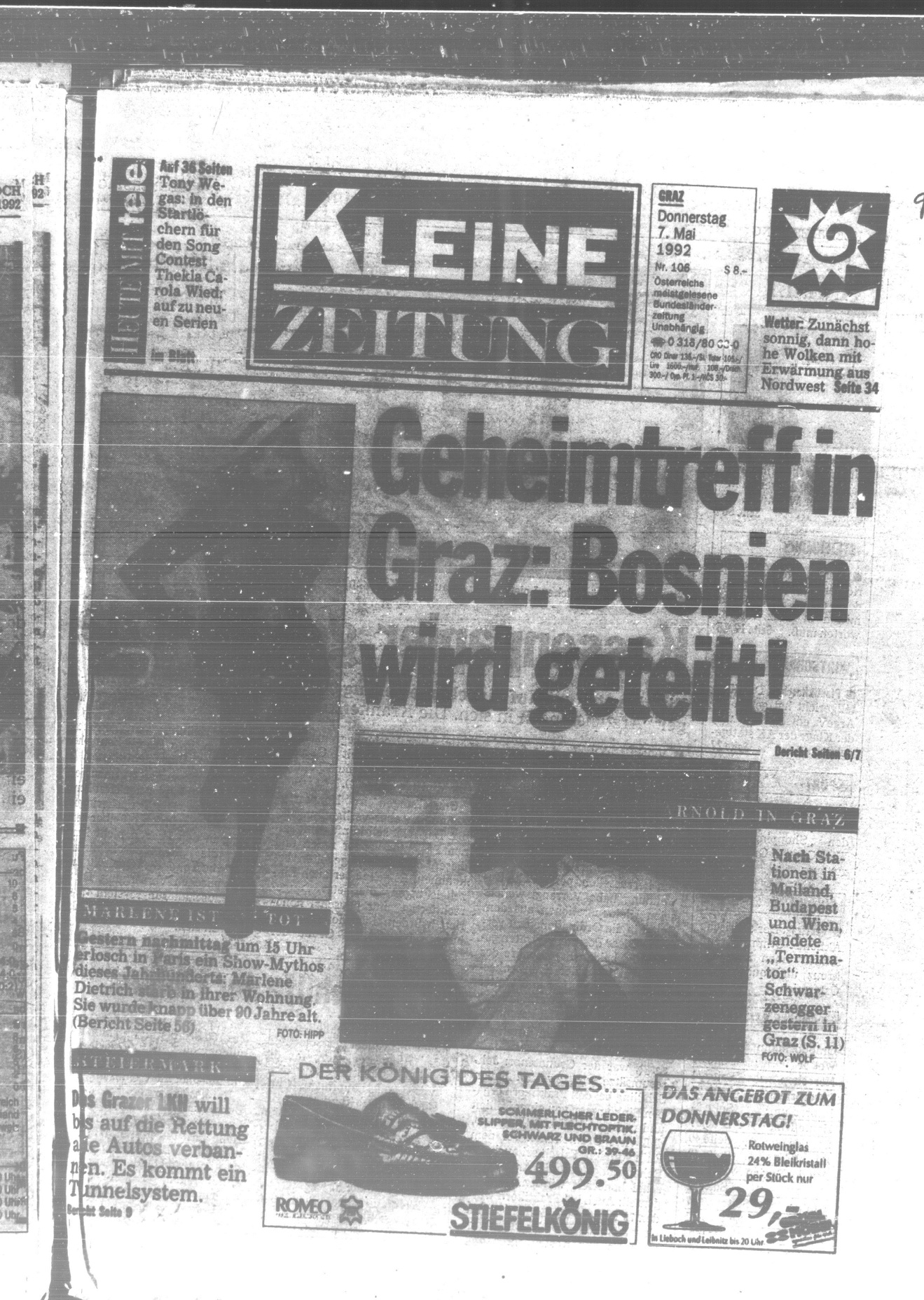
Kleine Zeitung, 7 May 1992

The Agreement does not in a single word mention the Muslim population (not to mention anybody else). This is particularly absurd when dividing Mostar, the scene of intense battles between Croat and Bosnian government forces just a year later. The agreement notes that Croats claim all of the city, while Serbs see the Neretva river once more as the line of division.

During his trial at the ICTY Karadžić noted the importance of the agreement as it largely put an end to the Serb-Croat conflict. Similarly the well respected Serbian journalist Miloš Vasić noted in 1993 that the Grazer Agreement constituted „perhaps the single most important document of the Bosnian war“, as it enabled the Bosnian Serb army to focus on Muslim targets and prepared the ground for the two side war against the Bosnian government in 1993.

The maps on which the nationalist leaders drew new borders have been rolled out before Graz: The European Community represented by Portugese diplomat José Cutileiro suggest the creation of ethnically defined cantons already in February 1992 at the insistence of nationalist politicians. The division of Bosnia also had been decided already in 1991. In Graz, however, new borders were drawn for the first time and one conflict, the Croat-Serb one in Bosnia, came to an end so that the overall war would continue much longer. The consequence of the agreement was the Croat-Muslim war within the war which only came to an end in 1994 with the Washington Agreement, a prerequisite for the Dayton Peace Agreement.

What remains of the Graz Agreement? With more than three years of war with and some 100,000 victims, the borders Boban and Karadžić drew in Graz were drawn and redrawn, some changed, others remained the same. The border between the Croat and Serb dominated regions of Herzegovina is similar to the 1939 Croat banovina, as Croat negotiators in Graz had hoped. The Posavina region has remained under control of the Serb Republic, even if it is divided by the District of Brčko. More important than the maps is the idea that Bosnia should be divided along ethnic lines. Despite (or because of) the Dayton Peace Agreement and extensive international support for refugee return, most of Bosnia remains divided into ethnically largely homogenous regions. The Graz agreement is thus a reminder 20 years after its conclusion of the failure of international mediation and ruthlessness of nationalist “leaders” to divided lands without any consideration of the people living there. While Mate Boban died in 1997 and Radovan Karadžić stands trial in The Hague, their ideas, maps and plans remain alive.

(thanks to Nidžara Ahmetašević and Iva Komšić  for researching the background materials).

The Risks and Benefits of Ethnic Citizenship

Millions of people in Southeastern Europe are citizens of more than one state. Many acquired this status when they were gastarbajteri [guestworkers] in Germany, Austria and elsewhere in Western Europe; others received a second passport as they fled the wars that accompanied the disintegration of Yugoslavia. For some people, dual citizenship seems due to a quirk of fate: for example, their father may have been born in a different Yugoslav republic than they and held that republican citizenship when Yugoslavia was still a single country and when republican citizenship had no practical significance. Due to some long abandoned vestiges of patriarchal rules, today they have the right to a second citizenship of a republic they never lived in. Among the many ‘multi-citizens’ of Southeastern Europe there are probably a million who have received passports from countries they have never lived in. Hundreds of thousands of citizens of Bosnia and Herzegovina hold Croatian citizenship as a result of their ethnic Croat identity. Over 50,000 Macedonians also became citizens of Bulgaria after declaring themselves to be ethnically Bulgarian. Recently, Serbs from Bosnia (and elsewhere) have been able to become Serbian citizens by declaring their loyalty to Serbia—most prominently, President of the Serb Republic, one of the two Bosnian entities, and Milorad Dodik, who publicly submitted his request for citizenship to the Serbian Foreign Minister Vuk Jeremić in 2007. Nearly a million Moldovan citizens have applied for Romanian passports and over 100,000 have been granted EU citizenship, on the grounds that they are descendents of former Romanian citizens who lost their Romanian citizenship when Bessarabia was annexed by the Soviet Union in 1944.

Read the rest of the comment at: http://www.citsee.eu/op-ed/risks-and-benefits-ethnic-citizenship


One Socialist party less in the Balkans: Dodik and the Socialist International part ways

After five years membership in the Socialist International, the Alliance of Independent Socialdemocrats of Milorad Dodik has been suspended at a meeting of the SI council in Athens. The suspension was for nationalism and extremist positions of the party.  The SNSD was only admitted in January 2006, just as it took over power in the RS. Considering the nationalist rhetoric of the party since the elections in 2006, the suspension is long overdue.The long wait was probable due to the (false) hope that the SNSD might return to more moderate policies. There has been no indication of this and there has long been nothing social democratic in its policies.

In response to the suspension Dodik announced that the SNSD would preempt its own exclusion by leaving the Socialist International. In explaining his move, he noted that there was no use to being part of the SI and that is members were responsible for the global crisis. Instead, he was moving to establish closer ties with United Russia the dominant party in the Russian Federation. This seems indeed like a much more appropriate match for Dodik’s SNSD: a party without any platform which provides for the support of the leader and is happy to dominate with undemocratic practices.

The suspension also puts an end to the curious situation that the key stumbling block to the formation of the Bosnian government has been the difficult relationship between two members of the SI: the SNSD and the SDP of Zlatko Lagumdzija. It also suggest that the SI was unable to make retaining membership sufficiently attractive to moderate Dodik’s policies–in contrast to Serbia where granting the Socialist Party (SPS) observer status in 2008 helped usher in the DS-SPS coalition government. Over recent years, Socialist parties and foundations have maintained low-level contact with the SNSD in the hope to shape the rank and file of the party. The exclusion from the Socialist International would probably mean that also those contacts would decrease (although this is up to the discretion of the individual parties and foundations). Considering the rhetoric and policies of the SNSD there is little indication that this affiliation had a moderating effect on the party.


Fantasies of New Cities: Andric’s Marina, an older Skopje and other etno-dreams

Ever since the mayor of Trebinje Božidar Vučurević announced during the siege of Dubrovnik that “we will build an older and nicer Dubrovnik” (Sagradit ćemo još stariji i ljepši Dubrovnik), the destruction of cities and towns has been matched with fantasies of new cities and towns which would reflect the respective nationalist fantasies. The engineers of destruction were so successful in their destruction of cities that even 20 years since the beginning of the wars, these fantasies remained largely unrealized (if one excludes the successful elimination of reminders of the other). Right after the war, there were plans about transforming the Eastern suburbs of Sarajevo and the mountain resort/war-time “capital” of the Bosnian Serb leadership Pale into a Serbian Sarajevo metropolis. After 15 years, little of what has been planed was ever built.  Most post-conflict states were busy with reconstruction and short in cash to engage in grandiose building plans. In recent years, there has been movement. There is no Astana on the horizon, but rather a number of smaller projects which are telling about today’s nationalist fantasies.

Andrićgrad. This project by director Nemanja Emir Kusturica to build a city/tribute to Ivo Andric/stage for his film of Andric’s novel The Bridge on the Drina. Ground breaking ceremony was held on 28 June (Vidovdan) with heavy machinery, Carmina Burana and the President of the Serb Republic and Government.  A large-scale project, co-founded by the RS government and Kusturica has an estimated cost of about 12 million euros (although the costs seems little considering the ambition of the project), includes 50 stone houses as well as a church, hotels, theatre, and shops. The project has been controversial for ignoring the context of the recent war–one of the worst war criminals Milan Lukic lived close by. Furthermore the project seems problematic due to its proximity to the UNESCO world heritage protected bridge, the hero of Andric’ novel. The plans suggest that the new ‘town’ is more a Disneyland for Andric (The New Yorker even picked up the story and suggested the establishment of a string of similar towns in the US, including Rothlandia in Newark, New Jersey), focusing on tourism (including a marina?!). The goal of this plan is not to re-create Ottoman Visegrad, as Andric describes it in his novel, but a parallel history, a Balkan renaissance city which never could happen due to the “Turkish occupation”.

Küstendorf-Drvengrad. This little fake Serbian village was a by-product of Kusturica’s film Life if a Miracle. It  looks like a modest dry-run for Andricgrad. Like Andricgrad, it is not a town or city, but rather the attempt to recreate an idealized village. This vision is rejecting diversity, but rather projects a homogenous idealized Serbian rural village, centred around a church and the anti-globalization film festival.

Etnoselo Stanišići. This little “ethnic village” (ethno selo sounds a lot less conspicuous than an ethnic village). The benefactor of this village, Borisa Stanišić apparantly brought together Serb farm houses from throughout Bosnia to build this idealized village, including a Greek restaurant and a hotel Pirg in a retro-‘Balkan’ style.

Slobomir. This is the only project which is clear modernist in outlook, it plans to be more than just a tourist destination–including the Pavlović Tower, the tallest tower in the Balkans (although the predicted 37 floors seem to be beaten by a number of candidates in the region, the Avaz tower in Sarajevo has 36 floors). However, the plan seems to be older than others (dating back to the late 1990s), but besides the university, bank and television station, not much has been built.

Skopje 2014 differs from the other projects. It does not create a new city, but is transforming an existing city. It does share a number of similarities: It is a project to re-write history to cover up the present. It includes the constructions of buildings which were destroyed by the earthquake in 1963, the recreation of a pseudo-authentic Macedonia architecture, interspersed with a monumental landscape which reminds of a host of national heroes at every corner, but also the old-fashioned style of the sculptures suggests that the monuments are ‘old’ and ‘authentic’ reminders of the heroes, not new creations.

The fantasies of new cities are fantasies of ethnically homogenous towns, often small, lying about their own age, suggesting that they are authentic and old. They are constructing an alternative history, idealizing a past which never existed, from a Balkan renaissance to an neo-classical  Macedonia style. It is no surprise that a project of creating a modern city in the rural countryside a la Slobomir has not fared as well as the creation of ‘new-old’ towns  that are justified as tourist destinations and shed the burden of complexity and diversity which real cities in the region can offer.

Coalitions of the unwilling. Or who needs a government in Belgium, Lebanon, Bosnia or Iraq?

A few countries around Europe and the Middle East have been having a harder time forming a government than most. If most Brits got nervous that there was no government formed for a few days following last years’ election, such a scenario sounds like a remote dream for Belgium, Bosnia, Lebanon and Iraq.

It took Iraq around nine months to form a government following parliamentary elections in March 2010, Lebanon had a change of premier in January, but the new premier Najib Mikati only was able to form a new cabinet a few days ago (based on support from Hizbollah and its allies). Belgium is “celebrating” a year since the parliament elections without a government and Bosnia is slowly catching up (emphasis on slowly) with Belgium, having held elections in October 2010 and only a few days ago the three member state presidency held a straw poll who might be the best candidate for the post—it looks likely that the government will not be formed before the fall. Of course, all four countries share a key feature: They are power-sharing systems, which require coalitions of the unwilling. Coalitions are between parties which have campaign against one another and which have often antagonistic views over the future of the country, not to mention its policies. Thus, coalitions are not based on securing “just” a majority, but rather on including parties representing the often deep divisions in society. With fractious and unstable party systems, forming a government is not an easy task.

It might be tempting to conclude that power sharing system which allocate power to parties claiming to represent these different ethnic, linguistic or religious groups should be done away with. Simple majority rule is, however, no alternative in the three countries. In Lebanon, Hizbollah would be able to take over the country, in Belgium Flemish nationalists would be able to dismantle the state with not consideration of the Walloon community, in Bosnia, a Bosniak parties might govern over a state that can’t govern of half of it, the Serb Republic (or alternatively, a Croat-Serb coalition would dominate at the expense of the largest population group), etc. A different alternative is the system used in Northern Ireland. Instead of lengthy coalition negotiations between parties which in all probability anyhow have to end up in government with each other, the Good Friday Agreement of 1998 just does away with complicated government formation altogether. Here the First Minister and the Deputy First Minister are elected by a double majority of both unionists and nationalists, all subsequent ministers are chosen by the D’Hondt system, which allows parties to pick ministerial posts according to their size and means that there is no need for negation between parties and all have a stake in the government. Of course, this also means that no party will be in opposition, but voting largely determines the dominance in the executive, rather than who is represented at all.

If such a solution is not possible, the question arises, does one really need a government? In Belgium, there have been protests in favor of any government (probably a first in history), a senator calling for a sex strike of the wives of Belgian’s politicians and the initiative G1000 which seeks to bring together 1000 citizens to demonstrate than in a few days of popular debate more feasible solutions and compromises can be found than after more than a year of talks among parties. Despite all the civic activism for a government, Belgium managed to hold the EU presidency, reduce its budget deficit and generally have a working country with only a caretaker government. The others’ are less lucky. Without a proper government and a budget, Bosnia was unable to draw further loans from IMF, is unable to move forward with EU integration, whereas Lebanon and Iraq were similarly paralyzed without a fully acting government. The secret to Belgium’s ‘non-governmental’ success despite its difficulties is simple, it is called the European Union and its regions and communities to which many powers are devolved. Granted, the EU lacks clear decision making structures and much of what one would expect from a government, but the Belgium experience demonstrates that it can be a crucial proxy for having a government. Monetary policy, no need. Foreign and security policy, not a big deal for a small EU member. Most laws and regulations come from the EU. What is not done by the EU in terms of everyday life is organized by the regions or communities. This leaves Belgium in the absence of a legitimate government much less exposed than Lebanon, Bosnia or Iraq. Now, of course, the problem is that some ethnic, linguistic or religious parties actually want to demonstrate just that—namely that the state is unnecessary. If citizens don’t feel the pinch of having a government, they might become less attached to the state. This is of course a fundamental dilemma, who much government does there need to be to make it worthwhile for citizens to have a state and what is the maximum of government and state some citizens can take before they support some alternative. Whatever the specific answer maybe, there are times when a country can work, even if there is no government.

First published on Nationalities Blog

Negotiating Division and Cooperation in today’s Bosnia

As Bosnia is recovering from the latest crisis, once more the largest one since Dayton, it is useful to reflect on the underlying challenges Bosnia is facing today. When late Richard Holbrooke brokered the Dayton Peace Accords in late 1995, most attention was devoted to drawing the new internal boundaries of Bosnia and Herzegovina (henceforth Bosnia) to arrive at the “magical formula” which implemented the previously agreed division of the country into 49 percent under control of the Serb Republic (RS) and 51 percent under control of the Federation of Bosnia and Herzegovina (FBiH), the predominantly Bosniak and Croat entity. Thus emerged an over 1000 km long border know euphemistically as the inter-entity boundary line (IEBL). On the other hand, the constitution and new institutions of the country received only scant attention during the negotiations. It is thus not without irony that it is those institutions which have been at the core of the profound political crisis which Bosnia has been slipping into over the past five years, while the borders have remained relatively uncontested.

Does this mean that too much attention has been placed to borders and too little to institutions? While certainly the institutions established at Dayton were often flawed, the border drawing was controversial and remains potentially a source of contestation. The boundary between the two entities largely followed the ceasefire line and only contained two major adjustments: One in western Bosnia to accommodate the 49/51 formula by placing thinly populated regions under control of the RS and granting the Federation full control over parts of Sarajevo previously under Bosnian Serb rule—a territorial transfer which came about with last chapter of ethnic cleansing with most Serbs leaving the neighborhoods under pressure from the RS leadership in March 1996.

The border between the entities has become largely invisible over the past 15 years: In the first years, many feared crossing the border and police check points in the vicinity of the border constituted efforts by the entities to prevent people from moving freely within Bosnia. Even if the police were absent, this invisible line became visible by stalls selling cheap cigarettes from the other entity and taxi drivers waiting for customers from the other side as few were willing to cross this line with the wrong license plates. With a common currency and a unified license plate, and a decline in the profitability of the cross-entity cigarette trade, the most visible reminders today are the large signs reading “Welcome to the Republic of Srpska”.

With few exceptions, the IEBL has also become the ethnic dividing line in Bosnia. Prior to the war, most municipalities were multinational, with a significant share of the population hailing not just the largest, but also from other groups. The ethnic cleansing during the war largely destroyed this diversity and territorialized ethnic belonging. The internationally administered return process was possibly the largest experiment to undo the consequences of ethnic cleansing. Refugees and internally displaced did not only have an unconditional right to return (unlike what seems currently likely in either Cyprus or Palestine/Israel), but were also assisted if they did want to go back home.  Even if (on paper) half of the two million IDPs and refugees returned (the return process has slowed to a trickle since 2003), the returnees often did not stay or became a new minority, marginalized when it comes to jobs, education and services. Only three municipalities bucked the trend and ‘changed hands’ since the end of the war. Grahovo, Drvar, Glamoč in Western Bosnia today have Serb majorities, as they did before the war, although they lie in a Federation canton named after the Croat secessionist project ‘Herceg Bosna.’ The main reason that these municipalities saw such massive returns after the war was due to the overwhelming Serb population majority they had before the war and the fact that Serbs were expelled from the region only towards the end of the war in 1995. These three towns are thus the exceptions which prove the rule that ethnic cleansing has largely worked.

The internal borders of Bosnia are today less physical markers, but continue firmly separate political power and cementing ethnic divisions. A second category of borders in Bosnia are the external borders with its three neighbors Croatia, Serbia and Montenegro. Here a two-level border regime emerged. The physical border became more substantial since 1995 as Bosnia’s border regime evolved and it is likely to increase in significance as Croatia’s EU accession will lead, if not immediately, to a Schengen border between the two countries. On the hand, there is an ethnic border regime: The overwhelming number of Croats in Bosnia hold Croatian passports and a growing, but unknown number of Serbs in the RS have been acquiring Serbian passports. According to the Gallup Balkan Monitor in 2009 and 2010, 15.4 and 7.5% respectively of surveyed inhabitants hold a Serbian passport, n the Federation, 15.2% and 33.8% respectively hold the Croat citizenship.

This trend was certainly encouraged by the one year gap between the EU decision to liberalize the visa regime for Serbian (2009) and Bosnian citizens (2010). Beyond formal dual citizenship, other informal privileges granted to Croats or inhabitants of the RS create a virtual ethnic trans-border community. There are two ways of looking at this reality. Often, the ethnic ties are seen as a negative hold-over from the war years and help to undermine the already weak Bosnian state cohesion. These networks produce and reproduce loyalties and identities which can challenge the Bosnian state. This is exemplified by statements from the current president of the RS, Milorad Dodik, in which he stated that “case that tomorrow Bosnia and Serbia would play, I would cheer for Serbia.” Accordingly, only 15.8% of inhabitants in the RS support the Bosnian football team, while 75.8% in the Federation do. Forging closer ties to Serbia and fostering informal cross-border ties also reduced the identification with Bosnia. A consequence is the large support (over 80%) among Serbs in the RS support the independence of their entity over the continued existence of Bosnia.

Alternatively, one could also interpret these ties as having a moderating effect. In 2009, Tim Judah, the Balkan correspondent of The Economist coined the term Yugosphere. This Yugosphere describes the network of ties with the countries of former Yugoslavia in business and culture which have emerged since the end of the wars. They do not express a desire to re-constitute a political unit called Yugoslavia, but rather describe an alternative within the framework of existing states. Now, in addition to the Yugosphere, there are also a ‘Croatosphere’, and a ‘Serbosphere’. These are cross-border networks based on affinity along national lines. These ties are fostered by the above mentioned examples of state policies, including citizenship regimes, and create a sense of community. If the Yugosphere does not necessarily present a challenge to the existing states, it could be argued that the national spheres similarly provide for another layer of identity, but do not have to undermine multi-national states per se. It could be argued that these linkages provide for multiple centres and networks, which might reduce the degree of contestation over only one, namely the state.

The challenge for Bosnia arising from the ‘Croatopshere’ and the ‘Serbosphere’ is that these often enjoy more legitimacy and have been able to provide greater benefits to Bosnian citizens which partake in these alternative spheres, including freedom to travel and jobs, than the state. Moreover, these spheres are exclusive and the largest Bosnian community, Bosniaks, lack such a comparable dimension. Most importantly, unlike the Yugosphere, the national spheres often (but not necessarily) challenge the legitimacy of the state and thus constitute an alternative rather than an additional layer to identity among Bosnians.

Both transnational and subnational structures and networks have been unable to overcome or to short-circuit the cumbersome decision-making processes within Bosnia. While there is widespread agreement that institutions in Bosnia which require consent across national lines have struggled to take decisions for years. The frequency of blockages increased since 2006 when Milorad Dodik came to power in the Republika Srpska for a second time and pursued a confrontational line towards the international actors and Bosniak parties. The fact that neither the state nor the Federation have had a government for more than four months after the elections in October 2010 is indicative of the tense political environment. The reason for the political blockages can be easily attributed to, depending on the perspective, the President of the RS, Milorad Dodik, or Bosniak politicians insisting on a further centralization of the state. The modest legislative record of the Bosnian parliament in recent years and the slow government formation cannot, however, are not caused only by a particular politician, or a particular elite.

Instead, it might be tempting to shift all the blame to the power-sharing arrangement established at Dayton. With its emphasis on ethnicity and strong linkage between ethnicity and territory, it seems to a recipe for confrontational ethnopolitics. Nevertheless, it is equally misleading to consider the entire political system as source of the current crisis in Bosnian politics.

While it is true , that just as there are populist politicians which thrive on the current impasse, there are institutions with multiple veto points and excessive emphasis on ethnic representation, colloquially known in Bosnia as “counting blood cells”, i.e. predetermining peoples professional opportunities based on their ethnic belonging. In order to find out why Bosnia is struggling, we need to explore other causes.

As survey for UNDP in 2007 found Bosnia to be at the bottom of international leagues when it comes to social trust. Only 7.8% of surveyed citizens indicate that they trust others, considerably lower than other countries, including in South Eastern Europe. This low level of trust transfers into low levels of trust in institutions and low level of interest in politics, again significantly less than in any country in the region. What is striking about the findings is that Bosnia is less characterized by low levels of trust between ethnic groups, or by particular groups towards some institutions—by Serbs towards the state for example—but by a generally low level of trust, not ethnically neutral, but preferences along ethnic lines are overshadowed by the general breakdown in trust.

Considering this backdrop, it is not surprising that Bosnia has essentially become a “low trust state”. The institutions are predicated on the low trust along ethnic lines: Veto rights and blocking mechanisms are the embodiment of low levels of trust in political opponents (sometimes justified). International supervision since Dayton has often interfered into political decisions due to low trust in local political elites (often for good reason). The political discourse of elites has been based on the rhetoric of low trust: A key theme of Milorad Dodik’s party SNSD over recent years has been the need to preserve the RS against threats from Bosniak parties and international pressure. The supposed threat and low trust in both parties from other ethnic groups and international actors were the core message. Similarly, Dodik recently rejected the introduction of a new article in the Bosnian constitution, known as the “Europe clause” which would allow for laws essential to EU integration to pass with fewer veto rights. Similarly, Croat parties have emphasized the need for a third entity to protect Croat interests from being marginalized. Finally, predominantly Bosniak parties emphasize their distrust toward the RS and the intentions of the non-Bosniak parties towards the state. While most citizens’ distrust is not primarily ethnic, the distrust of parties has clear ethnic overtones. If the goal of parties with a mono-ethnic electorate is to generate loyalty within the ethnic group at the expense of interethnic relations, the parties in Bosnia have failed. If, however, the ethnic distrust is both a way to channel broader frustration and a mechanism to re-produce distrust, it has worked. The effect of distrust is disengagement from politics and helps to sustain parties that re-affirm low trust politics and, while not being particularly trusted themselves, direct high levels of distrust elsewhere.

The Bosnian system of government is thus characterized by the tension between the different types of distrust: the distrust by citizens, as captured by surveys, is based on the perception of corruption and abuse of office, as well as by the inability of the state (and sub-state units) to deliver services citizens expect, such as health care, social protection and employment. The low levels of trust along ethnic lines, as promoted by most political parties, on the other hand reinforces ineffective institutions and legitimizes the (ab)use of office to further a particular mono-ethnic agenda, often in conjunction with party and individual interests. The two different sources of low trust in Bosnia thus are seemingly disconnected, yet mutually reinforcing. This has made institutional change and the emergence of new elites more difficult in Bosnia than in neighboring countries. Although low levels of trust are not a given, they are part of the DNA of Dayton Bosnia.

What does this experience tell us about post-conflict institutions and international intervention?

First, if the institutions have as many veto points as in Bosnia (a law proposed by government can be blocked in at least four different ways by both entities and “constituent people” before being passed), the risks of blockages increases and the state fails to deliver, further undermining the legitimacy of the state.

Second, if the state lacks incentives for cooperation and instead constantly has to compete with national ‘spheres’ or sub-state units which can govern in the absence of multiethnic decision making, the prospects for elites finding an interest in making institutions work decreases.

Third, without islands of ‘success’, where the state can generate trust and legitimacy, the underperformance of the state only helps to legitimize alternative state projects.

Fourth, while political contestation might often have ethnic overtones, social concerns are shaped by fear, distrust and low levels of social cohesion, with limited ethnic dimensions. In brief, the causes for ethnic politics might not be found in ethnicity, but in other dimensions of alienation and exclusion.

See you at the next crisis!

Once more “the most serious crisis of Bosnia since the signing of the Dayton Agreement” seems to have been averted thanks to the mediation of Catherine Ashton and EU threats against the RS. However, as Tim Judah reminds us, this is just the latest installment of the worst crisis since the end of the war. There is little reason to believe that the next “most serious crisis since the end of the war” is not far off. Dodik put himself in a win-win-win situation with the referendum: If it would have taken place, it would have given him popular-populist legitimacy to challenge any OHR decision (see the question: Do you support the laws imposed by the High Representative of the International Community in BiH, especially those pertaining to the Court of BiH and BiH Prosecutor’s Office, as well as their unconstitutional verification in the BiH Parliamentary Assembly?), including any state-building done over the past decade, from the flag to currency and numerous state institutions. If the OHR had banned the referendum, it would have polarized public opinion further, likely to his benefit. So what is the current “win” for Dodik for backing down? He manages to avoid sanctions and can even get some public displays of support (“We welcome your leadership, Mister President,” Ashton said) and gets internationals willing to negotiate with him. The EU offered a “structured dialogue” in exchange for shelving, not dropping the referendum.

I concur with Dan Serwer that this seems like a bad idea. The EU needs to have talks and take the lead in BiH, but not (only) with Banja Luka and certainly not on Dodik’s terms on the judiciary. Instead, solutions are needed on the implementation of the ECHR ruling in the Finci-Sejdic case and ensuring progress in regard to EU integration, as well as forming a govenrment. Once more, the EU is caught on the back foot, reacted rather than clearly acting in BiH. Dodik will continue to hold the threat of a referendum over such talks and with a largely hapless EU on the ground he is likely to gain from the talks.

The negotiations between Ashton and Dodik have shown that the RS parliament is a rubber stamp in the whole process and Dodik’s word is all that matters. Taken together with the structured dialogue, this is just the latest example of how international intervention continues to reaffirm the extra-institutional practices in BiH.

There will be a temptation among international actors now to relax and hope BiH will go away for a while to deal with other issues. However, if there is no follow up to address the core problems, the next, most serious crisis since the end of the war, is just around the corner.

Oh yes, and there is also that crisis in the Federation over the legitimacy of the government and there is no state level government.

Arresting the wrong general

Dobrovoljacka

The arrest of Jovan Divjak is an embarassement. After Ganic’s arrest last year in London, the arrest of General Divjak  in Vienna on a Serbian arrest warrent undermines Serbia’s credibility. Serbia’s request to have Ganic extradicted for the “Dobrovoljacka case” was thrown out by a London court with the explanaition that “proceedings are brought and are being used for political purposes, and as such amount to the abuse of process of this court.” There is not much to add to the arrest of Divjak. It is not without irony that his role during the Dobrovoljacka case is well documented: He is shown during the incident in the BBC documentary The Death of Yugoslavia trying to convince the ragtag group of Bosnian territorial defense forces  to stop shooting. Clearly they ignored him and an unidentified soldiers tells him to f*** off (see documentary, 44 min, hat tip to Ivana) Hardly the stuff war criminals are made of.

As with last years’ case, it is also entirely unclear on which grounds Serbia claims jurisdiction over the case. The arrest of Divjak is even more ironic. Not only does he come from a Serb family, opting to defend Bosnia and standing for a multiethnic society, he has remained moderate and without bitterness after the war. While he was retired after the war because a Serb general no longer fit into the ethnic categories imposed at Dayton, he once told me that he was grateful to have more time to work on humanitarian projects.

Pursuing this case is doing Serbia and the domestic war crimes chamber a great disservice. It undermines the credibility of the Serbian war crimes chamber and other European countries might have to start thinking twice as to whether to executed Serbian arrest warrants.

After there has been much progress in recent months in terms of judicial cooperation in the region, preventing criminals seeking refugee across the border through mutual extradition agreements, Divjak’s arrest constitutes a major blow to these efforts. It has also helped to fuel tensions in Bosnia as Dodik has immediately seized on the arrest and stating that “this should have happend a long time ago. The crimes committed by Divjak and others Dobrovoljačka in Sarajevo are obvious.”

In order to help to clear up this case once and for all, it would be good for the Bosnian war crimes chamber to seriously investigate the case. It began a parallel investigation with Serbian authorities, but it needs to ensure that it does not appear to be a non-investigation. Instead it will need to clarify the number of victims which remains contested, the exact events and those responsible. I strongly doubt that Jovan Divjak would find himself on such a list, but it will need to be a Bosnian court to determine this.


A Note to Hill and Knowlton and the Government of RS

A few days ago I received an email from a representative of “Hill and Knowlton” one of the largest international lobbying and PR companies to discuss how  “key people in the UK perceive Bosnia and Republika Srpska”. By the formulation it quickly dawned on me who was curious to find out my opinion, namely the government of the RS. Thanks, Hills and Knowlton for the offer of such an anonymous conversation (original email is below, I just removed the name and contacts of the person who wrote to me). Instead, I’d rather like to reply publicly about my views of the government of the Serb Republic:

First, it seems frivolous to spend RS taxpayer money on a big international lobbying firm.  Among the clients of the Brussels branch of H&K is not a single government of a state or a region. Instead, the company represents big business such as Unilever, Yahoo and HP. Interestingly, H&K also represents Delta Holding. In the UK, the register of the Association of Professional Political Consultants lists Hill and Knowlton and only mentions that RS was a paying client to the company in the period from 1 September to 1 November 2009. Between 1 March 2009 and the most recent reports up to the end of August of this year, Singapore and the RS are the only two governments represented by the company.

Second, if the government wants to improve the image of the RS it should fully and unequivocally stand by the report on Srebrenica issued in 2004 by the RS government of the time.  If the newly elected president of the RS continuous to downplay the number of victims, he undermines the credibility of the RS more than anybody challenging the RS from within Bosnia or outside.

Third, suggesting that the RS is a permanent category, while Bosnia and Herzegovina might not be, is undermining the legitimacy of the government of the RS. The Dayton Peace Agreement which the only basis on which the RS exist as part of Bosnia and Herzegovina clearly links the two. While Bosnia and Herzegovina can only exist with the RS, the RS can only exist within Bosnia and Herzegovina. There is no right for the RS to leave Bosnia, there is no international support for such an adventure and the RS is not Montenegro (i.e. to copy the mechanism chosen by Montenegro to leave the joint state with Serbia).

Fourth, if critical NGOs and media are repeatedly attacked and marginalized by the government, it cannot earn my respect.

Fifth, I keep hearing officials from the RS stating at public occasions that the existence of the RS is under threat and they have to defend the RS. This is of course absurd: No significant international actors is suggesting to abolish the RS. However, the government of the RS itself has over the last years significantly undermined the legitimacy of the RS.  By suggesting a referendum on independence, by undermining the state, it has gambled away a lot of international credibility.

If the government is concerned with its image, I recommend against hiring Hill and Knowlton or any PR firm and rather reconsidering its policy. No PR campaign can achieve what a different policy could.


From: K.M. …@hillandknowlton.com]

Subject: Consultation Request for Perceptions of Bosnia and Republika Srpska

Dear Dr Bieber,

I am writing to see if you would be willing to participate in a consultation we are undertaking on Bosnia and Herzegovina, and in particular, on the government of Republika Srpska.

The aim of this exercise is to ascertain how key people in the UK perceive Bosnia and Republika Srpska, as well as their opinion on the key issues facing the country including: the progress towards EU membership, the impact of recent parliamentary elections, the future of the OHR, etc.

The research will be conducted by Hill & Knowlton on behalf of the Government of Republika Srpska and, for your information, we are also carrying out a similar exercise in Brussels and several other EU member states. In the UK we will be speaking to stakeholders from government, the Foreign & Commonwealth Office, Parliament, think tanks and the media.

The format would be an informal interview lasting around 20 minutes and all discussions will be completely confidential and anonymous.

We do not have a ‘standard’ quantative questionnaire, but prefer to conduct an informal discussion with some questions to steer the conversation. The final consultation report will not only be totally confidential, but any quotes included will not be linked to any particular person and instead be referenced to the broader institution (eg. ‘media’, ‘UK decision-maker’ etc).

The reason why we are doing this consultation is to help the Government of Republika Srpska canvass opinions and views on the situation in Bosnia and Herzegovina, and also the upcoming challenges the country will be facing.

I realise that your diary is extremely busy, but hope that you will be able to spare 20 minutes for this exercise. Please do not hesitate to contact me if you have any questions.

Best regards,

K.


A history of Yugoslavia and Eastern Europe according to some of my students

Click here on a post on the recent press coverage of the text below.

A history of Eastern Europe and Yugoslavia as you might not know it. From exams 2006-2010 at the University of Kent:

The History of Yugoslavia

There have been many different countries/empires which have been huge and have had a range of different cultures but have managed to stay as one country. A very important example in term of Yugoslavia is the Ottoman Empire which oversaw some of that region. It was a huge empire with millions of servants who were of different race, religion, customs and beliefs. The empire managed to stay together regardless of this issue.

Furthermore, this can be debated as Yugoslavia never really had any enemy in ancient times…

The Creation of Yugoslavia

The formation of Yugoslavia was ‘man made’ rather than inherent and formed through the same values and cultures.

Yugoslavia ….was forced together by the Ottomens and meinteined by leaders such as Tito.

After Yugoslavia was formed three dominant groups fought for power on the left the fascist Usteche who used aggressive ethnic cleansing techniques to drive non-Serbians from the land.

Yugoslavia was formed in 1929 out of the Kingdom of Serbs, Croats and Cheks

Communist Yugoslavia

When the Ottoman Empire collapsed, Communist leaders took and expanded the idea of a united Yugoslavia.

It is true to say that Yugoslavia was a young state, before the second WW the area consisted of several kingdoms…. After Tito removed Yugoslavia from the Soviet Union & pioneered the non-aligned movements during WW2, Yugoslavia entered relative calm.

Communist rule in Yugoslavia defind the nation until 1948 and when the region detached itself from Commuism it scrambled to find an identity.

Tito was already emerging as the glue that binds this group of autonomous provinces.

Tito was almost the puppeter of Yugoslavia pulling its strings.

In the years before Tito’s death, when he was forgetful and sported a terrible wig…

In 1980, President Tito of Yugoslavia died, having ruled the state for over 10 years…

When Tito died the emperror died with him.

There were two bodies that led Yugoslavia right before it disintegrated, Tito Braz and Slobodan Milosevic.

Tito had maintained a Yugoslavia with a federal government system: again, not a typical feature of countries…if Milosevic had succeded would have made Yugoslavia a less artificial country.

The provinces of Yugoslavia include Serbia, Croatia, Slovenia, , Yugoveada and others…

It consisted of eight republics and of the eight two were provinces: Kosovo and Vojvonec.

Kosovo was 95% Algerian.

Yugoslavia had been in a terrible economic climate–following the 1930 global depression and the 1973 Yugoslavian oil crisis…

…Slovenia housed a large amount of institutions that Serbia used.

The Rise of Milosevic

When right wing Serbs were making their voices heard in Kosovo Ivan Stambolic sent Milosevic to sort out the situation. Tito would have never considered this. He would have sent an armed force and destroyed them.

Yugoslavia was powerful before Slobodan Milosevic, because it wasn’t just about Serbs but it was about other places as well such as Bosnea, Macedonia, Kosovo, Croatia, Slovenia, etc.

Milosevic attempted to mobilize the people by lighting a fire under their growing concerns for nationalism.

Milosevic attempted to keep the state as cohesived as possible by introducing the masses into politics.Unfortunately, all the masses had very strong views which was one of the factores led to its demise.

Milosevic was a gruel rotten apple.

His ambitions would not stop him from attempting to take the capital of Croatia Dubronik which as 90% Croat in which he failed.

Although Kosovo had been an independent nation for over 600 years, Serbia…had pulled the nation under Serbian rule

As both Croatia and Serbia were Orthodox believers that were majority.

While Serbia is Orthodox, Croatia and Bosnia are Muslim

War and International Intervention

The international community had viewed the situation in the Balkans as a bit of a ‘so what?’ scenario.

[In 1991] NATO was a relatively new organization and was busy with the USSR… and the UN was happy to observe the looming conflict yet unwilling to act.

The EC also felt under pressure to act because of ethnic ties that they had to ‘Yugoslavians’

The Baltic States are built on blood stains, and for the UN to go in, assuming it could achieve what it set out to was naive and demonstrated it’s lack of cultural understanding.

The declaration of independence infuriated Serbia. That is why today Serbia has rejected the acknowledgement of Serbia as a nation-state, it fears for the Serbians inside Kosovo.

With Germany independently supporting Serbia and the rest of Europe condemning its actions.

Bosnians soon rose up against the Muslims …forcing them to flee.

The Baltic States have always been at least troublesome…It’s a conflict hotspot teaming with ethnic tension and racial prejudice that has built up over centuries and passed down over generations

During the 1990s Yugoslvia and most of the Baltic region witnessed some of the worst atrocities and widespread genocide the area had ever seen.

The Kosovo Rambouillet plan succeeded in invading the conflict in former Yugoslavia, but failed in the short term with the loss of lives in the war.

Communism in Eastern Europe

More than 4 centuries of Communist rule has aggravated the economic situation and the competitiveness to the West.

Eastern Europe has been under the influence of five religions, three of which are branches of Catholicism.

A case example can be seen between Afghanistan and Armenia between 1918 and 1926. Between and much throughout the interwar period, the CPSU had problems with Afghanistan.

The cold war ended in 1950 when the US and the USSR signed a treaty of peace in Yalta

The appeal of Communism was that people would no longer work for the rich, but for each other.

The richest elite in a communist society tends to be the leader. As according to Karl Marx the buorgeoisie and the ruling class in a society tend to rule and keep the state in good order.

They created what was called Goulash communism–goulash being a Hungarian dish compiled with unlikely ingredients.

Gorbachev and 1989

Gorbachev not only talked the talk but walked the walk

Gorbachev made discussions and relations to the Western states about the plan to collapse the Communist regime…The United States president then Regan also accepted his plan…

Gorbachev was the ‘golden eye’ and the hero of east Europe helping to collapse communism and began his plan since the earlier 1990s.

It seems that the madness that took hold of the people of East and Central Europe in that momentous year of 1989, was one that had been inevitable forming like a thunderous cloud on the horizon, bringing with it the winds of change.

The claim that short term …factors are key to explain Communism’s collapse in 1989 is rather reactionary and ill-judged….Long term factors are key to explaining communism collapse in 1989 as one can assess the fall of communism or its demise started from a while ago.

there was a multi-party election carried out in Romania, Czechoslovakia, East Germany and Bosnia for a more decentralized east Europe.

Countries with a single party system run the risk of slipping back into a type of authoritarian regime.

…there is still the block mentality in Eastern Europe, showing it hasn’t integrated that greatly, this is made most apparent in the Eurovision Song Contest where the East European Countries will all vote for each other. This was seen this year when the Serbian entry won, despite how crap it was, because the Eastern Europe will vote for it’s own.

What is all means for Britain

Britain now is a coalition government, the icon of the West now using democratic practices most commonly fund (found?) in Eastern Europe…

Britain looked at the whole idea [EU] of the scheme as a waste of time…under Margeret Thatcher…but [she] was eventually removed and Britain joined… after Britain had been in a huge recession and were the 3rd poorest country in Europe.

The copyright to these statements lies exclusively with the students who wrote this.