Un-Happy Birthday, Republika Srpska
January 9, 2017 Leave a comment

Mailmen for Republika Srpska. Source: Srdjan Puhalo, twitter.
Last December, I gave an interview to Der Standard on the dangerous positions of far-right candidate Norbert Hofer in the Balkans, including his support for Serbian claims to Kosovo and his endorsement of the nationalist positions of Milorad Dodik. In response, not Hofer, but the representation of the Republika Srpska to Austria complained to the newspaper and criticised Adelheid Wölfl and not me, although it interview reflect mine and her views.
The comments of the RS representation seem an appropriate subject to respond to on the 25th anniversiary of the establishment Republika Srpska today. The celebration itself is a provocation, after it has been declared unconstitutional by the Constitutional Court of Bosnia and Herzegovina and an illegal referendum was held in the RS to reject the court decision. The celebration itself was designed to provoke with special police units parading with machine guns (and also the postal services of the RS).
The arguments put forth by the RS office in Vienna are part of the general effort of Milorad Dodik and his party to whitewash the RS of its responsibility and to continue with the construct a quasi-state begun by Radovan Karadzic and his party. Recently, Serb historian Čedomir Antić published a History of the Republika Srpska, which was praised by RS leadership as part of the answer to the campaign against the RS. Of course without irony, the book covers the history of the RS, going back centuries, a classic exercise in retroactive nation- and state-building. The fact that around 45% of the population living on the territory of the future RS in 1991 were not Serbs is conveniently ignored.
So the RS office objected to me calling violent establishment of the RS a cause of the war, pointing out that the RS was established before the war began. However, the RS might have been declared by a Serb politicians on 9 January 1992, but it was established through ethnic cleansing and the expulsion of non-Serbs after April 1992, and this has been documented in great detail in numerous books and judgements of the ICTY.
Next, the Vienna office objected to me characterizing the rule of Dodik as using authoritarian means and talking for years about secession. As for authoritarian means,his party has also over the years been publishing lists of enemies of the RS (see also here, here and here). These lists don’t only include names of foreign diplomats, but also Bosnian and Herzegovina NGOs, media and individuals. Such list-making of enemies and equating criticism of the party with attacks on the entities, can only be considered authoritarian practices. Furthermore, the state of the media and press freedom has been extensively noted and criticized by international organizations and NGOs (here, here and here).
Ironically, the office also objected I suggested that Dodik has been talking about secession for years, and that as a result the comment suggests that ‘he should not be taken seriously, which is damaging his reputation.’ Of course, it is ironic that main objection is that he just talks about secession not the project itself, which is of course in breach of the Dayton Agreement and UN Security Council Resolutions. Dodik and his party have been talking about independence and secession since 2006 (including a resolution in the parliament in 2008 in response to the Kosovo declaration of independence). Klix.ba counted 30 times Dodik threatened a referendum over the years. For claims to independence, here, see for also for 2008, 2012, 2013, 2015.
Now, of course, I cannot judge whether he really intends to pursue these threats and after more than 10 years of arguing that the RS should decide on independence and that is has the right (which it does not). Recent signs suggest that he more willing to take a chance and pursue this policy, even if it might be a hollow threat, as James Ker-Lindsay, as argued.
Finally, the RS office criticized my characterization of Milorad Dodik as nationalist. Instead, they noted that his politics are social-democratic and calling him a nationalist is damaging his reputation. Of course, they fail to mention that his party, the SNSD was expelled from the Socialist International in 2012. At the same time, the party been fostering ties to nationalist and far-right parties, including not only the Austrian FPÖ, but also Front National which sent a delegation to “celebrations” of the RS. Dodik has personally welcomed individuals who have been sentenced for war crimes by the ICTY and been a witness of the defense of Radovan Karadžić. None of this is particularly socialdemocratic.
Why bother, the claims made by the RS office in Vienna are silly and unsurprisingly don’t withstand scrutiny? However, there are commentators who either lazily or for other reasons imitate such claims, see the argument of Timothey Less in Foreign Affairs (for an effective critique by Eric Gordy see here). Furthermore, there is a paradox in the claims by the RS leadership , echoing what its creators in the 1990s, Slobodan Milošević, Radovan Karadžić, and others claimed, namely that they were not nationalists, while at the same time pursuing exactly nationalist, exclusionary policies.
Milorad Dodik and his leadership continue to dismantle Bosnia. For all their claims to the contrary, they also dismantle the RS. It is only recognized in Dayton as part of Bosnia, without Bosnia, there is no RS. Downplaying war crimes, glorifying its perpetrators, suggesting that the RS can only exist a weak or nonexistent Bosnia suggests the RS is not a salvageable political project, created through ethnic cleansing and mass murder and justified through its denial.
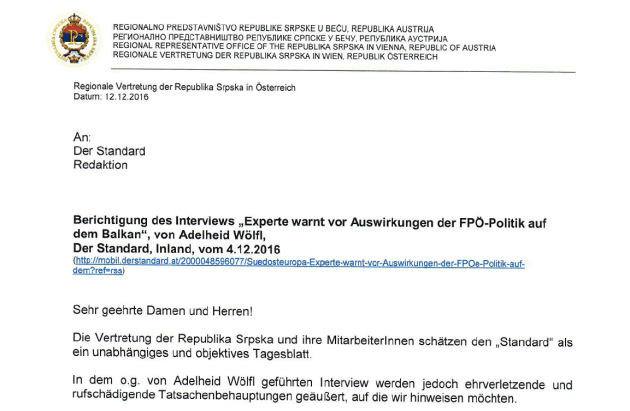
Here is the full text of RS office in Vienna discussed in this post


 Florian Bieber
You must be logged in to post a comment.