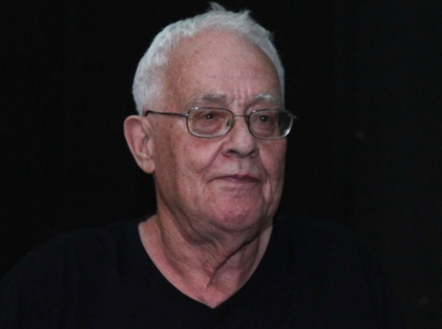
With Benedict Anderson on the Schlossberg

ben_anderson_1-38949b2ccc1e8d7200e939bec50c07e7

Benedict Anderson (Verso)

A bit more than  four years ago, Benedict Anderson visited Graz for a talkWhy We Believe Our Nation Is Good“at the university. As luck would have it, I was not going to be in town and very much regretted my absence. However, it turned out that none of the organizers were available to give him a tour of the city and thus on sunny Wednesday mid-October 2011 a Luxembourger, who had just come to Graz a year before, set out to show Benedict Anderson around. Of course, this is strictly speaking illegal as tour guides have to officially certified by the city of Graz, but then again my description of Graz was hardly a competition to those of the professionals.

We took a delightful stroll through the center of town and I was struck by having a highly observant on my side. As he later noted, he enjoyed “seeing Lust und Laune  against Law and Order”–a graffiti we spotted in the pedestrian zone.

Up on the Schloßberg, the view was not only magnificent, but also the numerous monuments to the nation seemed a fitting setting for our walk: we saw the Hackher-Löwe, glorifying Habsburg resistance to Napoleons army in 1809, and among others the monument to the “Kärnter Abwehrkampf”–the Carinthian “resistance” to Yugoslav claims to the region after World War One, a nasty little monument erected in 1980.

To quote a reflection on this walk I wrote two years ago, Anderson “remarked poignantly that it is probably only scholars of nationalism that notice these monuments, whereas ordinary citizens walk past and ignore these monuments to an era that seems of little relevance today.” He was right, of course, the tourists and visitors on the Schlossberg paid little attention to this or most other monuments and so it is all over the world (thank god). Monuments are often forgotten–they are the frozen manifestation of the past and that only resonates in particular moments–either if this past is important and-or the present seems to require such an interpretation.

I was struck by Benedict Anderson’s humbleness in this throwaway comment. Here, one of the most important scholars of nationalism mocked his own and our perceived self-importance. Of course, he was very much aware that nationalism matters and continued to matter, he modest attitude was engaging.

When I read his book some two decades earlier, I had no idea that I would get a chance to ever meet him. Together with two other grand scholars of nationalism Ernst Gellner and Eric Hobsbawm, his book transformed the field of research and helped to emergence of countless research that is informed by his toughts and insights. As any brilliant turn of phrase, the one of the “immagined community” has also become a curse. Too often, the word imagined has led the casual and lazy readers to conclude that nations are just an “imagination” or less real–instead, the idea that they are imagined does not deprive them of their persistence and reality.While all three, Hobsbawm, Gellner and Anderson come from different disciplines and made their careers in different institutions, they did not only share their connection to England, but more importantly their personal biographies that were complicated and did not fit neat nation categories. Thus, not only their intellectual background, but also their personal biography contributed to looking behind the state of nationalism and helping open a new field of inquiry, a note that I can personally relate to.

As a researcher who has been part of this field in one way or another and Benedict Anderson has made a tremendous contribution and while I am saddened by the loss, I am glad to have had those few hours in Graz to show my appreciation for his work.


An ordinary week in Serbia

Serbia had an eventful week: A coup d’état narrowly avoided, a war criminal returning home, a minister of defense dismissed and the minister of interior holding a press conference with masked special police units and a prime minister taking a lie detector test to prove his innocence, followed by a gratuitous attack with the Russian foreign minister of  the OSCE Representative on Freedom of the Media. Oh yes, and of course EU integration and reforms in Serbia are on track.

Headline from Informer

But first things first: The coup d’état that never was, began in November when the popular tabloid Kurir ran the headline “Excuse me, Serbia” written by the owner of the media group that publisher Kurir and numerous other media, Andrija Rodić. In it, he apologized for reporting to uncritically of the Serbian government and thus triggered a major confrontation with the government. Kurir had previously belonged to the loyal media that praised the government uncritically. His very public break with the government appears to be more motivated by business deals gone wrong than by a sincere change of mind. The editor in chief of Informer, the most loyal media, cum junkyard dog of the regime, Dragan Vučicevic began talking about a looming coup against the Prime Minister and pleaded him not to travel to a summit in China. Despite headlines of Informer warning about a coup against Vučić and  [media] snipers  targeting Vučić,  nothing came of it.

Minister Stefanović with decorative policemen (source MUP)

The drama ended when Minister of Interior gave a press conference with a masked special policemen in the background in which he announced that the Prime Minster took a lie detector test and passed it when asked about whether he was putting pressure on the media (An article Psychology Today notes “From a scientific perspective, there is no rationale for administering a polygraph test”–I guess except when you want to prove something that you can’t prove otherwise). Vučić himself ended the speculation by noting in an interview that there was no coup planned and he felt save. The government won the war, the insurgents defeated. Not quite, Vučić showed that the battle wasn’t over when in short press conference with Russian Foreign Minister Lavrov, only one question was permitted from “Vučić’s own public service broadcaster” Pink about the OSCE Representative on Freedom of the Media Dunja Mijatović (Honi soit qui mal y pense). Lavrov strongly criticized her work and Vučić took the role of the Prime Minister of a small and helpless country that was subjected to unfair criticism by international actors and was enduring this injustice.

Welcome back. (Source Tanjug)

At the same time, General Lazarevic, chief of staff of Priština Army corps during the Kosovo war returned to Niš after having served two thirds of his 14 year prison sentence to which he was sentenced at the ICTY for aiding and abetting “the crimes of deportation and inhumane acts (forcible transfer)” in Kosovo. He belongs a long list of war criminals who have been released in recent years after having served part of their sentence. They also belong to the increasing number of those who return and receive a heroe’s welcome. While some were welcomed by die-hard fans, some clerics and opposition politicians, like Dario Kordić in 2014 in Zagreb, others such as Biljana Plavšić and Momčilo Krajišnik received an officials welcome reception from Milorad Dodik, president of the RS. Even Macedonia gave Johan Tarčulovski a governmental welcome in 2013. Thus, the fact that Lazarević was picked up by the ministers of Justice and Defense and welcomed in Niš by the minister of Labour and the head of the army is not that exceptional, but just part of a wider pattern of openly defying the judgements of the ICTY (it is arguably qualitatively different to support suspected war criminal than those that have been found guilty and sentenced). Lazarević had continued to make a career in the army after the fall of Milošević and was notoriously praised by Prime Minister Koštunica in 2005 for surrendering voluntarily and given a Škoda by New Serbia, Koštunica’s junior partner for his patriotic act of surrendering.

The week ends after Minister of Defense Bratislav Gašić is forced to resign by Vučić after he commented during a press conference after a female journalist had to go on her knees to make place for a camera that he “likes [female] journalists who easily go on their knees” While he officially had to resign for these sexist remarks, maybe he was just a bit too close for comfort in his views of the media for the broader government approach?

 This week was a microcosm of Serbia today: Cooperation with the EU and seeming reforms of the government, or rather Vučić (the Serbian comedian Zoran Kesić observed in his 24 minutes that the ministers of the government that are placed behind him during press conferences are like ficus trees, decoration and not be asked questions, as a journalist discovered by annoying Vučić for not asking him but the minister of foreign affairs questions) distract from Serbia becoming a mixture of a telenovela (fast pace, a new scandal and twist all the time, but the plot of last week is forgotten) and reality TV (simulated reality).

P.S. I forgot to mention the ongoing court case on the possible rehabilitation of the head of the collaborationist WW2 head of the Serbian government, Milan Nedić. But that is a different story

Montenegro in NATO

A few days ago I wrote a small piece on why I think that NATO membership for Montenegro might paradoxically help the democratization process in the country. The comment was the result of some productive conversation at a workshop organized by the Südosteuropa Gesellschaft on Civil Society in Montenegro. Now that Montenegro has been invited to join NATO, I hope that this issue will be off the agenda and thus less divisive for the opposition. Of course at first, the government is likely to use this success to win elections next year. The main challenge will be whether the opposition can re-focus on different issues.

Montenegro has experienced an unprecedented wave of protests against the government in recent weeks. Initially focused on the governments bid to join NATO the heavy-handed government response have shifted the focus to the government itself and the dominance of Milo Đukanović over Montenegrin politics for nearly 25 years.

While it is unlikely that the protests will gather the momentum (see here and here) to put the government under real pressure, the question remains, should Montenegro join NATO? A formal decision is due these days and would mark a major success of the current Montenegrin government, which is seen by many as “NATO government”, i.e. a government whose primary purpose it was to bring the country into NATO. Amidst the protests, Russia has ramped opposition to Montenegrin NATO membership in reporting of loyal media and Duma resolution. At times, it seemed like Russia was starting to engage in its own colored revolution it so much worries about. However, such a view is misleading, even though some Serb nationalist groups joined the protests and the Montenegrin government was quick to blame Russia for the opposition it faces. This argument is about as credible as the argument that the EU orchestrated the protests in Majdan in Ukraine.

Arguably, NATO membership is not going to fundamentally alter the security situation of Montenegro: Albania to the South and Croatia to the North are already members and pose no threat to the country. Bosnia and Kosovo are no conventional security concerns for which NATO membership would matter and both host EU and NATO peace keeping troops. This only leaves Serbia, which as clearly rejected NATO membership and aspires to some ill-defined neutrality. However, to claim that Serbia poses a security threat to Montenegro stretches the bounds of imagination. The last time Serbia constituted such a threat was in 1999 during the Kosovo war and this was in the context of being part of the same country (the Federal Republic of Yugoslavia) and with Milošević at its helm. Today, Serbia is an improbable threat. Of course, this does not preclude Serbian influence or even meddling in Montenegrin affairs (today the relationship between the two countries’ governments has become rather symbiotic), but nothing that could be prevented by NATO.

At the same time, Montenegro is clearly the prototype of the semi-democratic regimes that bedevil the Western Balkans and who are characterized by tight party control of the state, violations of the freedom of speech and corrupt clientalistic practices. Thus, encouraging the current government would help to send a larger message to the region that authoritarian control wedded with the talk of EU-compatible reform pays.

The logical conclusion of the combination of the non-essential nature of NATO membership for Montenegrin security and the reward it constitutes for government would be that it might be better not to invite Montenegro into NATO. However, this would be a logically fallacy.

First, the government has a track record to instrumentalize divisive issues to catch the opposition on the wrong foot and bind reformers to it who would otherwise oppose the government. By advocating NATO membership, it encouraged large parts of the opposition to oppose NATO, discouraging Western support for the opposition and occupying a monopoly over pro-Western reformist rhetoric. The longer the pro- and anti-NATO debate persists, the more the government will be able to divide the country into a pro-Western reformist wing represented by itself and an anti-Western, pro-Serb and pro-Russian opposition (even if such a clear dichotomy does not exist). Thus, if NATO membership were postponed, the government will not celebrate victory, but be able to continue talking on this issue and thus paralyze discussion about genuine reform.

Second, the rejection of the NATO-bid will be viewed a victory of anti-NATO forces within the opposition and weaken the more enlightened opposition who care more about democracy than about whether the country is in NATO or not. Thus, the balance of power in the opposition would be tilted the wrong way.

Paradoxically, giving what the government wants—an invitation to NATO—might be the best way to help the opposition in Montenegro and push for democratization in the country. This provides no guarantee that the country will democratize in the coming year, but without it, the recent protests are likely to appeal only to a few and NATO membership will enable the government to retain control for another electoral cycle as the next parliamentary elections are looming in 2016.