Bosnia’s Ghosts in Syria

Twenty years ago I spent a month in Syria. I managed to find a nice small flat in a neighborhood that extended up Mount Qasioun just north of the city center of Damascus. Past the wide boulevards on which the embassies lay the slope of the mountain became steeper and modest apartment buildings lined the streets. Here, was my apartment which a landlady in her late fifties had been renting out to students who mostly came to Syria to study Arabic. Before I could move in, I met her in her cramped apartment and discussed the rent. She was a bit puzzled by Luxembourg and where this place was and her curiosity about my home country exceeded the usual level of interest. After a while of back and forth, she just asked me outright what was on her mind: “Luxembourg has nothing to do with Yugoslavia, right?” This was not a question I expected. I could answer will all sincerity of course that Luxembourg never was a part of Yugoslavia or had nothing to do with. Her question had nothing to do with the war that was raging in Bosnia or the dissolution of the country. For her, Yugoslavia was still real and nothing good. Her previous tenants were from that country and had left the apartment in a terrible state. She swore never rent to Yugoslavs again. After I laid her concerns to rest, I received the keys and could move into my apartment. The only trace of my previous tenants were a few Panini stickers of the Yugoslav football team. I don’t remember if they were of the European championship in 1992 when Yugoslav qualified but was barred from participating due to the sanctions or whether it was from two years earlier when Yugoslavia lost in the Quarter Finals to Argentina.

Untitled-Scanned-50

It was not during my month in Syria that I ever thought of parallels between Yugoslavia and Syria, but four years later when I visited Lebanon that the parallels to Bosnia struck me. Today, after two years of war in Syria it is hard not think of the parallels to Bosnia. Of course, there are striking differences: The war came to Bosnia as the Bosnian Serb leadership rejected Bosnian independence and sought to create an “ethnically clean” statelet to join Serbia and started a war with the support of the Yugoslav army and Serbia. In Syria, the war began as a crack-down of the regime on protesters demanding a change of government that has escalated into a brutal war with the government killing protesters and opponents.

What is reminiscent of the war in Bosnia is the passivity of what is euphemistically called the international community. External intervention was never seriously on the agenda. Whether it was the blockage in the UN Security Council, difficulty of intervention (unlike in Libya), or the fear of giving weapons to the wrong side, arguments are plentiful. The result is the continuation of the war with increased brutality and more severe long-term consequences.

Big Brother is watching

Big Brother is watching

As the war continues, it turns more into a conflict over identity and the Assad regime in Syria has it wish. Originally a repression by a brutal dictatorship is turning into a war between the Sunni majority and Alavites who have been associated with the Assad regime. The longer the war drags on and as the rebels see little support for their cause to rid Syria of the Assad regime, the more this conflict becomes sectarian. Increasingly, it seems that even if the rebels were to win, this would just usher in further conflict in which the Alavite minority and other smaller communities such as Christian groups would become the target by the majority. Currently, it is hard to imagine what post-war Syria would like, but it seems certain that the two years of war have seriously damaged community relations and segregation and conflict will follow. Three and a half years of war in Bosnia also undid many ties and created a deeply divided society. In this sense, those who started the war created a new reality where the divisions they invoked became real. The longer the conflict continues, the harder it will be in peace time to undo the damage done. Not intervening will not make Syrian reality go away, but every day that the war continues, the peace will be harder. These are the parallels to Bosnia.
Balkan Horoscopes

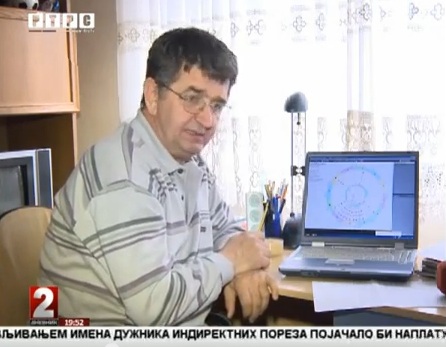
Last month just in time for the 20th anniversary of Republika Srpska, the main public broadcaster RTRS decided to broadcast in its evening news as one of the main stories the predictions of Gojko Mandić, astrologer by profession (his computer does give him some authority, but it does lack the magic). He warns that the state (the RS is meant) and the nation should not invest in risky financial transactions and number of other really promising predictions. This type of news does remind of the Milošević years in Serbia when the paranormal, the paranoid and the paramilitary worked hand in hand and nations got their horoscopes, cards read and other funnies. Some of these are still around, such as Treće Oko (current headline: why do aliens love Novi Sad?), the Serbian equivalent of Weekly World News.

Predicting the future of the RS

Predicting the future of the RS

But maybe it is a good idea to look into the stars of the countries in the region…

Let’s start with our latest birthday boys and girls: Serbia (15.2.) and Kosovo (17.2). Both are Aquarius, so it would seem like their future is kind of similar (I didn’t figure out the ascendents and all of that). According to yahoo horoscope, this what 2013 holds for Serbia and Kosovo:

“2013 is the year when all of your hard work starts to truly pay off in spades. Saturn, the cosmic taskmaster, is taking up residence at the tip top of your horoscope for the next few years, giving you the make-it-or-break-it impetus to get the job done right. You’ve been biding your time over the past few years, collecting the necessary research and finding a slew of inspiring mentors. Now is your chance to finally get your genius concepts on the map where they belong. Yours has been a slow-and-steady climb rather than a meteoric rise to the top, thus you’ve built a rock-solid foundation to carry your dreams through with serious staying power. Your success is anything but a flash-in-the-pan. Over the next two years, you’ll continue to work hard to build on earlier accomplishments and integrate all that you started investing in since 2000…

… 2013 is the perfect balance of business and leisure for you, Aquarius!”

Our next Birthday country is Bosnia (1 March), which makes it a Pisces:

2013 is nothing short of stellar for you, Pisces. … Your powers of psychic perception and healing have never been stronger. Your ability to create glamour, weave fantastical illusion and provide invisible-but-potent healing to others is beyond measure. Others will feel inextricably drawn to you without understanding why. This is excellent for your star potential as others sense something extraordinary and sublime in your presence. People want to have you around as much as possible even without fully comprehending why. The best part is that people are willing to pay big bucks for whatever it is you have to offer and no matter how intangible it may seem. For once, you won’t feel like the oddball, freak or the perpetually misunderstood alien in the crowd but rather the mysterious-yet-sought-after special someone that others cannot resist. It’s all part of your otherworldly glamour and mystique. Work it, Pisces! … If you were planning on expanding your home or upgrading, now’s the time. … The eclipse points of 2013 will stir up your travel sectors — both domestic and foreign — so keep your passport and suitcase handy. This year is all about mind and soul expansion for you on every level. Get ready to leave the comfort of familiar territory for more experience and adventure than you’ve dared to dabble in for years. This year will be anything but ordinary.

Montenegro is Cancer (13.7), as is Croatia (25.6.) so they’re having similar prospects.

Get ready for a year of fabulous expansion, sweetness and love galore, Cancer. This summer, lucky Jupiter is moving into your constellation to bring amazing opportunity and expansion to your world — all the way into 2014! You’ve been preparing for the breakthrough and surge in success, so you’ll be more than ready to take your rightful place in the limelight. All areas of your life receive the benefits and blessings of Jupiter for the second half of 2013. Your confidence is sky high and you feel more optimistic about life and your future than you have in ages. All of the suffering, heaviness and loss of 2012 will quickly become a thing of the past as you embrace the amazing opportunities being showered upon you in 2013.

2012 had you face some very deep fears steeped in your childhood. Family issues and wounds from childhood were the challenges you had to face. It wasn’t easy but it brought a tremendous amount of inner strength in its wake. Rest assured, this new phase takes you out of the past and into the world of love, romance and creativity. You’re being asked to put considerable time into pursuing your heart’s desire — without exception. If you can structure time for what you love, your life will be infinitely more rewarding than it has been in years. The depression is definitely lifting and you are willing to embrace the sweet life once again.

And finally Macedonia is a Virgo (8.9.):

2013 brings you sweeping change and intensity, Virgo. The biggest transformation takes place in the realm of the mind. Communication, correspondence and courses of new study carry great importance…. If you’re not already a powerful public speaker, teacher or writer, get ready to discover your latent potential to sway the masses with your power of speech! You’re also hungry for knowledge in 2013, and will want to strengthen your skill set and beef up your resume with even more knowledge than you possess naturally.

The eclipse patterns stir up endings and new beginnings in relation to siblings, travel and legal issues. Siblings or close relatives could become a source of strain, and you’ll have to create firm boundaries. In fact, boundaries in all realms of communication will serve you to avoid overload. Your life is about to become ridiculously busy and filled with more people than you know what to do with. At the end of the day, you’re still a hermit at heart and need plenty of alone time, so be sure to carve that out regardless of how social your world becomes.

Ok, I give up, there is no more need for political analysts, commentators and all the rest. Some good yahoo horoscopes do the trick much better and of course, there updates are plenty (daily, weekly, monthly). .

Notes from Ditchley

IMAG0153

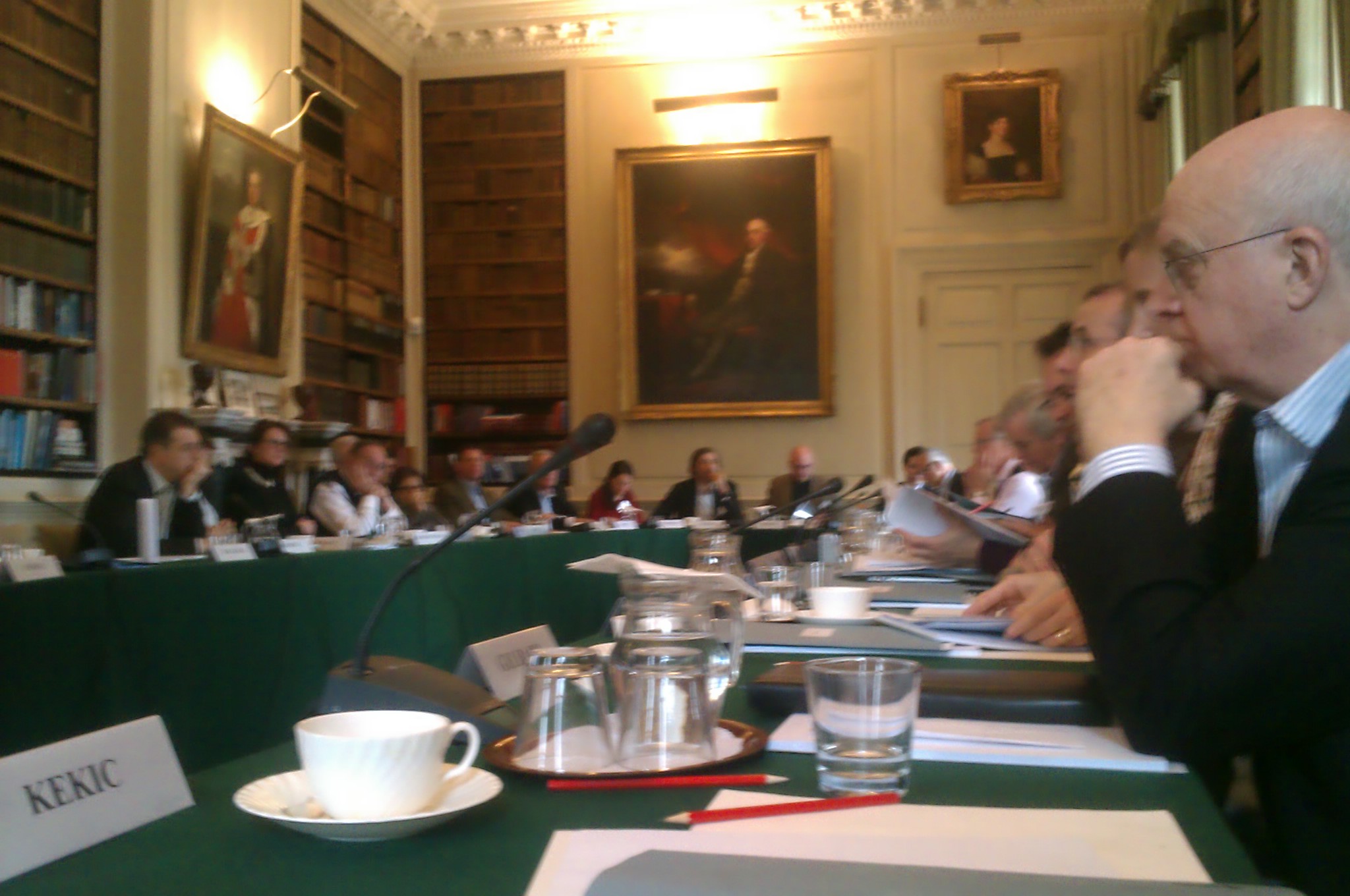
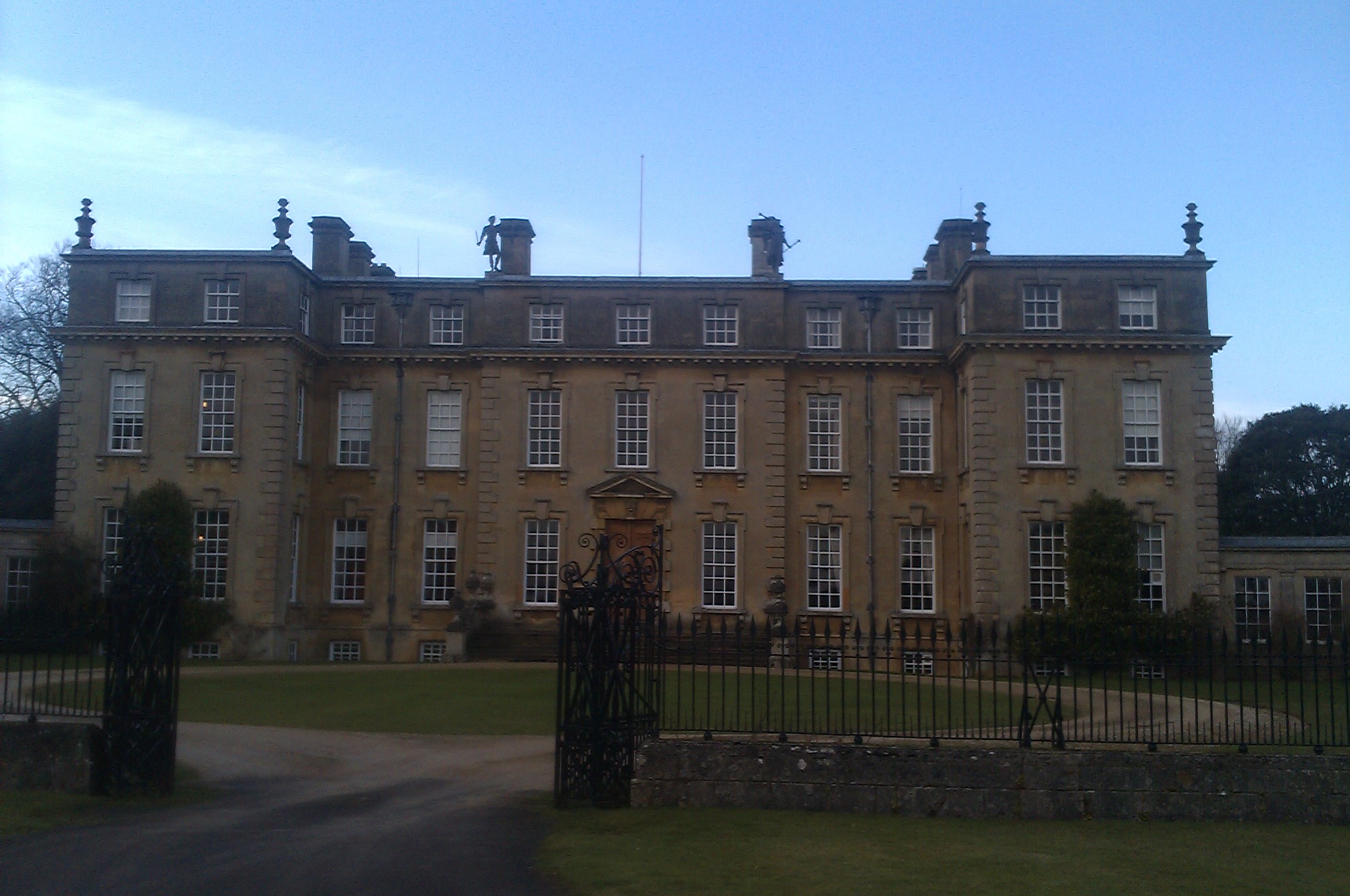
I returned a few ago from a very interesting conference at Ditchley on the Western Balkans. The discussions with policy makers and analysts did not raise any radical new ideas, but it was good opportunity to take the temperature on thinking about and from the region. It was also a lesson in bad metaphors. Many felt that carrots and sticks are not working, but theories why differed: People in the Balkans prefer meat to carrots or the carrot is actually a stick. Either way, the days of carrots and sticks seems to be over (nobody mentioned that the metaphor implies that the person in question is either a horse or a donkey).

There was broad consensus that overall things were heading in the right direction, but there were a number of warnings: many (but not all) thought that the state of democracy & rule of law and lack of deep rooted reforms in the economy will continue to be a source of difficulties in the years to come. There was a bit of a divide between a number of Western policy makers who felt that the EU and its member states were doing enough to bring the countries of the region into the EU and that it was up to political elites to make an extra effort and a number of analysts who thought the EU should do more and make the membership perspective more realistic. A specific suggestion was for the EU to begin accession talks with all countries of the region as soon as possible rather than wait for each country on their own to fulfill the specific conditions. Once talks begin–the symbolic year of 2014 was mentioned as start date–the negotiation process will force countries to shape up and carry out reforms in a manner that is unrealistic prior to the beginning of talks. It seemed clear that such a scenario is unrealistic at the moment with a many member states skeptical about enlargement and afraid (although unjustifiably so–see Turkey) that accession talks would lead to membership ‘on the sneak’. A problem that has become more pronounced in recent years is the use of individual member states to use the accession process to set additional conditions. This has made the accession process less predictable as the Commission cannot guarantee the next step in the process as individual countries might block whatever comes next for unexpected reasons that have little to do with accession. Of course, this also undermines the credibility of EU accession. The current approach of the Commission to launch dialogues with countries without accession talks has been a good way forward but without beefing up the DG Enlargement this cannot be expanded more broadly.

IMAG0161
The most encouraging signals came over the Serbia-Kosovo talks which are expected to lead to some tangible conclusions before the summer and when the current window of opportunity might close. On the other hand, Bosnia was much discussed, but there were few new ideas on how to help the country out of its current deadlock.

I found it encouraging that there is a clear sense that incrementalism is the way forward, there is not going to be a big bang, but rather small steps that will change the region and resolve the open questions. For this to be successful, one needs to overcome the dynamics of what one participants aptly called the EU member states pretending to enlarge and elites in the Western Balkans pretending to reform.

The Debate continues: Serbian membership of the EU or EEA?

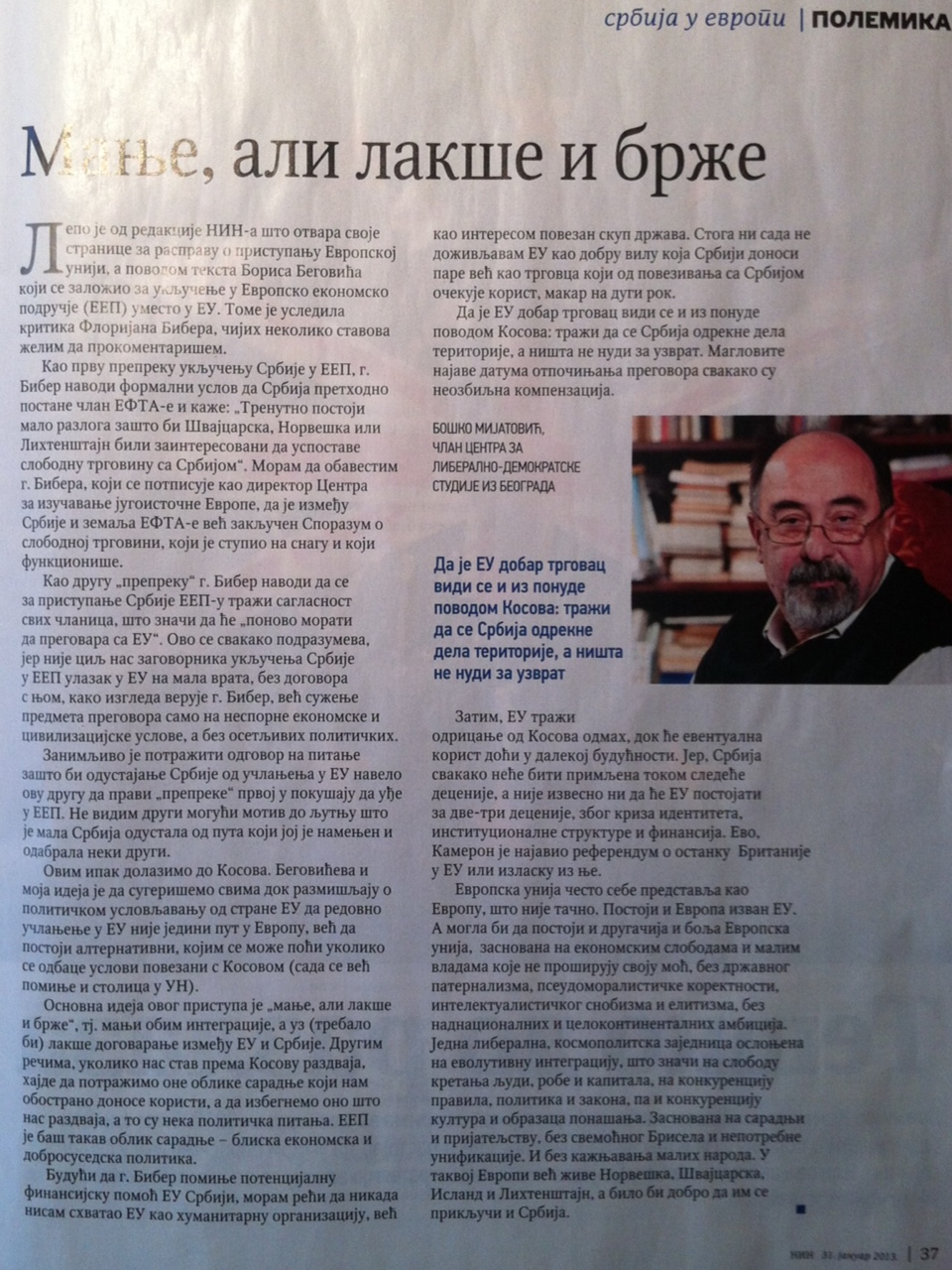
As a follow up to my comment on Boris Begovićs suggestion that Serbia should join the EEA rather than the EU, NIN has published a series of responses. These include a clarification by Boris Begović, a comment by Boško Mijatović sand Miroslav Jovanović. The latter two I am including below.

photo photo1


I am pleased that NIN is glad to see a debate gowing, so there will be further comments by Suzana Grubišić, the Minister for EU Integration and a representative of the EU delegation.

Quiet interestingly, this debate is going on in parallel with the debate of the UK-exit/referendum. Here, similar arguments have been made about the Norwegian model. Here, a comment published on Open Democracy is instructive, as it makes some similar arguments I am making for Serbia. Below is my response for NIN in a slightly longer version than the Serbian text that will be published shortly.

I am glad that my response to Boris Begović’s article has triggered a number of responses and is leading to a useful exchange. However, I regret that sometimes the tone of the responses descends to insinuations that is neither helpful not appropriate. I used the term “shortcut” for membership in the EEA, not because of some kind of Balkan stereotype, but simply because EU membership and the negotiations require profound reforms that are crucially important for Serbia. The alternative proposed by Boris Begović is to me neither realistic nor desirable.

Miroslav N. Jovanović suggests that the EU is not very attractive, with foreign debts rising, agriculture destroyed and people migrating. This is a very one-sided view. The foreign debt in new member state did not rise because of EU membership, but due to the global economic crisis. The fact that people migrated is also in part a result of EU membership and not necessary a loss for a country (he should know better, being a UN diplomat in Switzerland) : many have come back with money and new skills, as has been the case with Poles that left for the UK in 2004 and came back.

Of course, the EU and the members have many problems. However, to blame the EU for all of them is simplistic. While many EU citizens are skeptical towards the EU, and despite having undergone a deep crisis, only the Great Britain and Eurosceptic parties on the extreme left or right are playing with the idea of leaving the EU. This is telling that most EU citizens consider it better than any alternative.

Second, let me know outline why I think EEA-EFTA membership is not a likely alternative for Serbia.  Boško Mijatović is right to point out that EFTA has signed a free trade agreement with Serbia. However, this is not evidence for a possible Serbian membership. Some 33 countries around the world have also signed a Free Trade Agreement with EFTA, including Columbia, Ukraine, Mexico and Singapore, hardly plausible candidates for EFTA membership.

The 2012 EU report on relations with Norway, the most important EEA partner, notes that “EEA membership entails either EFTA or EU membership. Until now, the EFTA states have not wanted to enlarge EFTA.”  Thus, unlikely the EU which has a commitment to enlargement, EFTA has none. It is thus hard to see why EEA membership is more likely than EU membership.

In addition, the responses suggest that the EU is setting unfair political conditions that Serbia is unwilling to fulfill (the only concrete example given is Kosovo). It is not clear why the authors believe that the EU member state would not insist on these conditions to join EEA. Consider that membership in the EEA entails freedom of movement: i.e. citizens can take a job anywhere in the EEA, one can expect EU member state setting high criteria, including political demands.

Next, does EEA membership reflect Serbia national interests? Being an EEA member means that much of EU law needs to be implemented, but there is no ability to influence the content. The relationship is not that different than during the accession when future members adopt laws, but don’t sit at the negotiating table. It is no surprise that the EU noted that the “EEA Agreement is best suited to small states, which are accustomed to having to adapt to others and have no particular desire to influence developments in Europe.” I also do not consider the EU to be a ‘humanitarian organisation’, but the EU provides substantial financial support to many member state that, if well used, can have tremendous impact.

Finally, Kosovo. Boško Mijatović suggest that EU is a good trader and demands that Serbia gives up part of its territory for nothing in return. Two points :  The EU  has not demanded Serbia to recognize Kosovo. The EU has asked for the normalization of relations which does not need to entail recognition. While some individual officials from EU member states have asked for Serbia’s full recognition, this is NOT EU policy. Second, some of the polemics and other comments suggest that Serbia has to ‘give up’ Kosovo for the EU. Who is being unrealistic now? Kosovo is not under Serbian control (except 15% in the North), it is recognized by nearly 100 UN members around the world. Kosovo’s independence is a fact and will not go away. It is good advice of the EU to Serbia to come to terms with this reality. It seems a folly to foresake EU membership for the fiction of Kosovo. This brings me to the comment by Miroslav N. Jovanović.  His suggestion that the EU would ask for an independent Vojvodina or “Raška” is totally unfounded and belongs to the horror cabinet of extreme nationalist ideology and merits no further comment.  His argument that there are 1890 possibilities of a veto and thus it is hopeless to even start negotiations is unfounded. First, his math is wrong, because from July 2013, there will be 28 member states, not 27. Croatia had 1890 possible vetoes and it took 5 ½ years (October 2005 to June 2011) to conclude its negotiations. That is long (too long), but not impossible. Yes, Kosovo will make it more difficult for Serbia, but there is no reason to believe that negotiations would take substantially longer.