Who won the Montenegrin elections?

I participated in a workshop on the state of the Western Balkans last week in Munich organized by the Hanns-Seidel Foundation, the party foundation of the Bavarian Christian Democrats. As a speaker noted that in Montenegro there has not been a change of government through elections since 1945 (a point I have made as well), an unnamed gentleman sitting next to me whispered in my ear “This is just like in Bavaria!” The location, the “Franz Joseph Strauss Saal” made the comment even more appropriate. There are some differences between Bavaria and Montenegro, however. A political system with a single party dominance can be more easily compatible with a consolidated democracy when a region of a larger state is in question. At least national politics brings about changes of government. It could thus be argued that the lack of change of government (at least not through elections), indeed a feature of Montenegro, has become a more serious deficiency of the political system once Montenegro become independent. However, looking a the result of the most recent parliamentary elections suggests that this is not about to change.

As the election results came in, both the government and opposition celebrated their victory. The opposition of course did not win the largest share of the votes, but it celebrated for depriving the governing coalition of their absolute majority. So who really won?
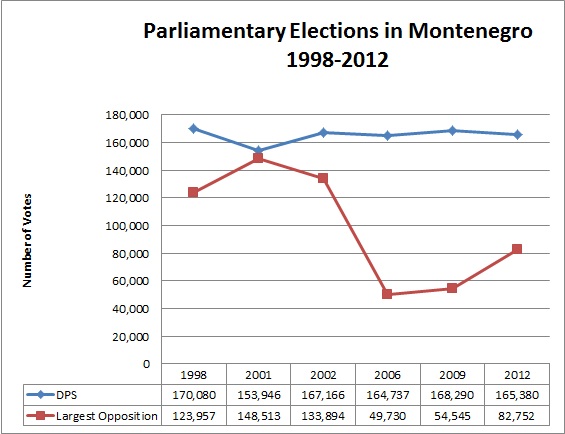
It is true that the governing DPS and its partners (SDP and the Liberal Party) lost their absolute majority in these elections, but considering them as losers would be getting the numbers wrong. First, having won 46.3% of the vote and 39 of 41 seats necessary to form a government means that the current governing parties are still doing extremely well. A comparison with previous elections also shows that the loss of the governing coalition is insubstantial. Since 2002, i.e. for ten years, the ruling parties have gained nearly identical numbers of votes (between 164,000 and 168,000). This variation of less than 2.5% of the vote over a ten year period is a striking sign of stability and the ability of the DPS and its allies to mobilize a very stable and large segment of the electorate. From this point of view, the elections in 2012 were worse than in 2009, but better than 2006. Thus, there is clearly no defeat visible here. If we look now at the largest opposition party, we find considerably more variation over time. The lowest point is reached in 2006 when the opposition is divided between pro-Yugoslav (whatever that meant at the time), Serb national and technocratic-economic camps. The opposition has left this low point now firmly behind, but it remains weaker than the SNP was as the main opposition party in 2001 and 2002. While the Democratic Front might signal the increasing ability of the opposition to form a joint platform and focus on issues other than identity politics, the odds of winning elections without a change in DPS seems difficult to imagine considering its very steady electoral base.


Why the critics are right and the EU still deserves the Nobel Prize

Image

There is a monument in Sarajevo to honor the international community hiding behind the now closed Bosnian museum. It is a giant can of beef with the ironic “thank you to the International Community”. The EU flag leaves little doubt who is the main addressee of the ironic monument.

The decision of the Nobel committee to award this years peace prize to the EU has been probably nowhere as controversial as in the Balkans. The suggestion that the EU “for over six decades contributed to the advancement of peace and reconciliation, democracy and human rights in Europe” rings hollow. After the ill-fated claim of Luxembourg FM Jacques Poos that this was the “hour of Europe”, the EC and later the EU failed miserably in the first half of the 1990s not only in preventing the dissolution of Yugoslavia and its ensuing violence, but also in ending the massive human rights violations (see the new excellent book in the topic by Josip Glaurdic). A comment in The Atlantic suggests that its failure in the Balkans during the 1990s makes it undeserving of the prize (this is more substantial criticism than others which suggest that continents shouldn’t win it–after all the EU isn’t a continent or opposing organizations winning it–plenty organizations including international organizations have won the prize in the past, i.e. the UN in 2001)

Tim Judah argued that it is in the Balkans that the EU has actually deserved its prize for transforming the region in the past decade through accession. It is easy to remind of the failings of the EU in the 1990s and to take a cynical view of the EU’s policies towards the Balkans in the past ten or so years. However, the prize is deserved for two reasons.

First, the prize is not just awarded to those who have worked for peace in the past, but also for those that hold promise to do so in the future. Winner like Jassir Arafat and Itzhak Rabin or Mohamed Sadat and  Menachem Begin. It is thus not only the past that matters but also the future. The prize has been used by the Nobel Committee to nudge those who had taken steps towards promoting peace. As such, the prize is not a reward, but an encouragement.

Second, the prize is also a reminder: It comes at the right time for the institutions and the governments of the member states to reflect on the fact that the at the core of EU integration lay its aim to secure peace, or as Robert Schuman notes in the 1950 declaration “World peace cannot be safeguarded without the making of creative efforts proportionate to the dangers which threaten it.” The EU has found a  gradualist approach, often against the will of key actors who became unwittingly builders of the Union, to bring this about. This gradual movement, not build on a single plan or blueprint can be frustrating to those who want a federal Europe now and infuriating to skeptics who miss the agency of the process. However, no other way could the EU have been built. The prize is a recognition for what the EU is, not what it did or does. Its policy to bring peace and prosperity is admirable, but often flawed and ineffective. As such, the prize should remind the EU and its political leaders to not just talk about the peace project EU on Sunday speeches, but fill it with meaning.

In order to become deserving of the prize, the EU should own up to past mistakes—an appology for its flawed role in the 1990s would be appropriate and make sure that its raison d’etre is not forgotten.